Top 10 Questions to Ask at the End of an Interview—HR Guide
Stop asking zero questions. Get smart questions that impress recruiters, plus what to avoid. Interview guide from an HR expert.
Author: Hira Riaz
Published On 13 June, 2026.
Why Asking No Questions at the End of an Interview Can Hurt Chances of Candidates
Every hiring manager notices when a candidate skips questions at the end of an interview. Here’s the exact moment it cost someone a job offer.
I once sat across from a candidate who had aced every question. Great answers, solid experience, perfect fit. Then I asked, “Do you have any questions for me?”
She smiled and said, “No, I think I’m good.”
I paused. Every other candidate had asked something about the team, the culture, the challenges.
She didn’t. It wasn’t the only reason I didn’t move her forward, but it was the moment I started doubting her genuine interest.
Asking zero questions at the end of an interview is almost as bad as giving wrong answers. It tells me you’re not curious. Not prepared. Not truly interested.
Good questions matter, but they’re only part of the equation.
My full walkthrough on Interview Prep covers the rest, including the STAR method and common questions you’ll face.
In this guide, I’ll give you 10 smart questions that work for any role; from fresh graduate to senior executive.
Why “Do You Have Any Questions?” at the end of an interview Is a Test
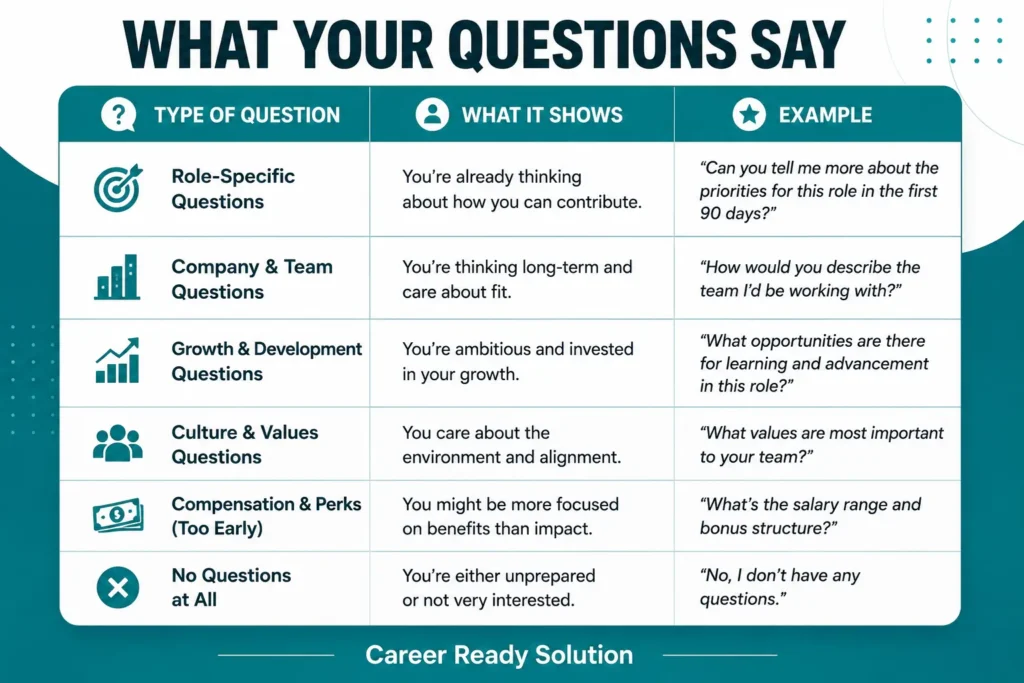
After I’ve asked all my questions, I turn the table. “Do you have any questions for me?” I’m not being polite. I’m actively evaluating you. Here’s what your questions (or lack of questions) tell me:
In my 7+ years of hiring, candidates who asked great questions were almost always the ones who got offers. Not because the questions themselves were magic, but because they showed preparation and genuine interest.
Now, let me give you the exact questions I love to hear.
The End of Interview Questions That Make Hiring Managers or Employer Remember You
Here are the 10 questions I personally find most impressive, the ones that make me sit up straighter and think: this person is different.
Note: Question 8 is Gold. Make sure you don’t miss that.
Question 1: What does success look like in this role in the first 90 days?
This is the single most powerful question you can ask.
It does three things simultaneously.
- It shows you are already thinking about how to perform and not just how to get the job.
- It gives you a concrete roadmap if you are hired.
- And it often reveals whether the company actually has a clear vision for the role or is making it up as they go.
I have had candidates ask me this and watched hiring managers visibly impressed.
I have also watched hiring managers suddenly look uncomfortable because nobody had actually defined what success means in this position.
Both outcomes are valuable information for you. Remember, you are also evaluating the company.
Question 2: What are the biggest challenges the person in this role will face in the first six months?
Most candidates only want to hear the good stuff. They nod along to the job description, smile at the benefits, and avoid anything that sounds difficult.
But smart candidates want the full picture.
When you ask this question, you signal maturity. You are saying: I am not naive. I know every role has challenges and want to understand them so I can prepare.
And the answer? Genuinely useful.
If a hiring manager tells you the biggest challenge is rebuilding a team after three people quit, that is critical information.
- It tells you about the culture.
- About the pressure you will be walking into.
- About whether this is an opportunity or a disaster waiting to happen.
Ask it. Listen carefully.
The answer will tell you more than the entire job description.
Question 3: How would you describe the management style of the person I would be reporting to?
This one makes some interviewers slightly uncomfortable.
Which is exactly why you should ask it.
Management style is one of the top three reasons people leave jobs.
- Not pay.
- Not workload.
- The person they report to.
You have every right to understand who you will be working with before you commit months or years of your career to them.
A good company will respect this question.
A toxic one will hedge, deflect, or give you a rehearsed PR answer.
Pay attention to both the words and the hesitation.
Question 4: What do the most successful people at this company have in common
Being a Recruitment consultant and serving the industry for 7+ years, I personally love this question.
Every time a candidate asks me this I think he/she is clever because it is doing something brilliant.
It is asking the company to describe its IDEAL employee so you can immediately assess whether you fit that profile.
And whether that profile fits you.
- If the answer is “they work 70-hour weeks and are available on weekends” and you value work-life balance you just saved yourself from a very bad decision.
- If the answer is “they are curious, collaborative, and take ownership of their work” and that describes you perfectly you have your closing statement handed to you.
Question 5: Is there anything about my background that gives you pause — that I could address right now?
This one takes courage. Most candidates avoid it because it feels risky.
It is actually your most powerful closing move. You are giving the interviewer permission to voice any concern they have about you while you are still in the room.
While you can still respond.
While you can still change their mind.
Without this question, doubts sit unspoken.
They fester. They become the reason you do not get a callback
And you never know why.
With this question, you get a chance to address the concern directly.
- To clarify a gap.
- To reframe a weakness.
- To add context to something on your resume that looked confusing.
I have seen candidates completely turn around a lukewarm interview with this one question because it shows self-awareness and confidence.
And it shows that you genuinely want the role enough to fight for it.
In case you want to learn strategies and check examples, give a read to a complete interview guide.
Question 6: How has this role evolved since it was first created?
This question uncovers the story behind the job.
Was this role created because the company is growing? That is a good sign.
Was it created because the last three people in it burned out and left? That is a warning sign.
Has the role expanded in responsibility over time? suggesting there is room to grow.
Or has it shrunk? suggesting the company is contracting or the function is being deprioritized.
The evolution of a role tells you everything about how the company values the work you will be doing.
And how much runway you have for your own career development.
Question 7: What does the onboarding process look like for this role?
This question separates prepared candidates from passive ones.
A structured, thoughtful onboarding process signals a company that invests in its people.
A vague, improvised answer “oh you know, you’ll just figure it out as you go” signals the opposite.
It also shows the interviewer that you are already thinking beyond the interview.
You are mentally preparing for your first week.
Your first month.
You are taking this seriously.
And it gives you practical information you actually need if you accept the offer.
(Remember, you are also evaluating the company. I will keep on reminding this to you to save you.)
Question 8: What do you personally enjoy most about working here?
Personal questions get personal answers and these are almost always more honest than corporate ones. And, even more important in the era of AI.
When you ask someone what they personally enjoy, you are bypassing the rehearsed company line.
You are inviting a human moment in what is often a very formal conversation.
(Believe me, NO formal question can beat this GOLD)
Watch their faces when they answer this.
- Do they light up?
- Do they pause and have to think hard to find something genuine?
- Do they deflect back to company achievements rather than their own experience?
Those micro-expressions and hesitations tell you more about the culture than any Glassdoor review.
Question 9: Where do you see this company in three to five years and how does this role fit into that vision?
This question does something most candidates never do. It connects your individual role to the company’s larger trajectory.
And it forces the interviewer to articulate whether this position has a meaningful place in the organization’s future or whether it is a short-term fix for a short-term problem.
It also signals ambition.
- You are not just thinking about the job.
- You are thinking about the company.
- About where it is going.
- About whether your career can grow alongside it.
Hiring managers love this. Yes, including me too!
It demonstrates strategic thinking; one of the most valued traits at any level.
Question 10: What is the next step in the process and what is the timeline?
Not knowing what happens next is one of the most anxious experiences of job searching. When does the decision get made?
Will there be another round?
Who else is involved?
This question eliminates all of that uncertainty at least for now.
- It gives you a timeline.
- It tells you when to follow up.
- And it signals that you are organized and respectful of everyone’s time.
It also subtly communicates that you are evaluating other opportunities without saying so directly. A hiring manager who knows you are asking about timelines understands that you are an active candidate.
Even after asking about the timeline, the employer may later say they are still interviewing other candidates. This does not automatically mean rejection—understanding the message will help you decide when and how to follow up.
Questions You Should Never Ask at the end of an Interview
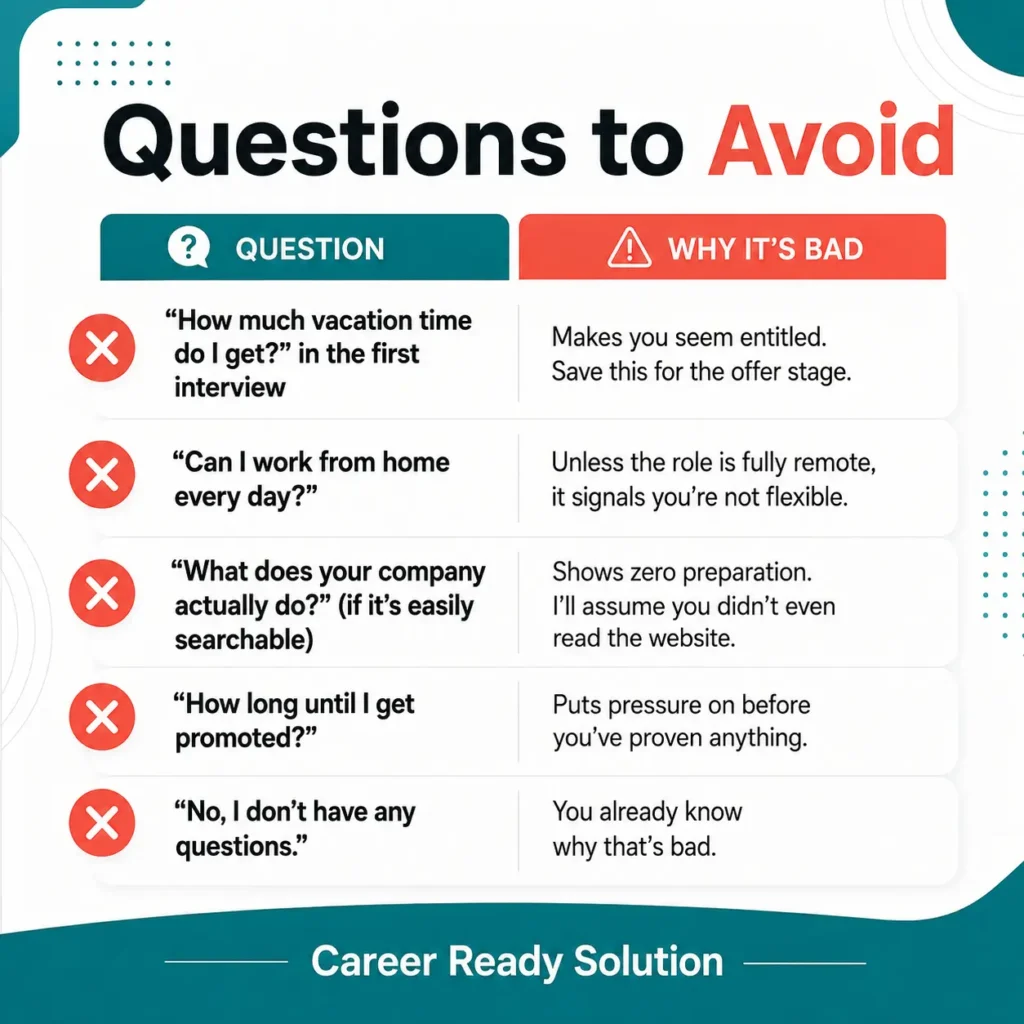
On a safe side, avoid the following questions in your first interview:
From My Hiring Notebook
I was hiring for a senior marketing role. Two final candidates. Both were strong on paper.
At the end of the interview, Candidate A asked about team challenges and growth opportunities. Solid questions.
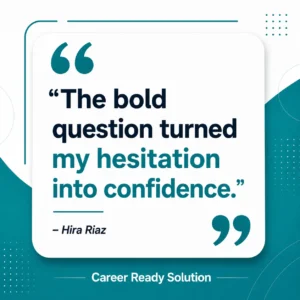
Candidate B asked: “Is there anything about my background that makes you hesitant to move me forward?” I was surprised. I admitted I was concerned about his lack of experience in our specific industry.
He replied, “That’s fair. I haven’t worked in (industry), but I’ve led two successful market entries for new verticals. I’d approach yours the same way; research, pilot, scale.
Can I share a quick example?” His answer was compelling and he was hired.
Don’t be afraid to ask the bold question; if you’re prepared to answer it.
Conclusion & Next Steps
The interview isn’t over when the interviewer stops talking. It ends when you leave the room or close the Zoom window.
The questions you ask in those final minutes leave a lasting impression.
Don’t waste that opportunity. Pick 2–3 questions from the list above.
Practice them. Write them down.
Ask them with genuine curiosity. That small effort might be the reason they remember you.
Good questions leave a strong final impression, but they won’t undo your mistakes made earlier in the interview. See Common Interview Mistakes To Avoid to make sure you’re covered on both ends.
Prepare for the Full Interview; Not Just the Interview Questions
If you want to walk into your next interview completely prepared with questions, answers, Salary Negotiation, and everything in between. I have designed exactly this to help you.
If you are an HR professional, Grab our 100 Most Asked Interview Questions with Sample Answers — covering every category from behavioral to technical, with STAR method examples you can adapt immediately.
And, if your resume is not getting you to the interview stage in the first place — that is the first problem to solve. Have a tour of my complete blog on ATS Resume & CV Optimization.
Looking for a recruiter-friendly ATS Executive Resumes? Explore the templates, here.
What questions should I ask at the end of an interview?
Ask 2–3 smart questions that show curiosity and preparation.
Examples include:
- “What does success look like in this role in the first 90 days?”,
- “What’s the biggest challenge your team is facing right now?”
- “Is there anything about my background that makes you hesitant to move me forward?”
Key Takeaways | ||
|---|---|---|
1
|
Asking zero questions can cost you the job – it signals disinterest.
| |
2
|
Prepare 2–3 smart questions before every interview.
| |
3
|
Tailor your questions to the role and the interviewer.
| |
4
|
Avoid asking about salary and benefits in the first round.
| |
5
|
The bold question (#10) can turn hesitation into an offer – if you’re ready to answer it.
| |
6
|
Write your questions down – it shows you’re prepared.
| |
Frequently Asked Questions
Aim for 2–3 good questions. Asking a long list can feel exhausting. Asking zero feels disinterested.
Q: What would make someone unsuccessful in this role?
(Rationale: Flips the usual “what does success look like” question — often gets a more honest, specific answer about real pitfalls.)
That’s fine. Say: “You actually already covered my question about (topic). I appreciate that. I do have one more…” Then ask a different question. It shows you were listening.
Q: Is there anything in my background that gives you hesitation about moving forward?
(Rational: Lets you address objections directly instead of losing the offer silently)
Q: What separates your top performers from everyone else?
(Rationale: Gives you a clear benchmark for what “great” looks like and shows you’re aiming for it.)
About the Author
Hira Riaz is an HR Consultant with 7+ years of experience hiring across tech startups, pharma, and NGOs. Having reviewed hundreds of resumes and interviewed candidates across roles, she brings real recruiter insights into what actually works in today’s job market.
She specializes in resume optimization, interview strategy, and career growth, helping professionals turn their experience into interview calls. She also shares practical career advice with 60,000+ professionals on LinkedIn.