
Ideal Resume Length: How Many Pages in 2026?
One page or two? Learn the ideal resume length based on experience level, industry norms, and recruiter preferences. HR insider advice.
Author: Hira Riaz
Published On 1st July, 2026.
TABLE OF CONTENTS
Introduction
2- The One-Page Rule — Myth or Reality?
- Fresh Graduates
- Mid‑Career
- Senior / Executive
Estimated read time 10 minutes.
Resume Length: How Many Pages Is Too Many?
How many pages should your resume be? One? Two?
Does it even matter anymore? I get this question more than almost any other on LinkedIn.
Every time I post about resumes, someone asks: “Should I stick to one page?” or “Is a two‑page resume too long?” And honestly, the confusion makes sense. You’ve heard the “one‑page rule” since college. But then you see senior executives with three‑page resumes landing great roles. So what’s the truth?
In this guide, I’ll give you a clear answer; not a rigid rule, but a strategy. I’ll share what I’ve learned from reviewing thousands of resumes across pharma, NGOs, and tech startups.And if you haven’t nailed the fundamentals of resume formatting yet, start with my ATS-Friendly Resume Guide — resume length only matters once your formatting can actually get past the bots.
Why Resume Length Still Matters
Let’s start with a reality check: recruiters spend an average of 6–8 seconds scanning a resume before deciding whether to read further.
That’s barely enough time to read a few lines.
If your resume is three pages long, you’re not giving me more value; you’re giving me more to ignore. (apologies but tats a fact)
I’ll scan the first page, and if I don’t see what I’m looking for, I’ll move on.
The second and third pages might contain your best achievements, but I’ll never reach them.
ATS (Applicant Tracking System) also prefer concise, well‑structured resumes. While they can parse multiple pages, a bloated resume increases the chance of errors or overlooked sections.
More importantly, length signals judgment. A 4‑page resume from a fresh graduate tells me you don’t know what’s important.
A 1‑page resume from a senior executive might look like you’re hiding something.
So yes, length matters not because there’s a universal page limit, but because it reflects your ability to prioritize and communicate clearly.
The One‑Page Resume Length Rule – Myth or Reality?
The famous “one‑page rule” started decades ago when resumes were mailed or faxed. Today, it’s more of a guideline than a law.
Here’s how I recommend thinking about it based on your career stage.
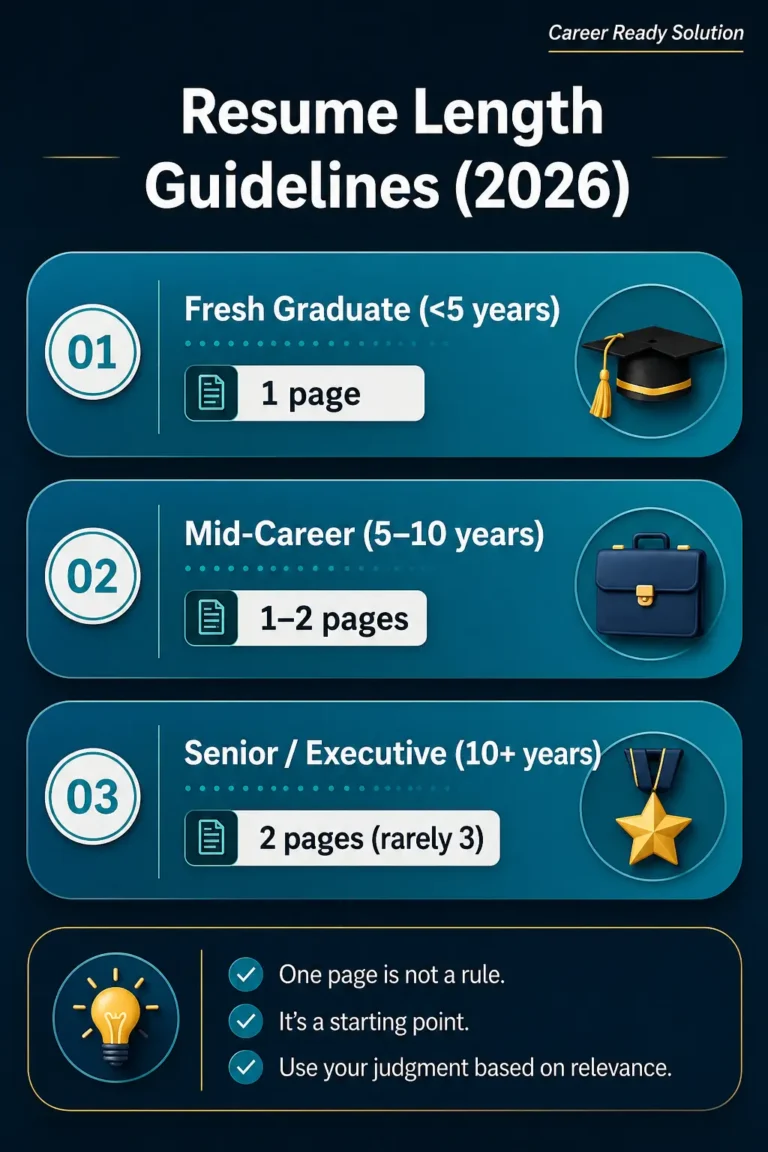
Fresh Graduates (and less than 5 years of experience)
Stick to one page. You haven’t had time to accumulate decades of achievements.
A One‑Page Resume forces you to highlight your education, internships, projects, and skills without adding fluff.
I’ve seen fresh graduates try to stretch to two pages with irrelevant part‑time jobs or high school details—it always looks like filler.
Example
A business graduate with two internships, a final‑year project, and some volunteer work. One page is plenty to showcase that. If you’re tempted to add a second page, ask yourself: “Is every single line essential to proving I’m the right candidate for this role?” If not, cut it.
Mid‑Career (5–10 years)
One to two pages Resume is acceptable.
At this level, you’ve built a solid track record. You can use two pages if your experience is directly relevant to the roles you’re targeting.
But don’t pad it. Focus on the last 5–8 years and summarize older roles briefly.
Example
A project manager with 8 years of experience across three companies. Two pages let you detail achievements from the most recent roles while summarizing earlier experience. I often tell mid‑career clients: “If your resume is two pages, make sure the first page alone would still make someone want to call you.”
Senior / Executive (10+ years)
Two pages is standard.
You have a career story that deserves space. Two pages allow you to show progression, leadership impact, and key results.
Three pages is rarely necessary; if you’re going beyond two, you’re probably including details that don’t matter to the recruiter.
Example
An HR director with 15 years of experience, two major companies, and a history of organizational transformation. Two pages capture the highlights: the most recent roles with 4–5 bullet points each, a summary of earlier roles, and a concise skills section.
What to Cut – The Art to Edit Resume Length
Before (3 pages)
- Lists five jobs from the past 15 years, with 8–10 bullet points each.
- Includes a part‑time job from university.
- Has a long list of hobbies and personal interests.
- Shows “References available upon request” as a separate line.
After (2 pages):
- Focuses on the last three roles (10 years), with 4–6 bullet points each.
- Summarizes earlier roles briefly without bullet points.
- Removes hobbies and references line.
If your resume is too long, it’s usually because you’re including things that don’t add value. Here’s what I recommend removing:
- Outdated experience – Anything beyond 10–15 years ago, unless it’s directly relevant to the job. For most professionals, the last 10 years are what matter.
- Irrelevant jobs – That summer job at a retail store from a decade ago can go. If you have a career gap, mention it in your cover letter, but don’t list every job you’ve ever had.
- Excessive bullet points – Three to six bullet points per role is plenty. Focus on achievements, not daily duties.
- Hobbies and personal details – Unless your hobby is directly relevant (e.g., “coding side projects” for a developer), remove it.
- References – “Available upon request” is sufficient. Don’t list actual references or waste space on that line.
Resume is the blueprint of your career story. Make it worth while. To learn how to craft a compelling Resume, give a read to my comprehensive guide on ATS Resume Optimization.
Example
A software engineer I worked with had 12 years of experience and a 3‑page resume. He had included every project he’d ever worked on, even those from a decade ago. We cut it to 2 pages by removing projects older than 8 years and combining similar technologies into a skills section. His interview rate doubled.
Still unsure what to keep, remove, or shorten? Get Personalized Resume Advice based on your experience and target role
How to Condense Resume Length Without Losing Value
Cutting pages doesn’t mean cutting impact. Here’s how to keep your resume powerful while making it concise.
- Use action verbs: Replace “was responsible for” with “led,” “managed,” “designed,” “implemented.”
- Combine related points: Instead of two bullets about team leadership, merge them: “Led a cross‑functional team of 8 to deliver a $2M project ahead of schedule.”
- Quantify results: Numbers make each bullet more valuable, so you need fewer of them. “Increased sales by 30%” says more than three bullets about sales activities.
- Prioritize relevance: Put your most impressive achievements at the top of each role. If a bullet doesn’t support your current career goals, shorten or remove it.
One thing you shouldn’t cut in the process: Your Keywords.
See my Resume Keywords guide to know exactly which terms are worth protecting as you tighten each bullet.
Before
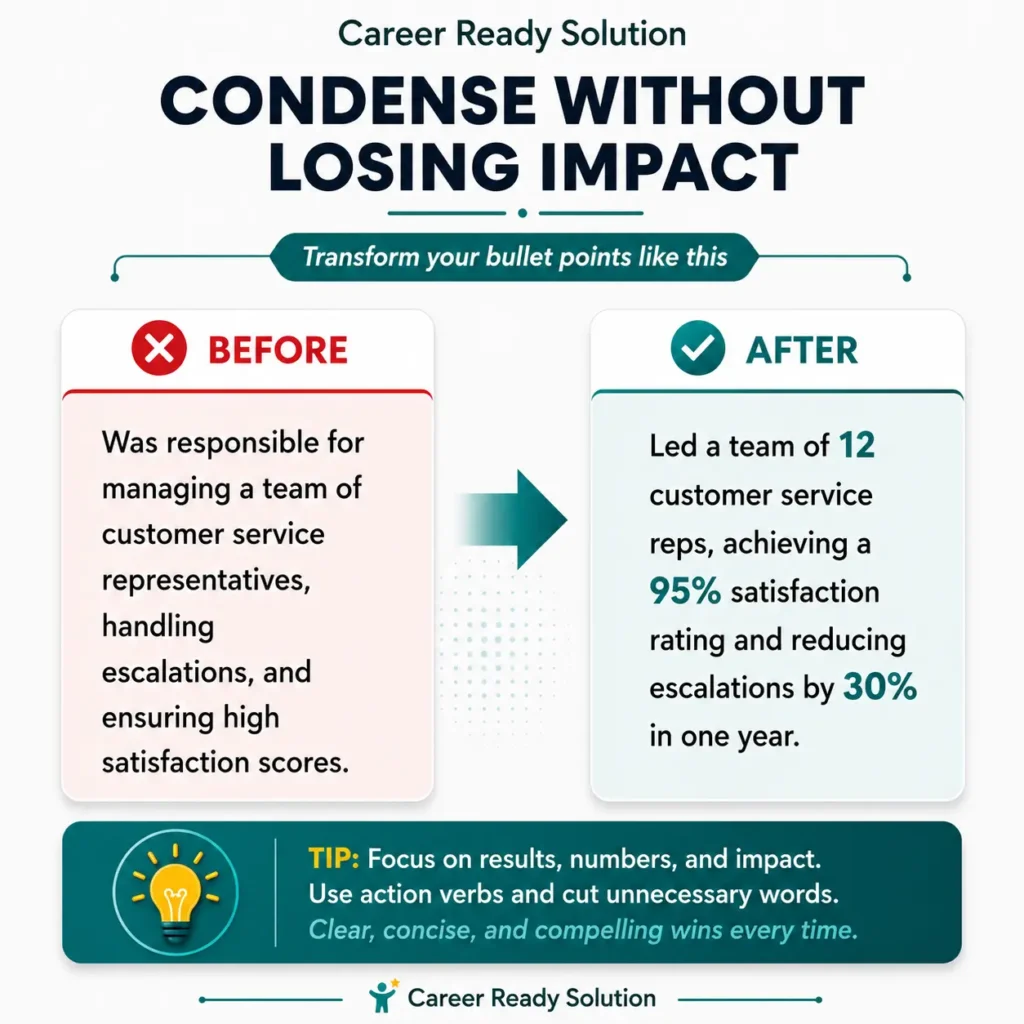
Was responsible for managing a team of customer service representatives, handling escalations, and ensuring high satisfaction scores.
After
Led a team of 12 customer service reps, achieving a 95% satisfaction rating and reducing escalations by 30% in one year.
Same content, half the words, more impact.
How to Test If Your Resume Length Is Right
Before you send your resume, run it through these quick tests:
- The “First Page” Test – Open your resume and read only the first page. If you were a recruiter, would you call the candidate based on that alone? If not, you’ve buried your strongest points too deep.
- The “10‑Second” Test – Hand your resume to a friend and ask them to scan it for 10 seconds. Then ask: “What’s the one thing you remember?” If it’s not your key selling point, your layout or length is distracting.
- The “Relevance” Filter – For every bullet point, ask: “Does this help me get the job I’m applying for?” If not, cut it.
Having worked for more than 7 years, I know how recruiters scan resumes so I always advised my clients to take these tests and save their selves from sending a resume that’s too long or too cluttered.
Resume Length--Industry‑Specific Considerations
While the guidelines above work for most roles, some industries have different norms. Here’s what I’ve observed:
- Tech / IT – Recruiters value scannable resumes. 1–2 pages, with a clear skills section and project highlights.
- Finance / Consulting – Often strict about 1 page for analysts/associates, but 2 pages for managers and above.
- Creative fields – Your portfolio matters more than page count. Keep your resume to 1–2 pages and showcase your work elsewhere.
- Academia / Research – Academic CVs are longer (3–5+ pages) because they include publications, teaching, grants, and conferences. This is an exception.
Just like length, your summary should flex by industry too. Dive into my Resume Summary Examples by domain and level for how to adjust tone and focus depending on your field.
Even within these norms, the principle remains: include only what’s relevant, and make every line count.
A Lesson I Learned While Hiring
Early in my HR career, I was hiring for a senior supply chain role. One candidate’s resume was four pages long. I almost skipped it because it felt overwhelming. But her experience was strong, so I forced myself to read through.
She was exactly what we needed—but her resume had buried her best achievements on page three. I later helped her cut it to two pages, and she started getting interviews for roles she’d been rejected from before.
That experience taught me that length isn’t just about recruiter convenience. It’s about your ability to tell a clear, compelling story. If I have to dig for your value, you’ve already lost me.

Conclusion: Make Every Page of Resume Count
Your resume length isn’t about rigid rules—it’s about respect for the reader’s time and your ability to prioritize. By following the guidelines in this guide, you’ll create a resume that’s concise, impactful, and tailored to your career stage.
Remember: every line you keep should earn its place. If you’re unsure, ask yourself: “Would a recruiter regret not reading this?” If the answer is no, cut it.
Of course, length is just one piece of the puzzle — if you want to see the other reasons resumes get rejected, check out 10 common resume mistakes that most candidates overlook.
Now it’s your turn:
- Download my FREE Resume checklist to review your resume.
- Connect with me on LinkedIn for more career tips.
ATS‑Friendly Resume Templates – Your Time saver
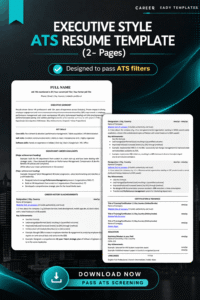
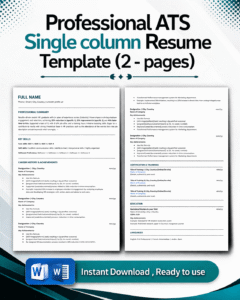
How many pages should a resume be in 2026?
- For fresh graduates: 1 page.
- Mid‑career (5–10 years): 1–2 pages.
- Senior/executive (10+ years): 2 pages max.
Avoid 3+ pages unless applying to academic or research roles. Focus on relevance; every bullet point must earn its place. Trim older jobs, irrelevant details, and reference lines to keep it concise.
What You'll Learn
- How many pages your resume should be based on your experience level
- What to cut (outdated jobs, irrelevant details, excessive bullet points)
- How to condense without losing impact (before/after examples)
- Industry‑specific considerations (tech, finance, creative, academia)
- How to test if your resume length is right
Frequently Asked Questions
Yes, if you focus on the most recent 8–10 years and trim older roles to a single line or omit them. But two pages is perfectly acceptable.
Use a one‑page layout with a “Projects” or “Key Achievements” section. Prioritize the most impressive ones; you can mention others in a brief list if space allows.
No. ATS can handle multiple pages. The issue isn’t page count but whether your content is scannable and keyword‑rich.
Never. Font should be 10–12 pt for readability. If it doesn’t fit, edit, don’t shrink.
Not literally, but if they see a three‑page resume for a junior role, they may assume you lack focus. First impressions matter.
Follow industry norms. But even then, clarity and relevance are key. Academic CVs can be longer, but they should still be well‑organized.
If you have more than 3–4 bullet points per role older than 5 years, it’s likely too long. Also, if you’re using filler content to “fill space,” you’ve got too much.
Only if you have exceptional, highly relevant experience—like multiple strong internships, a published paper, or a significant project. Otherwise, aim for one page.
“References available upon request.” It’s outdated and wastes space. Remove it and use that line for an extra achievement.
If you have 15+ years of experience, a one‑page resume may look like you’re hiding your accomplishments. Two pages is usually better.
Mention the gap briefly in your cover letter. On your resume, use a combination format or simply list the dates with a brief note (e.g., “Career break – family care, 2023–2024”). Don’t add extra pages to explain.
About the Author
Hira Riaz is an HR Consultant with 7+ years of experience hiring across tech startups, pharma, and NGOs. Having reviewed hundreds of resumes and interviewed candidates across roles, she brings real recruiter insights into what actually works in today’s job market.
She specializes in resume optimization, interview strategy, and career growth, helping professionals turn their experience into interview calls. She also shares practical career advice with 60,000+ professionals on LinkedIn.
