
15 Interview Mistakes Candidates Make - And How to Fix Them
Avoid interview mistakes that can cost you the offer. Learn how to answer better, prepare smarter, and walk into your next interview with confidence.
Author: Hira Riaz
Published On 20 June, 2026.
TABLE OF CONTENTS
Estimated read time 10 minutes.
The Interview Mistake That Revealed More Than the Resume
Common interview mistakes cost candidates the offer more often than lack of skills or experience.
I once interviewed a candidate who walked in like he already had the job.
He leaned back in his chair, interrupted me twice, and when I asked what he knew about our company, he said, “Honestly, not much. But I’m a fast learner.”
His resume was strong. His attitude was not. I didn’t call him back.
A week later, I saw on LinkedIn that he’d posted: “Another rejection. These recruiters don’t know talent when they see it.” That post told me everything I needed to know.
It wasn’t his skills, it was how he showed up.
For the Complete Playbook on Interview Prep; from STAR answers to tricky questions, check out my companion post. Come back here once you’re set, so you don’t undo that prep with an easy slip-up
Over 7+ years of interviewing candidates for Pharma, NGOs, and tech start-up and now working as a HR Consultant, I’ve seen brilliant people lose offers because of mistakes they didn’t even know they were making.
I’ve grouped the 15 most common mistakes into four themes.
Read them. Learn them. And don’t make them.
Theme 1: Preparation & Research Failures (Interview Mistakes 1–4)
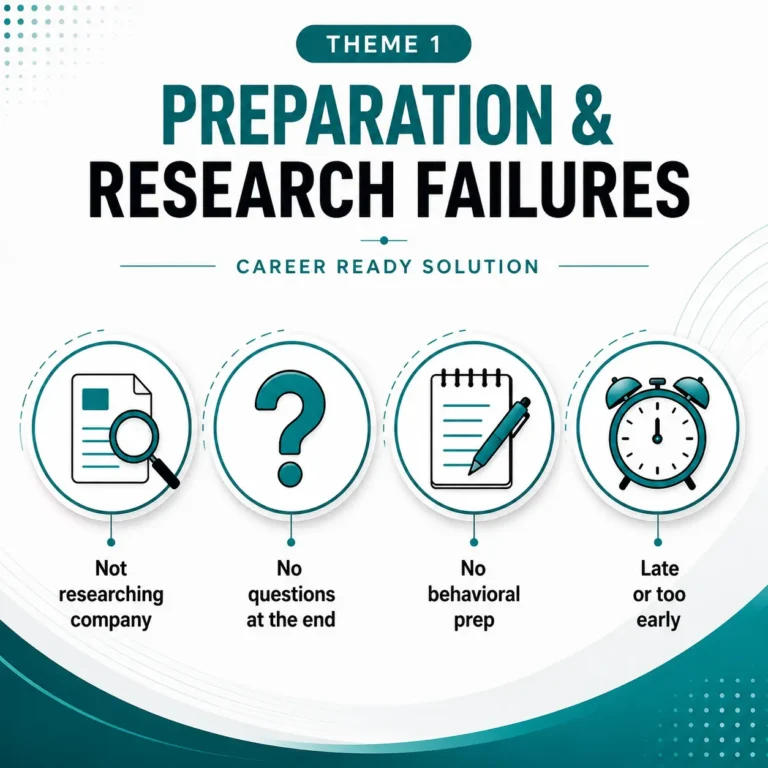
Mistake 1: Not researching the company or interviewer
What I’ve seen: A candidate asked me, “So what does your company actually do?” halfway through the interview. Another said, “I didn’t have time to look you up.”
Why is it a problem
It tells me you’re not genuinely interested. You’re spraying your resume everywhere without caring where it lands.
How to fix it
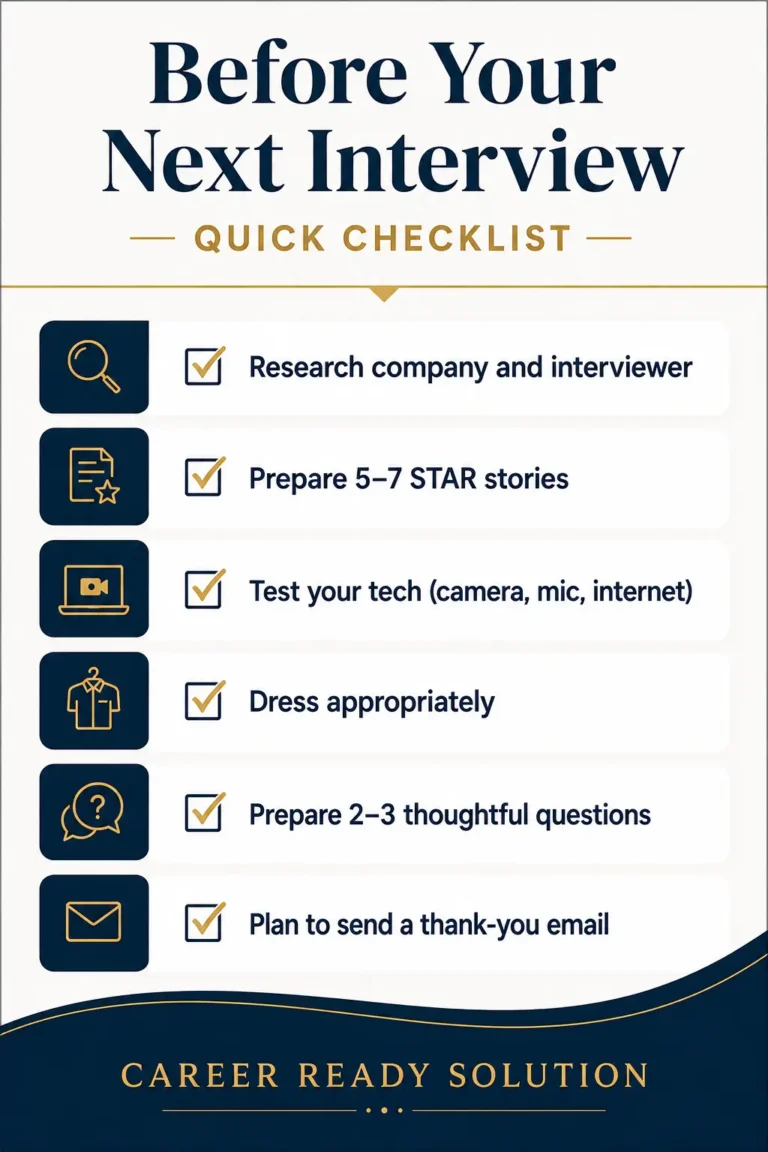
Spend 20 minutes before every interview. Read the company’s “About Us,” recent news, and leadership bios. Look up your interviewer on LinkedIn. Mention one specific thing: “I saw you recently launched (product). That’s impressive.”
Mistake 2: No questions at the end
What I’ve seen: “Do you have any questions for me?” – “No, I think I’m good.” Silence.
Why is it a problem
It signals low curiosity, low preparation, or low interest. I assume you don’t care.
How to fix it
Always have 2–3 thoughtful questions ready. Examples: “What’s the biggest challenge your team is facing?” or “How do you measure success in this role?”
Mistake 3: Not preparing for behavioral questions
What I’ve seen: “Tell me about a time you handled conflict.” – “Uh, I don’t really have an example.” The candidate had 10 years of experience.
Why is it a problem
Behavioral questions are the heart of most interviews. Without examples, I can’t assess how you’ll act on the job.
How to fix it
Prepare 5–7 STAR stories (teamwork, conflict, leadership, failure, problem‑solving). Practice them out loud. For a structured approach, check out my ebook for HR professionals to prepare STAR interview answers – it’s filled with templates and real examples.
Mistake 4: Arriving late (or too early)
What I’ve seen: A candidate joined a Zoom call 15 minutes late with no apology. Another arrived 30 minutes early for an in‑person interview, expecting me to drop everything.
Why is it a problem
Late shows disrespect for my time. Too early disrupts my schedule and feels pressurized.
How to fix it
For virtual, join 2–3 minutes early. For in‑person, arrive 10–15 minutes early and wait in the lobby until your scheduled time.
Theme 2: Body Language & Virtual Presence (Interview Mistakes 5–7)
Mistake 5: Poor virtual presence
I have been taking a lot of virtual interviews after Covid and I believe virtual interviews are here to stay. Period.
Recently, I was conducting a virtual interview for the position of HR Executive. It was for a medical billing agency in the US.
Throughout the interview, the candidate barely looked at the camera.
He kept staring at his desk, his posture was slumped, and he was leaning so far forward that his face was cut off.
It felt like he wasn’t even talking to me.
Why is it a problem
It signals disinterest, low confidence, or disrespect. I’ve rejected candidates solely based on how they showed up on video.
How to fix it
Position your camera at eye level. Look at the lens, not the screen. Sit up straight, keep your shoulders back. Smile occasionally.
Mistake 6: Bad posture or distracting habits (in‑person)
I have been in the industry for more than 7 years and I have seen slouching, crossing arms, tapping fingers, looking around the room shows bad posture. One candidate kept checking his phone.
Why is it a problem?
It makes you look nervous, bored, or unprofessional. I lose confidence in you.
How to fix it
Sit up, place your hands on the table, and lean slightly forward. Maintain natural eye contact. Put your phone away.
If you are looking for real insights from my hiring journey, go through my guide on preparing interviews strategically.
Mistake 7: Forgetting to test your tech
Last month, I was taking interviews for the position of UI Designer and one candidate whose mic didn’t work, camera was dark, and the internet kept cutting out. She spent the first 10 minutes apologizing and troubleshooting.
Why is it a problem
It wastes my time and shows you didn’t prepare. I have other candidates waiting and it can disrupt my whole calendar.
How to fix it
Test your equipment one hour before. Check camera angle, lighting, microphone, and internet speed. Have a backup phone number ready.
Being an HR Consultant, I know how much weight your whole interview carries. To help you fully outshine, I have written a blog on 10 smart questions to be asked at the end of interview. Do give a read before going to your big day.
If you know what you want to say but struggle to communicate it confidently during interviews, my Personalized Interview Preparation can help.
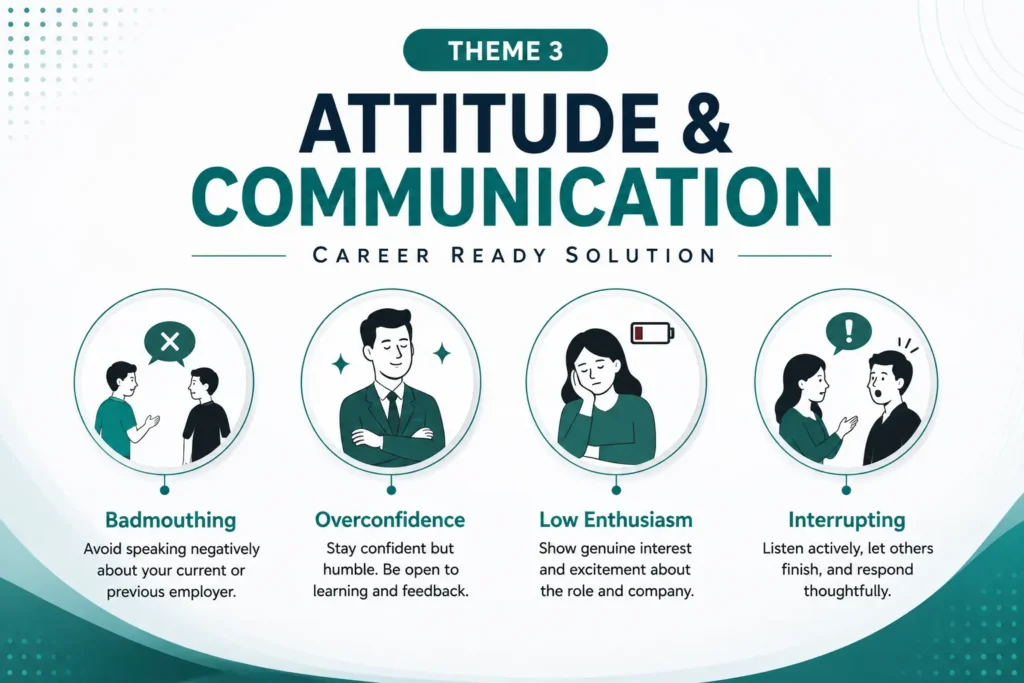
Theme 3: Attitude & Communication (Interview Mistakes 8–11)
Mistake |
Weak Candidate (What I’ve seen) |
Strong Candidate (How to fix) |
|---|---|---|
Badmouthing your current employer
|
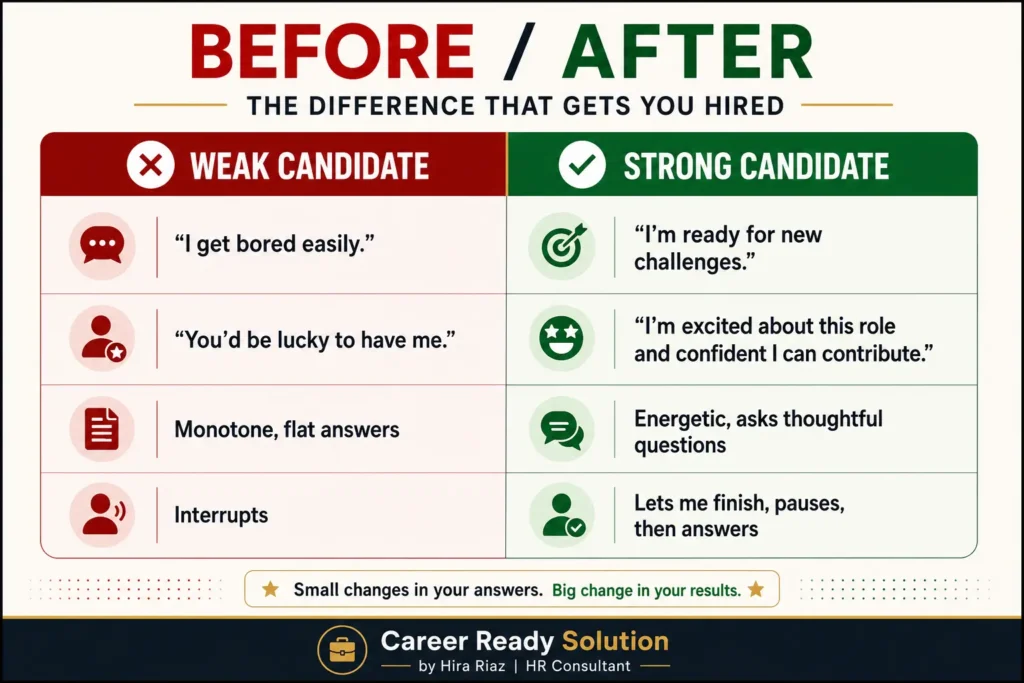
“I’m switching because I get bored of my current company.” (Shows zero enthusiasm, only frustration.)
|
“I’ve learned a lot at my current role, but I’m ready for new challenges that align with my long‑term goals.” (Positive, forward‑looking.)
|
Overconfidence or arrogance
|
“You’d be lucky to have me.” “I don’t really need to prepare.” (Comes across as entitled.)
|
“I’m excited about this role and confident I can contribute. Here’s how…” (Quiet confidence, backed by evidence.)
|
Showing no enthusiasm
|
Monotone voice, flat answers, no smiles. Says “I’m just looking for any job.”
|
Energetic, asks thoughtful questions, says “I’ve been following your work on X, and I’d love to be part of it.”
|
Interrupting the interviewer
|
Cuts me off mid‑sentence to give his answer. Then does it again.
|
Lets me finish, pauses one second, then answers. If he’s excited, he takes a breath first.
|
If unfair treatment is the real reason you are leaving, you don’t need to hide it—but keep your resignation letter and interview explanation brief, factual and professional. These resignation letter examples for unfair treatment show how to explain the situation without sounding emotional or accusatory.
Whether you are just starting your interview preparation or want to understand what employers are looking for in 2026, read my complete guide to preparing strategically for your next interview.
Theme 4: Delivery, Content & Follow‑Up (Interview Mistakes 12–15)
Mistake |
Weak Candidate (What I’ve seen) |
Strong Candidate (How to fix) |
|---|---|---|
Rambling or giving vague answers
|
Talks for 5 minutes, repeats himself, loses the plot. Uses no structure.
|
Answers in 1–2 minutes using STAR (Situation, Task, Action, Result). Stops when done.
|
Not having examples for your skills
|
“I’m great at project management.” – “Can you give me an example?” – “Well, I managed projects.” (No proof.)
|
“I led a project that cut delivery time by 25% and saved $50k. Here’s how I did it.” (Specific, quantified.)
|
Forgetting to follow up
|
Great interview, then silence. No thank‑you email. Doesn’t respond when I reach out.
|
Sends a personalized thank‑you email within 24 hours, referencing something specific from the conversation.
|
Lying or exaggerating
|
Claims fluency in a language. During the interview, can’t string together a basic sentence. I end early.
|
Says, “I have foundational knowledge but I’m actively learning.” (Honest, self‑aware, growth mindset.)
|
From My Hiring Notebook
I mentioned two candidates earlier – the one who wouldn’t look at the camera, and the one who said he gets bored easily. Both had solid resumes. Both could have done the job. But their interview behavior made me hit “reject.”
The first candidate, with the poor posture and downcast eyes, later emailed me asking for feedback. I told him honestly: “Your body language made me feel like you weren’t present.” He thanked me and said he’d work on it. I hope he did.
The second candidate, the bored one.
He never followed up. I saw him apply for another role six months later.
Same resume. Same attitude. Still no job.
Don’t be those candidates. Your skills open the door.
Your interview behavior walks you through it.

Conclusion: Your Interview Is Your Stage
Interviews aren’t just about answers. They’re about presence, preparation, and perception. The 15 mistakes above are the ones I’ve seen cost candidates the most opportunities. But they’re also the easiest to fix.
Now you know what not to do. Go show them what you can do.
In case, you want to proof read your resume, have a tour of my complete ATS Resume Optimization Guide.
Ready for more?
- Explore my ATS‑Friendly Resume Templates to get the interview first.
- Connect with me on LinkedIn for daily career tips.
What are the most common interview mistakes?
The most common interview mistakes candidates make include:
- Not researching the company or role
- Giving vague answers without examples
- Not preparing STAR stories for behavioral questions
- Talking too much or not answering directly
- Speaking negatively about past employers
- Failing to connect skills with the job description
- Not asking thoughtful questions at the end
What You'll Learn
- 15 common mistakes grouped into 4 themes (preparation, body language, attitude, delivery)
- Real rejection stories from my hiring notebook
- Before vs. after examples for attitude and delivery mistakes
- How to fix each mistake with simple, actionable steps
- 15 FAQs about what not to do in an interview
Frequently Asked Questions
Arrogance or badmouthing a previous employer. I’ve ended interviews early for both. It tells me you’ll be difficult to work with or that you’ll speak badly about us later.
Practice with a friend. If your answer exceeds 2 minutes, it’s too long. Also, watch for my cues – if I stop nodding or try to interject, stop talking. A good answer is concise, not exhaustive.
Yes. I expect nervousness. What I don’t accept is being unprepared. Practice and preparation reduce nervousness. Take a sip of water, breathe, and remember: I want you to succeed.
Yes. Each round, within 24 hours. It’s professional and keeps you top‑of‑mind. A personalized email referencing something we discussed can tip the scales in your favor.
Send a brief, polite follow‑up email clarifying your answer. Keep it to one sentence. Don’t dwell on it. For example: “I wanted to add that the project I mentioned actually saved $50k, not $10k.” That’s fine.
Aim for 10–15 minutes early, then wait in the lobby or your car until about 5 minutes before the scheduled time. Arriving too early (30+ minutes) can disrupt the interviewer’s schedule.
Dress as you would for an in‑person interview – from head to toe. It puts you in the right mindset. Avoid busy patterns or bright white shirts. Solid, neutral colors work best on camera.
Yes, but keep it minimal. Jot down key points or questions you want to ask. Don’t spend the whole time writing – maintain eye contact and engage naturally.
Use the Past‑Present‑Future formula: (Past) what you’ve done, (Present) what you’re doing now, (Future) why you’re excited about this role. Keep it under 90 seconds.
Be honest but pivot. Say, “I haven’t faced that exact situation, but here’s a similar challenge I solved…” or “I’ve thought about how I would handle that, and here’s my approach.” Show problem‑solving skills.
No. Choose a real weakness that is not critical to the role, and show how you’re improving. For example, a designer might say, “I struggle with public speaking, so I’ve joined Toastmasters.”
Address each person briefly. Make eye contact with the person who asked the question, but glance at others to include them. Take notes on names and use them in your answers.
Don’t take it personally. They might be having a bad day or multitasking. Stay professional, positive, and focused. Your job is to give the best interview you can, regardless of their mood.
Generally, avoid bringing up salary unless they do. Focus on the role and value you can bring. If they ask, give a range based on market research. Save detailed negotiation for after an offer.
Send a brief, polite email to your main contact. Reiterate your interest, mention something specific from the interview, and ask if there’s an updated timeline. Don’t pester – one follow‑up is enough.
About the Author
Hira Riaz is an HR Consultant with 7+ years of experience hiring across tech startups, pharma, and NGOs. Having reviewed hundreds of resumes and interviewed candidates across roles, she brings real recruiter insights into what actually works in today’s job market.
She specializes in resume optimization, interview strategy, and career growth, helping professionals turn their experience into interview calls. She also shares practical career advice with 60,000+ professionals on LinkedIn.
