Can ChatGPT Write My Resume? A Recruiter's Honest Guide
Author: Hira Riaz
Updated On 28 Sept, 2026.
TABLE OF CONTENTS
Estimated read time 11 minutes.
Can ChatGPT write a resume?
- Yes, ChatGPT can write a resume, but using it without caution can backfire. 74% of hiring managers say they can spot AI‑generated applications.
- The safest approach is to use ChatGPT as a coach and not as a replacement for yourself.
- Polish your own messy draft, add specific numbers and personal details, and never let AI invent achievements you can’t explain in an interview.
- A hybrid resume (AI for structure, you for soul) works best.
Can ChatGPT Write Your Resume?
Yes. But should you let it? No – not without serious personalization.
ChatGPT can draft resume content, rephrase bullets, and help you beat the blank page. But it cannot reliably finish a resume alone. It invents metrics, writes generic phrasing, and doesn’t parse your file, format a document, or test ATS compatibility.
Being an HR Consultant, I have reviewed thousands of resumes across Pharma, NGOs, and Tech start-ups. I’ve seen the good, the bad, and the “too‑perfect” resumes.
Let me share my most recent experience. I sat across from a candidate whose resume was flawless. Every bullet point is perfectly worded. Every achievement is quantified..
Then I started asking questions. “Tell me more about the project where you increased efficiency by 40%.”
She froze. She couldn’t explain it.
She couldn’t tell me what tools she used, who she worked with, or what “efficiency” even meant in that context.
That’s the danger of ChatGPT on a resume. Not the tool itself.
To get a complete roadmap, read my Guide on Resume Optimization.
I’m not here to tell you to stop using ChatGPT. I’m here to show you how to use it without getting caught or worse, without embarrassing yourself in an interview.
What ChatGPT Can and Cannot Do
Let me be clear about where ChatGPT actually helps and where it falls short and you need to use your conscience.
| What It Can Do | Why It Helps |
|---|---|
| Rephrase bullet points | It can make your language more professional and concise |
| Suggest action verbs | It knows which verbs grab attention |
| Fix grammar and spelling | It catches errors you might miss |
| Generate a first draft | It helps you beat the blank page |
| Suggest keywords | It can pull relevant terms from job descriptions |
| Structure your content | It knows standard resume sections and formats |
| Improve weak bullet points | It can clean up vague descriptions quickly |
| What It Cannot Do | Why It Fails |
|---|---|
| Write your CV for you | It can't plug into your memories to select the examples that demonstrate your skills |
| Add personal details | It generates generic phrasing that could belong to anyone |
| Invent accurate metrics | It frequently invents numbers and achievements you never had |
| Understand your context | It doesn't know your team, your struggles, or your tiny wins |
| Format a document | It can't create a properly formatted resume file |
| Test ATS compatibility | It doesn't know if your resume will actually parse |
| Add your voice | It neutralizes quirks and makes everyone sound generic |
How to Use ChatGPT to Write or Improve Your Resume: Step-by-Step approach
Here’s the method I teach my clients. Use ChatGPT as your helping hand, not a ghostwriter.
Prepare and redact your information
Before you paste anything into ChatGPT, remove all personally identifiable
information (PII) – your full name, phone number, email address, company names, and specific dates.
Why? Because every prompt and upload is data you are actively sharing. In the EU, uploading resumes to ChatGPT could violate GDPR and the EU AI Act. Even if you’re not in the EU, it’s a good habit to protect your privacy.
Redact like this:
- “I worked at [Company Name] as a (Job Title)” instead of “I worked at Google as a Product Manager”
- “I led a team of (X) people” instead of “I led a team of 12 people”
- “I increased revenue by (Y)%” instead of “I increased revenue by 25%”
You can add the real details back later. ChatGPT doesn’t need your specific company names to improve your wording. Protect your private information always.
Ask for a Recruiter‑style critique
One of the most powerful ways to use ChatGPT is to get an honest, recruiter‑style review of your resume.
Then paste your resume (with redacted info).
I’ve seen ChatGPT catch things candidates miss for years – weak summaries, unclear achievements, and buried strengths.
Compare your resume with the job description
This is where ChatGPT truly shines.
This gives you a tailored, role‑specific review in minutes.
Improve one section at a time (Summary, Experience, Skills etc)
Don’t ask ChatGPT to rewrite your entire resume. I always advised to work section by section. Following are some Prompts to copy:
"Turn my work experience into stronger resume bullet points with action words and measurable impact. Here are my current bullet points: [paste]."
"Write a short professional resume summary for a [role] position in the [industry] industry. Here's my background: [paste key details]."
"Based on my experience below, suggest 10-15 skills I should list on my resume: [paste experience]."
Fact‑check and personalize everything
This is the most important step and unfortunately most candidates skip. ChatGPT invents metrics. If it adds a percentage you didn’t provide, remove it. You must be the truth‑teller.
If ChatGPT’s version doesn’t sound like you, rewrite it. Read your resume out loud. If it sounds like a robot, change it.
ChatGPT doesn’t know the name of the project you worked on, the tool you used, or the team you managed. Add those details to make it sound human.
Copy-and-Paste ChatGPT Resume Prompts for Different Career Situations
These prompts are designed to help you improve your resume without allowing ChatGPT to invent skills, experience or achievements.
Before pasting your resume, remove sensitive information such as your full address, phone number, personal identification numbers and confidential employer or client information.
Act as an experienced recruiter in the
[TARGET INDUSTRY]. Review my resume for a
[TARGET JOB TITLE] position and compare it with
the job description. Identify weak or generic
statements, missing keywords, irrelevant
information, and formatting problems that could
affect ATS screening.
Rewrite my professional summary and strongest
experience bullets using action verbs and clear
results. Recommend which skills and achievements
should appear first. Use only the information I
provide. Do not invent experience, skills, or
numbers. If important details are missing, ask me
questions before rewriting.
Resume: [PASTE RESUME]
Job description: [PASTE JOB DESCRIPTION]
Act as a professional resume writer who specializes
in entry-level candidates. Create a one-page,
ATS-friendly resume for a recent graduate applying
for a [TARGET JOB TITLE] position.
Use my education, internships, academic projects,
coursework, certifications, volunteer work,
part-time jobs, and technical skills to demonstrate
my potential. Include a professional summary,
education, experience, projects, skills, and
certifications.
Write strong bullet points that show
responsibilities, skills, and outcomes. Do not
invent qualifications or claim that I have
professional experience I have not completed.
My information: [PASTE DETAILS]
Job description: [PASTE JOB DESCRIPTION]
Act as a career-transition recruiter. I am moving
from [CURRENT ROLE/INDUSTRY] to
[TARGET ROLE/INDUSTRY]. Compare my resume with the
target job description and identify my most relevant
transferable skills, achievements, and experience.
Rewrite my headline, professional summary, skills
section, and relevant bullet points using language
appropriate for the new industry. Reduce emphasis
on unrelated duties and prioritize experience that
supports the career change.
Keep my actual job titles and dates accurate, and
do not invent experience or qualifications. List
any important skill gaps separately.
Resume: [PASTE RESUME]
Target job description: [PASTE JOB DESCRIPTION]
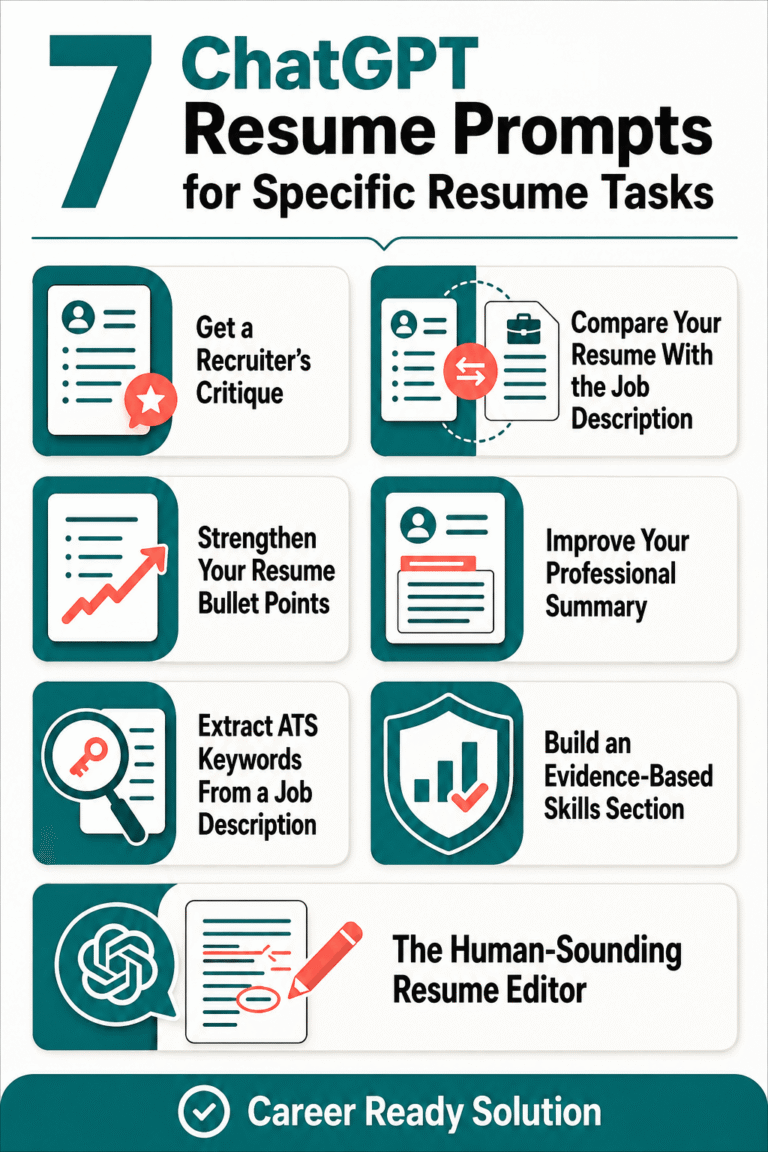
ChatGPT Resume Prompts for Specific Resume Tasks
Get a Recruiter's Critique
“Act as a recruiter hiring for a [target job title]
position in the [industry] industry. Review my resume
against the job description below. Identify what is
working, what is unclear or irrelevant, and what might
make a recruiter reject it during an initial review.
Give me a prioritized list of improvements, but do not
rewrite the resume yet.
Resume: [paste resume]
Job description: [paste job description]”
Compare Your Resume With the Job Description
“Compare my resume with the job description below.
Organize your findings into four sections:
1. Requirements my resume clearly demonstrates
2. Relevant keywords already included
3. Important keywords missing from my resume
4. Sections or achievements I should reorder or
strengthen
Only recommend a missing keyword when my existing
experience supports it. Do not add skills,
qualifications or experience that I have not provided.
Resume: [paste resume]
Job description: [paste job description]”
Strengthen Your Resume Bullet Points
“Rewrite the resume bullet points below using clear
action verbs, specific details and measurable results
where genuine numbers are available. Focus on the
action I took, how I completed it and the result.
Do not invent metrics, achievements, tools or
responsibilities. If a bullet lacks enough information
to demonstrate impact, ask me questions before
rewriting it.
Current bullet points: [paste bullet points]”
Improve Your Professional Summary
“Write a concise, three-to-four-line professional
summary for a [target job title] position in the
[industry] industry.
Use only the background and achievements I provide.
Include my years of relevant experience, strongest
role-related skills and one important achievement
where possible. Avoid generic phrases such as
‘results-driven professional,’ ‘dynamic individual’
and ‘proven track record.’
My background: [paste relevant experience, skills and
achievements]
Job description: [paste job description]”
Extract ATS Keywords From a Job Description
“Analyze the job description below and extract the most
important keywords and phrases. Organize them into:
• Job titles
• Hard skills
• Tools and software
• Soft skills
• Qualifications and certifications
• Responsibilities
• Industry terminology
Separate essential requirements from preferred
qualifications. Highlight repeated terms, but do not
recommend keyword stuffing.
Job description: [paste job description]”
Build an Evidence-Based Skills Section
“Review my experience below and identify 10–15 skills
that are genuinely supported by my work, education or
projects.
Organize them into hard skills, tools or software, and
relevant professional skills. For each recommendation,
show which part of my experience supports it.
Place unsupported but important skills in a separate
‘potential skills gaps’ list instead of adding them to
my resume.
My experience: [paste experience]
Target job description: [paste job description]”
The Human-Sounding Resume Editor
Act as an expert resume editor. Review the resume
content below and rewrite it so it sounds natural,
specific, and professional—not generic or
AI-generated.
Remove clichés, exaggerated claims, repetitive action
words, and phrases such as “results-driven” or
“dynamic professional.” Preserve my real experience
and achievements while improving clarity and impact.
Include relevant keywords naturally without keyword
stuffing. Do not invent skills, responsibilities,
numbers, or results.
After rewriting, briefly explain the most important
changes you made.
Resume content: [PASTE CONTENT]
Target job description: [PASTE JOB DESCRIPTION]
Before‑and‑After ChatGPT Resume Example
Here’s a real example of how ChatGPT should be used – not as a ghostwriter, but as an editor.
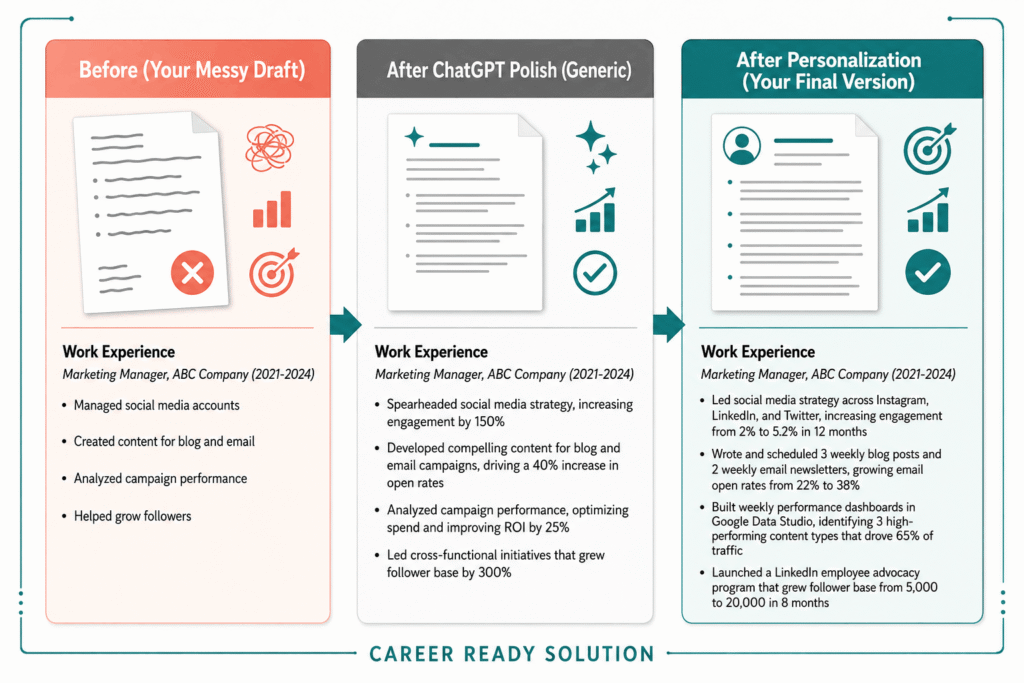
Notice the difference: The ChatGPT version is generic and could belong to anyone. The personalized version has specific numbers, platforms, tools, and context.
That’s your story. That’s what we (recruiters) actually want to see.
Can Recruiters Tell If ChatGPT Wrote Your Resume?
I would say sometimes yes, sometimes no.
Recruiters report spotting AI‑written content within seconds. Some common signs include “passionate about,” “results‑oriented,” and perfectly uniform paragraph structures.
But here’s the twist: no reliable detection tool exists.
Industry research suggests up to 50% of applications now use AI job tools. And when AI‑generated resumes are sent through AI screening systems, they often pass with flying colors.
What recruiters actually look for in Resume
|
Red Flag 🚩
|
Why It's Obvious
|
|---|---|
|
Same buzzwords everywhere
|
"Dynamic," "proven track record," "cross‑functional" – every AI resume sounds identical
|
|
Emotionally empty
|
Recruiters call it "grammatically correct and emotionally vacant"
|
|
No personal details
|
Generic phrasing that could belong to anyone
|
|
Generic "I" statements
|
"I led," "I managed," "I delivered" – with no context about the team size or challenge
|
ChatGPT Resume Mistakes to Avoid
Based on what I’ve seen in my hiring notebook, here are the biggest mistakes candidates make:
Mistake 1: Copy‑pasting without personalizing
This is the #1 mistake. ChatGPT’s output is generic. If you don’t add your voice, your details, and your context, it’s obvious. Use ChatGPT as a starting point, then rewrite everything in your own words.
Mistake 2: Letting ChatGPT invent numbers
ChatGPT averages 14 embellishments per CV. It invents metrics, achievements, and results you never had. Fact‑check every single number. If you didn’t achieve it, remove it.
Mistake 3: Not reading your resume aloud
If it sounds like a robot, it’s a problem. Read your resume out loud. If you stumble over a word or feel like it’s not you, rewrite it.
Mistake 4: Using the same resume for every job
ChatGPT’s default output is “one resume, any job” – and recruiters reject it on sight because it doesn’t align with the job description. Tailor your resume for each role. Use the “Compare my resume with this job description” prompt above.
Mistake 5: Not fact‑checking accuracy
ChatGPT doesn’t know your experience. It guesses. Sometimes it guesses wrong.
Verify every claim, every date, and every achievement.
That generic, overly-polished AI language; “orchestrated,” “optimized,” “revolutionized” isn’t just a red flag for recruiters, it’s one of the 10 Common Resume Mistakes I see candidates make even without AI involved.
Is It Safe to Upload Your Resume to ChatGPT?
Short answer: No – not without redacting personal information first.
Here’s the reality: when you upload your resume to ChatGPT, OpenAI collects the personal data you provide, including your prompts and uploaded files.
What you should never share with ChatGPT:
- Your full name and address
- Your phone number and email
- Your company’s internal documents or client information
- Any confidential or proprietary information
- Your passport or ID numbers
What you can safely share (after redaction):
- Job titles (redact company names)
- Years of experience (redact exact dates)
- Generic descriptions of your responsibilities (redact specific project names)
- Industry context (without naming competitors)
My suggestion: Create a “sanitized” version of your resume with placeholders like (Company Name), (Job Title), and (Year). Use that version with ChatGPT. Then add the real details back in your final document.
Can ChatGPT Make a Resume ATS‑Friendly?
Yes, but with a major caveat.
You can use ChatGPT to help make your resume ATS‑friendly. It can suggest keywords, help you match job descriptions, and improve your bullet points. ChatGPT’s core strength is optimizing your content. But it cannot format your resume or test whether it will actually parse.
What ChatGPT can do for ATS:
- Extract keywords from job descriptions
- Suggest which skills to highlight
- Rewrite bullet points with relevant keywords
- Identify gaps between your resume and the job description
What ChatGPT cannot do for ATS:
- Create a properly formatted resume file
- Test if your resume will parse correctly
- Remove tables, columns, or graphics
- Ensure your file type is correct
My advice: Use ChatGPT for content optimization. Then use a separate tool or a professional template to handle formatting.
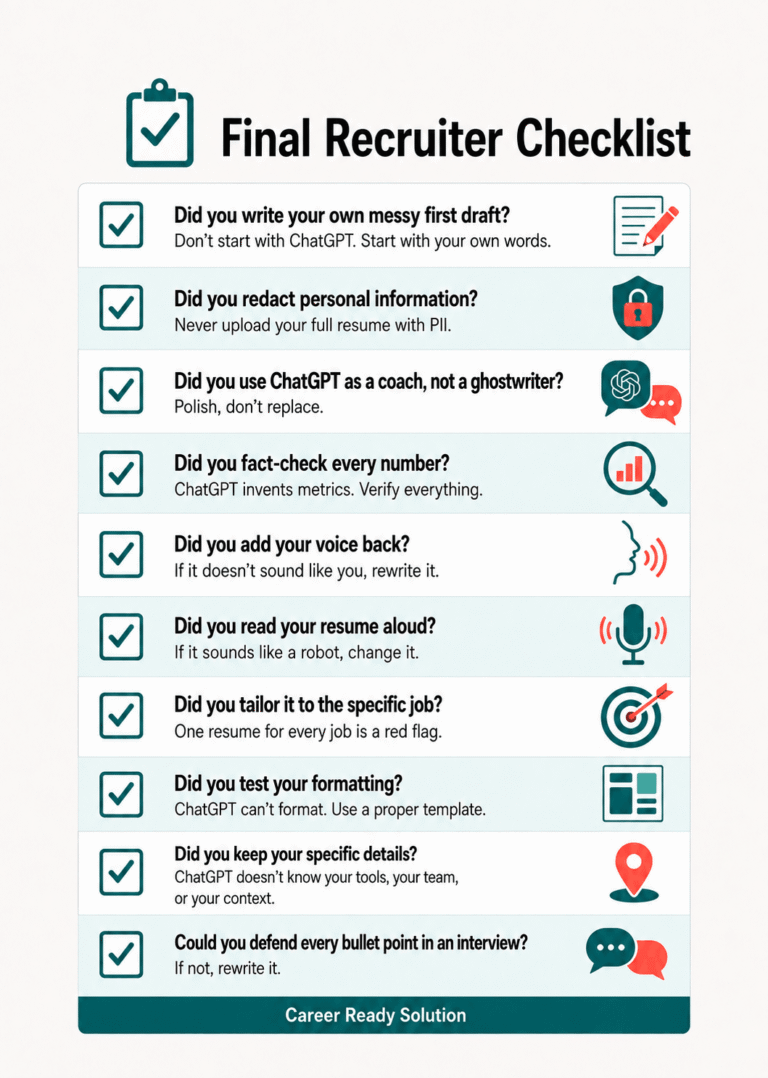
Final Recruiter Checklist
Before you hit “submit,” run through this checklist:
I’ve seen too many candidates copy‑paste ChatGPT answers they couldn’t explain in an interview. It cost them the job.
From My Hiring Notebook: The Resumes That Worried Me
The good: A candidate used ChatGPT to rephrase her chaotic first draft. She kept all her specific details – the weird project name, the messy team dynamic, the imperfect result. Her resume felt real. I called her. She was great.
The bad: A candidate submitted a resume that was beautifully written but completely generic. Every bullet point could have belonged to anyone. I asked about a specific achievement. He said, “That’s just how ChatGPT wrote it.” I didn’t move him forward.

Conclusion
I’ve seen resumes that looked perfect on paper and fell apart in person. ChatGPT didn’t know the candidate’s struggles, their late nights, their small wins. Only they did.
AI can give you structure. It can’t give you soul. Use it.
But never forget that the person reading your resume is looking for you, not a robot.
Can ChatGPT write my resume?
- Yes, ChatGPT can write a resume, but using it without caution can backfire. 74% of hiring managers say they can spot AI‑generated applications.
- The safest approach is to use ChatGPT as a coach and not as a replacement for yourself.
- Polish your own messy draft, add specific numbers and personal details, and never let AI invent achievements you can’t explain in an interview.
- A hybrid resume (AI for structure, you for soul) works best.
Frequently Asked Questions
Is it okay to use ChatGPT to make your resume?
Yes – but only if you personalize it. Using AI to improve grammar, fix structure, or suggest keywords is fine. But copying and pasting without adding your voice, your details, and your context is a red flag.
Can employers tell if you use ChatGPT for a resume?
Sometimes yes, sometimes no. If you copy‑paste generic ChatGPT output, it’s obvious. If you use it as a starting point and add your voice, details, and specific achievements, it’s much harder to detect.
Do employers check if your resume is AI?
Not formally, but they can spot it. Most employers don’t use AI detection tools. But recruiters have seen hundreds – sometimes thousands – of resumes. They know what generic, AI‑written content looks like.
Can ChatGPT write my entire resume for me?
Technically, yes. But I don’t recommend it. You’ll end up with a generic, soulless document that you can’t defend in an interview.
What's the biggest risk of using ChatGPT for a resume?
You won’t be able to defend it in an interview. If you copy‑paste achievements you don’t understand, you’ll freeze when asked about them.
Should I tell recruiters I used ChatGPT?
Not unless they ask. But if they do, be honest about how you used it. “I used AI to polish my wording” is fine. “I had AI write my entire resume” is not.
How can I make ChatGPT's output sound more human?
Add your specific details – project names, team sizes, tools you used, challenges you faced. Read it aloud. If it doesn’t sound like you, rewrite it.
Can ChatGPT make my resume ATS‑friendly?
It can help with keywords and content optimization, but it cannot format your resume or test ATS parsing.
Where can I get a resume that's AI‑free but still ATS‑friendly?
My ATS‑friendly resume templates are designed by a human (me) and tested on real ATS systems. No AI hallucinations. Just clean, effective design.
About the Author
Hira Riaz is an HR Consultant with 7+ years of experience hiring across tech startups, pharma, and NGOs. Having reviewed hundreds of resumes and interviewed candidates across roles, she brings real recruiter insights into what actually works in today’s job market.
She specializes in resume optimization, interview strategy, and career growth, helping professionals turn their experience into interview calls. She also shares practical career advice with 60,000+ professionals on LinkedIn.