The Complete Interview Guide: STAR Method, Behavioral Questions & Salary Negotiation
Master the STAR method, ace behavioral questions, and negotiate salary. Complete interview guide with scripts and insider HR tips.
Author: Hira Riaz
Published On 22 July, 2026.
TABLE OF CONTENTS
The STAR Method (With 10+ Real Examples)
• Example 1: Project Manager
• Example 2: Software Engineer
• Example 3: Fresh Graduate
• More Examples (Brief)
10 Most Common Interview Questions
(And How to Answer)
• Question 1: Tell me about yourself.
• Question 2: Why do you want to work here?
• Question 3: What’s your biggest weakness?
Estimated read time 20 minutes.
Why Structure Beats Experience in Interviews
You’ve Optimized Your Resume, aced the ATS, and finally landed an interview.
Now comes the part that actually decides the offer: answering behavioral interview questions with the STAR method and knowing how to handle salary negotiation once you get there.
As an HR consultant, who built departments from scratch, and as the person who’s interviewed hundreds of candidates across Pharmaceutical, NGOs, and Tech start-ups.
I’ve seen brilliant candidates lose offers because they didn’t know how to structure an answer.
And, I’ve seen seemingly underqualified candidates win the job because they told their story with clarity and confidence.
In this guide, I’ll give you everything I’ve learned from years of interviewing.
Why Most Interviews Fail (And How to Succeed)
Let’s start with a hard truth: a study cited in Forbes found that 60% of hiring managers make their decision within the first 15 minutes of an interview and 20% within the first five minutes (Booker, 2021).
As a hiring manager myself, I’ve watched stellar resumes crumble on basic questions. And, I’ve watched less experienced candidates win me over.
why? simply because they were prepared, confident, and real.
So why do interviews fail?
Beyond lack of preparation, three hidden factors often decide your fate:
Communication, Confidence, and Personality.
And if you want the full list of what trips candidates up most, I’ve broken down the Most Common Interview Mistakes separately.
Communication: How You Say It in interviews Matters as Much as What You Say
I’ve interviewed candidates who had perfect answers on paper but delivered them in a monotone, rambling, or overly rehearsed way.
Communication isn’t just about words or talking non-stop.
It’s about clarity, pacing, and listening.
- Clarity: Use simple language. Avoid jargon unless it’s industry‑standard. I once had a software engineer explain a complex bug fix using everyday analogies; I understood it immediately and was impressed.
- Pacing: Don’t rush. A calm, measured pace signals confidence. When candidates talk too fast, I assume they’re nervous or trying to hide something.
- Listening: Answer the question asked, not the one you prepared for. I’ve seen candidates ignore my question and launch into a rehearsed story. Honestly, it feels disrespectful.
How to Show Confidence in an Interview
Confidence isn’t arrogance. It’s believing in your value.
Look, How do I spot it?
- Posture: Sit up straight, shoulders back. Slouching signals insecurity.
- Eye contact: Look at me (or the camera). Glancing away too often reads as discomfort.
- Voice: Speak at a steady volume. Trailing off at the end of sentences suggests uncertainty.
I once interviewed a candidate who, despite having less experience than others, sat upright, made steady eye contact, and answered with conviction. I hired her.
Later, she told me she was terrified inside but she practiced until her body language showed otherwise.
What you wear matters too. Before your interview, check these 10 interview outfit mistakes that can weaken an otherwise strong first impression.
Personality: Letting Your Human Side Show
I hire people, not robots.
Personality helps me see if you’ll fit the team.
Be authentic
If you’re naturally humorous, light humor is fine. If you’re more reserved, that’s fine too. Don’t force a persona.
Show enthusiasm
A flat “I’m interested” doesn’t cut it. Say “I’m genuinely excited about this role because…” and mean it.
Ask about the team
When you ask what it’s like to work there, you show you care about culture, not just a paycheck
The candidates I remember most are the ones who made me feel like I was having a real conversation and not an interrogation.
The STAR Intervview (With 10+ Real Examples)
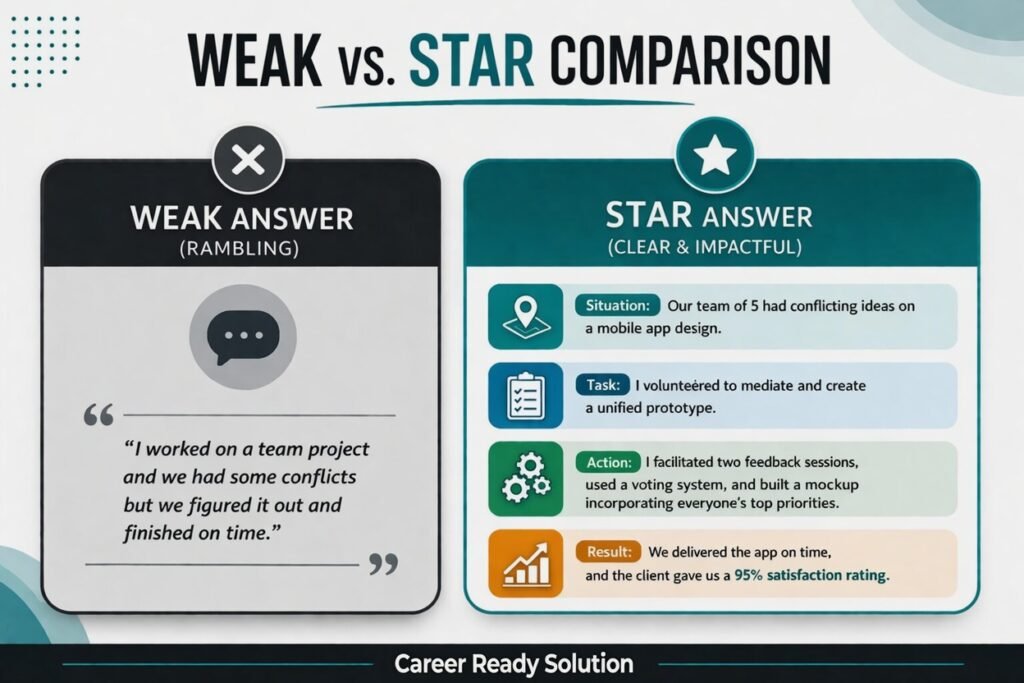
The STAR method is the gold standard for answering behavioral interview questions. Those that ask about a time you handled a situation.
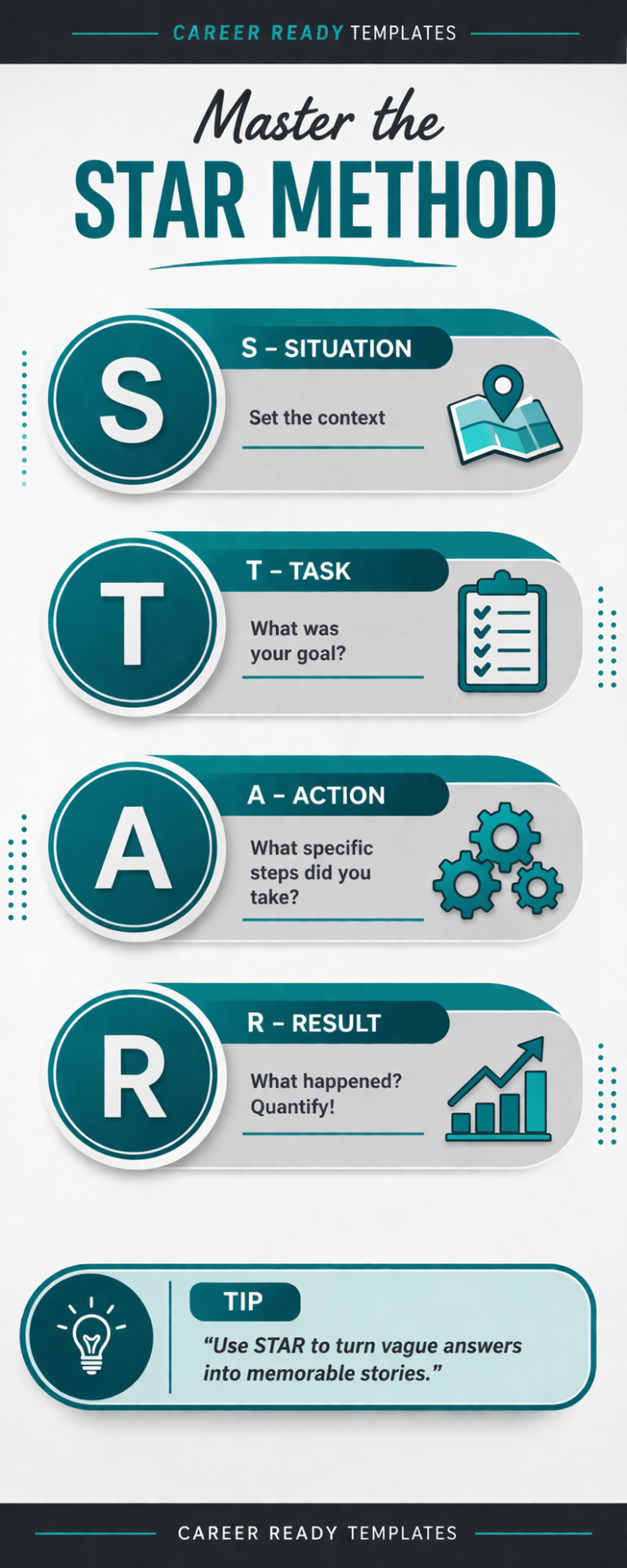
STAR stands for:
- Situation – Set the context.
- Task – What was your goal or responsibility?
- Action – What specific steps did you take?
- Result – What happened? Quantify if possible.
I’ve used STAR to evaluate candidates for roles ranging from software engineers to social mobilizers/community workers. When a candidate uses STAR, their answer becomes clear, memorable, and credible.
You can use the STAR method even if you have never held a formal job.
Draw examples from internships, academic projects, volunteering and extracurricular activities. These interview questions and sample answers for candidates with no experience will show you how.
STAR Interview Example 1: Project Manager
Question: Tell me about a time you led a project under a tight deadline.
|
|
||
|---|---|---|
|
S
|
Our company landed a new client with a 3‑week launch deadline—half our usual time
|
|
|
T
|
As project lead, I had to coordinate design, development, and marketing to deliver on time
|
|
|
A
|
I broke the project into sprints, held daily stand‑ups, and personally handled client communication to keep everyone aligned.
|
|
|
R
|
We launched on time, and the client signed a 12‑month contract
|
|
STAR Interview Example 2: Software Engineer
Question: Describe a time you solved a complex technical problem.
|
|
||
|---|---|---|
|
S
|
Our e‑commerce platform faced frequent downtime during peak hours, affecting customer orders
|
|
|
T
|
I was tasked with identifying the root cause and implementing a fix within two weeks.
|
|
|
A
|
I profiled the database queries, discovered an unoptimized join, and rewrote the query to reduce execution time by 80%
|
|
|
R
|
Downtime dropped to zero during the next peak sale, and sales increased by 15% year‑over‑year
|
|
STAR Interview Example 3: Fresh Graduate (No Work Experience)
Question: Tell me about a time you worked in a team to achieve a goal.
|
|
||
|---|---|---|
|
S
|
In my final year, our university group project required building a mobile app for a local NGO.
|
|
|
T
|
I was responsible for frontend development and coordinating with backend teammates
|
|
|
A
|
I set up weekly syncs, used Git for version control, and resolved a conflict
|
|
|
R
|
We delivered the app two weeks early, and the NGO used it to train 200+ volunteers
|
|
STAR Method Examples for Interviews
- HR Executive – Resolved a conflict between two employees by mediating and creating a new communication protocol, resulting in improved team morale.
- Sales Manager – Turned around a declining territory by retraining the team and implementing a new CRM, leading to 30% growth in six months.
- Content Writer – Managed a tight editorial calendar during a product launch by reprioritizing tasks and communicating with stakeholders, ensuring zero missed deadlines.
- UI Designer – Redesigned a user flow after negative feedback, using user testing to iterate, which boosted conversion by 25%.
- Quality Assurance – Introduced automated testing for a critical module, reducing regression time from 2 days to 4 hours.
- Social Mobilizer/Community worker – Gained trust in a resistant community by organizing small focus groups and listening to concerns, eventually achieving 90% participation in a health program.
- Accountant – Streamlined month‑end closing by creating a checklist and automating reconciliation, cutting closing time by 40%.
If you are preparing for your first interview, prepare with these 25 interview questions and answers for candidates with no experience.
For more practice, I’ve compiled a comprehensive e-book with STAR examples for every common HR interview question.
It has helped many HR job seekers land roles in top companies. Get the 100 STAR Interview Answers for HR Professionals here
Practice your own stories now.
10 Most Common Interview Questions with Answers
Here’s how to handle the questions that show up in almost every interview.
1. Tell me about yourself.
What they want: A concise summary of your career, not your life story. |
How to answer: Use the “Past‑Present‑Future” formula. I started in (field), where I (key achievement). Then I moved to (next role), where I (another achievement). Now I’m looking to bring my skills to a role like yours, where I can (value you’ll add). |
If your career story includes time away from work, prepare for that conversation too. See how to explain a career gap in an interview with practical answer examples.
2. Why do you want to work here?
What they want: Proof you’ve done your homework and are genuinely interested. |
How to answer: Reference their mission, recent news, or products. Connect it to your values. I’ve followed your work in (area), and I’m excited by your recent (project). I believe my experience in [skill] can help you achieve (goal). |
3. What’s your biggest weakness?
What they want: Honesty, self‑awareness, and a plan to improve. |
How to answer: Pick a real weakness (but not a core skill). Explain how you’re addressing it. I tend to over‑prepare for presentations. To fix it, I now set a time limit and practice with a colleague to ensure I stay focused on key points. |
4. STAR Interview question: Tell me about a time you failed.
STAR answer
|
|
||
|---|---|---|
|
S
|
In my first month as a project coordinator, I assumed the data was correct without double‑checking.
|
|
|
T
|
I needed to ensure accuracy before sending it to senior leadership.
|
|
|
A
|
I sent the report, later discovered a discrepancy, immediately informed my manager, and implemented a two‑step verification process.
|
|
|
R
|
My manager appreciated the honesty, and the new process reduced errors by 90%.
|
|
5. STAR Interview question: Why should we hire you?
STAR answer
|
|
||
|---|---|---|
|
S
|
Job description emphasizes improving customer retention
|
|
|
T
|
In my last role, our retention rate dropped to 70%.
|
|
|
A
|
I analyzed feedback, identified pain points, and proposed a new onboarding process. I led a team to implement it.
|
|
|
R
|
Retention climbed to 85% within six months. I’m confident I can bring that same focus here
|
|
6. STAR Interview question: Where do you see yourself in five years?
STAR answer
|
|
||
|---|---|---|
|
S
|
I’ve always been passionate about product management
|
|
|
T
|
In my current role, I’ve taken on product‑adjacent tasks like user story mapping.
|
|
|
A
|
I’ve completed two courses on product strategy and volunteered to lead a cross‑functional feature launch
|
|
|
R
|
That feature increased user engagement by 20%. In five years, I’d love to be a product manager here.
|
|
7. STAR Interview question: Describe a time you had to work with a difficult person.
STAR answer
|
|
||
|---|---|---|
|
S
|
On a marketing campaign, a designer missed deadlines
|
|
|
T
|
I needed assets to launch on time.
|
|
|
A
|
Instead of escalating, I asked for a chat, learned he was overwhelmed, and we agreed on a mini‑schedule with daily check‑ins
|
|
|
R
|
The campaign launched on time, and our relationship improved.
|
|
8. STAR Interview question: How do you handle stress?
STAR answer
|
|
||
|---|---|---|
|
S
|
During a product launch, our lead developer fell ill two days before go‑live.
|
|
|
T
|
I had to ensure no delay.
|
|
|
A
|
I re-assigned tasks, took over code reviews, and communicated transparently with stakeholders.
|
|
|
R
|
We launched one day late, but the client was understanding, and the team stayed calm.
|
|
9. STAR Interview question: What’s your greatest achievement?
STAR answer
|
|
||
|---|---|---|
|
S
|
Our support response time was 48 hours, causing complaints
|
|
|
T
|
I was asked to reduce it to under 24 hours
|
|
|
A
|
I introduced canned responses, trained the team, and set up automated routing
|
|
|
R
|
Response time dropped to 12 hours, and satisfaction scores increased by 30%.
|
|
10. STAR Interview question: Tell me about a time you showed leadership.
STAR answer
|
|
||
|---|---|---|
|
S
|
In my university capstone project, our team missed two milestones
|
|
|
T
|
I wasn’t the lead, but I saw we were failing
|
|
|
A
|
I called a meeting, created a task board, and delegated responsibilities. I also set up daily stand‑ups
|
|
|
R
|
We finished on time and scored the highest grade
|
|
For a complete library of STAR interview answers for HR roles, check out my 100 STAR Interview Answers for HR Professionals ebook.
If interviews make you nervous or you struggle to explain your experience clearly, explore my Personalized Interview Preparation.
Software Engineer Interviews & Case Studies
Having worked as HR Manager of a SaaS based Tech start-up, I know professionals having technical background will likely face a technical or case interview.
Here’s how to prepare and what to avoid.
For Software Engineers: Problem‑Solving Tests
I’ve hired many Software Engineers for Node.js and React roles in a SAAS based Tech start-up. The technical interview usually involves live coding, take‑home assignments, or whiteboarding.
Here’s how to excel:
- Practice platforms: LeetCode, HackerRank, or Codewars. Focus on medium‑difficulty problems related to data structures and algorithms.
- Explain your thought process: I don’t expect you to solve every problem perfectly. I want to see how you break down a problem, handle edge cases, and communicate. Talk out loud.
- Ask clarifying questions: Don’t assume. Clarify input constraints, expected output, and performance requirements. It shows thoroughness and your efforts.
A personal warning about Cheating:
I’ve seen candidates submit take‑home assignments that were clearly not their own—perfect code, but when they were being asked to explain a single line in the final interview, they froze.
One candidate couldn’t even tell me why he used a specific loop.
He got rejected immediately.
Not only is it dishonest, but it wastes everyone’s time.
Your integrity is worth more than any job. Always Remember this.
For Data Analysts & Consultants
- Data analysts: Practice SQL (joins, aggregations), Excel (pivot tables, vlookup), and Python (pandas). Be ready to present insights as if to a non‑technical stakeholder.
- Consultants: Use frameworks like MECE (Mutually Exclusive, Collectively Exhaustive). Practice case interviews with a friend. Always ask clarifying questions before diving into analysis.
Virtual Interview Tips
Remote interviews are here to stay. Period.
I’ve conducted hundreds of interviews for roles including Engineering, UI designer, Content writer, SEO specialist, Business development and many others.
Here’s what separates winners from those who get forgotten.
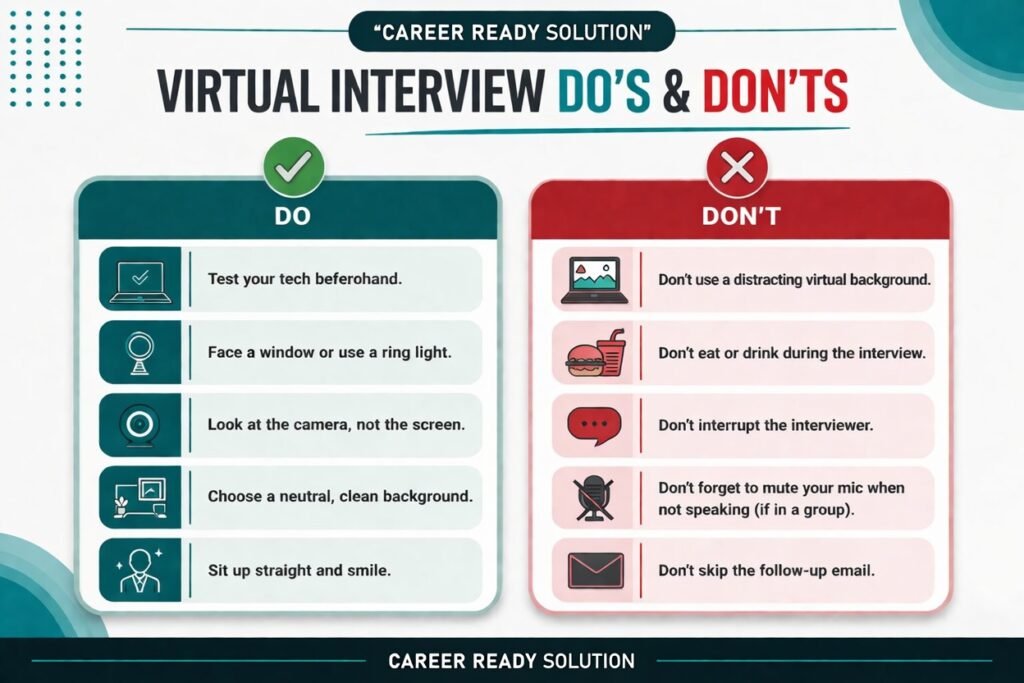
What to Do
- Tech check: Test your camera, mic, and internet an hour before. Have a backup phone number ready.
- Lighting: Sit facing a window or use a ring light. Shadows across your face are distracting.
- Background: Simple, neutral. Avoid clutter or distracting images.
- Eye contact: Look at the camera, not the screen. It mimics real eye contact.
- Body language: Sit up straight, nod occasionally, smile. Energy translates even through a screen.
These are just the virtual-specific slip-ups. If you want the complete picture, including mistakes candidates make before and after the interview too, check out my guide on Common Interview Mistakes To Avoid.
My rule of thumb: Act as if the interview is in person. Would you wear a hoodie to a face‑to‑face meeting?
Would you check your phone? No.
So don’t do it virtually.
How to Negotiate Salary & Benefits (With Scripts)
Many candidates fear this conversation.
In my 7+ years HR career, I’ve helped people negotiate offers that were higher than the initial range.
Here’s a deeper look, focusing on the total compensation package, not just cash.
The Mindset
Salary negotiation is not a confrontation. It’s a collaboration.
The employer already wants you; they’re investing time and money. Your goal is to find a win‑win.
Most hiring managers expect some negotiation—only 20% of candidates actually do it, and those who do often get more.
When to Start the Conversation?
Never bring up salary before you have an offer. If the recruiter asks early, say:
“I’d love to learn more about the role first so I can give you a fair range. Could you share the budgeted range for this position?”
If they insist, give a broad range based on market research: “Based on my research, roles like this typically range from X to Y. But I’m flexible depending on the total package.”
How to Negotiate a Written Offer (Total Package Focus)
Once you have an offer, thank them enthusiastically. Then:
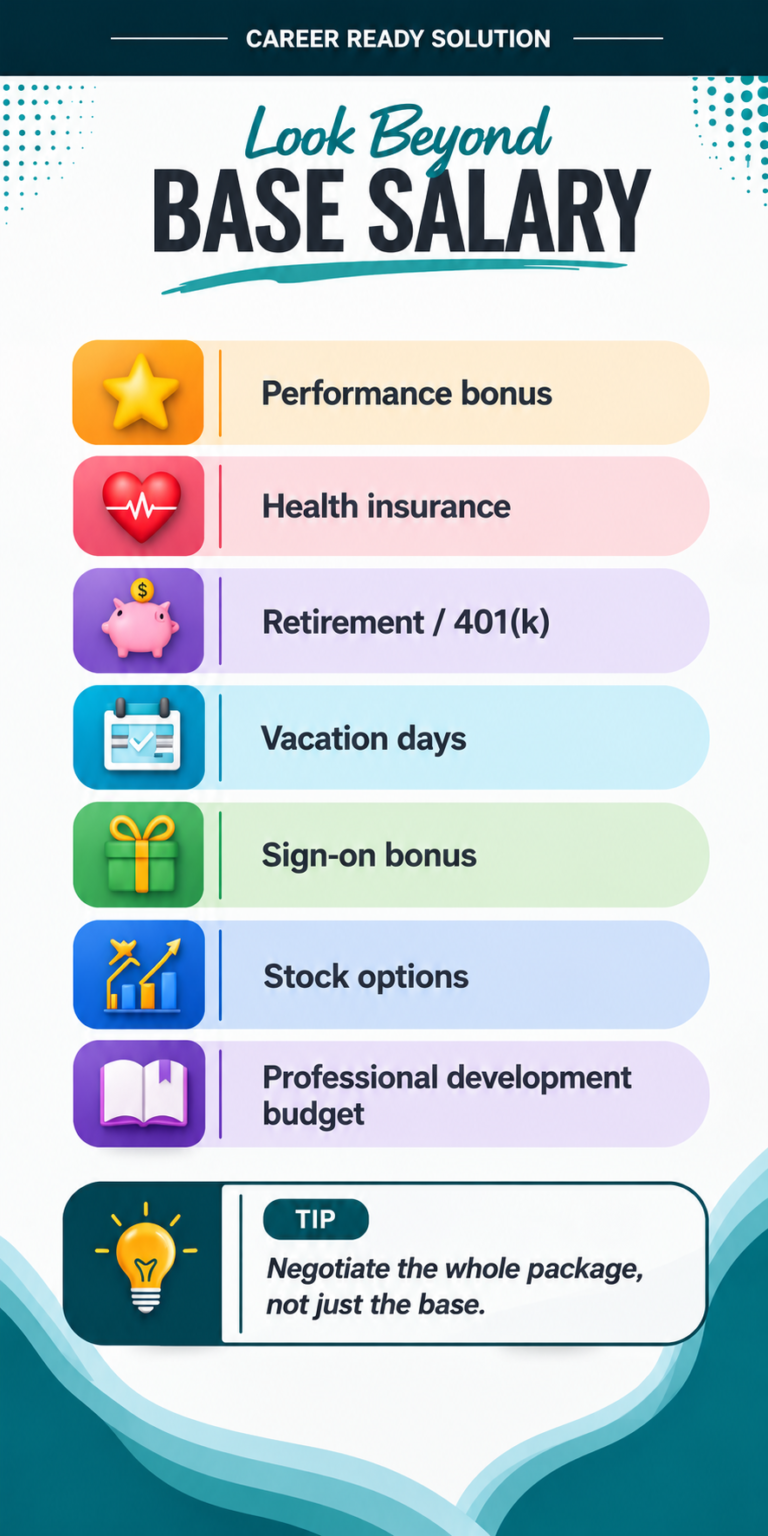
“Thank you so much for the offer. I’m very excited about the role. Before I respond, could you share more about the full benefits package? I’d like to consider everything together; health insurance, retirement contributions, vacation days, professional development budget, and any performance bonuses.”
Why this approach works?
It shows you’re thoughtful and looking for a long‑term fit, not just a paycheck.
|
Component
|
What to Ask For
|
|---|---|
|
Sign‑on bonus
|
One‑time payment, especially if you’re leaving unvested equity or bonuses behind.
|
|
Performance bonus
|
Target percentage (e.g., 10–20% of base). Ask about historical payout rates.
|
|
Health insurance
|
Does the company cover premiums for dependents? What’s the deductible?
|
|
Retirement plan
|
401(k) matching? Vesting schedule?
|
|
Vacation / PTO
|
Can you get an extra week? Unpaid leave flexibility?
|
|
Professional development
|
Budget for courses, certifications, conferences.
|
|
Remote work / flexibility
|
Hybrid schedule? Home office stipend?
|
|
Stock options / equity
|
For startups: number of shares, strike price, vesting cliff.
|
|
Relocation assistance
|
If moving for the job, ask for a lump sum or direct billing.
|
Script for Negotiating Benefits
- “I’m very excited about the base salary of $X. Could we also discuss the possibility of an extra week of vacation? I value work‑life balance and believe it helps me perform at my best.”
- “I noticed the health insurance plan covers only the employee. Would it be possible to include family coverage? I can contribute a portion of the premium if needed.”
Real Stories from My HR Desk
- The candidate who asked and won: A Node.js developer was offered $80k. She asked for $95k, citing her niche skills. The company came back with $90k plus a $5k signing bonus. She got an extra $15k in total compensation.
- The candidate who didn’t ask: A senior project manager accepted the first offer. Later, she learned her colleague in the same role was paid $15k more. She had no leverage after accepting. Always negotiate.
What If They Say No to Everything?
Don’t panic. You can still ask for a performance review at 6 months with a guaranteed raise if you meet targets.
- “I understand. Could we agree on a performance review after six months, and if I meet certain goals, we revisit the salary?”
Often, they’ll agree to this, which gives you a clear path to a higher total package.
Want step‑by‑step scripts for every negotiation scenario? I’ve created a dedicated Salary Negotiation Scripts Ebook with exact phrases for phone calls, emails, and in‑person meetings.
Follow‑Up After Interview (Thank‑You Emails That Make a Difference)
I can’t count how many times a thoughtful thank‑you email did play its part for a candidate.
Send it within 24 hours. Here’s how to make it personalized and effective.
The Structure
- Subject line: Thank you – (Your Name) – (Role Title)
- Opening: Reiterate your gratitude and mention a specific moment from the interview.
- Middle: Reaffirm your interest and briefly connect your skills to a need they mentioned.
- Closing: Restate your enthusiasm and offer to provide more information.
Personalized Example
Subject: Thank you for the Interview opportunity – Position: Senior HR Consultant
Dear (Name of Interviewer),
Thank you again for the opportunity to interview today. I really enjoyed hearing about your upcoming HR digital transformation project—it’s exactly the kind of challenge I thrive on.
As we discussed, my experience building an HR department from scratch at a tech startup and leading digital change at an NGO aligns directly with your goals. I’m confident I can help you streamline processes and drive employee engagement.
Please don’t hesitate to reach out if I can provide any additional information. I’m very excited about this role and look forward to the next steps.
Best regards,
Hira Riaz
Why Personalization Matters?
A generic “Thanks for your time” email is fine, but it won’t move the needle. When you mention something specific; a project, a problem, or a comment. It reminds the interviewer of your conversation and show you were paying attention.
What NOT to do:
- Send a one‑line email.
- Copy‑paste the same email to every interviewer.
- Send it a week later.
Pro tip: If you interviewed with multiple people, send each a separate, personalized email. They will talk to each other, and consistency will be noted.
Conclusion: Your Interview, Your Story
1
Download my free ATS resume guide to make sure your resume matches the job description—first impressions start before the interview.
I’ve sat in the hiring chair more times than I can count.
The candidates who got the job weren’t always the ones with the most experience.
They were the ones who prepared, who used STAR to tell their stories, who asked thoughtful questions, and who followed up with genuine enthusiasm.
Nailing the interview is only one part of the journey. If you’re still working on where to find the right opportunities and how to approach your search strategically, check out my complete Job Search Strategy Guide for a step-by-step approach.
You have the same opportunity.
The guide you’ve just read is the same framework I’ve shared with clients who landed roles in pharma, tech, NGOs, and startups. Now it’s your turn to apply it.
Here’s what to do next:
2
Explore my ATS‑friendly templates for a professional look that carries into your interview.
How do you prepare for a behavioral interview?
- Use the STAR method: describe the Situation, Task, Action, and Result.
- Prepare 5–7 stories covering teamwork, conflict, leadership, failure, and problem‑solving.
- Practice aloud until each answer fits within 90 seconds.
- For salary negotiation, never give the first number, ask for the budget range instead.
Frequently Asked Questions
From my experience, aim for 1–2 minutes per answer. Any longer and I start to lose focus. Use STAR to stay on track. If you see me glancing at the clock, you’ve talked too long.
No. I once had a React developer say his weakness was “JavaScript fundamentals.” That made me question his ability to do the job. Choose a real weakness that isn’t critical to the role, and always show how you’re improving.
Be honest, then pivot. I’ve hired candidates who said, “I haven’t led a full project, but I’ve supported projects by (action), and I’m eager to take on more responsibility.” That shows self‑awareness and potential.
I’ve been on both sides of panel interviews. My advice: address each person briefly when you answer. Make eye contact with the person who asked the question, then glance at others to include them. And bring extra copies of your resume—one for each panelist.
Absolutely. I love when candidates ask, “What do you enjoy most about working here?” It tells me you care about fit, not just a paycheck. Avoid asking about “work‑life balance” in a way that sounds like you want to work less; instead, ask about team collaboration and values.
It’s normal. I’ve been nervous as an interviewer too. Take a sip of water, pause, breathe. I’ve hired many visibly nervous candidates who delivered great answers. Nerves don’t disqualify you, lack of preparation does.
Politely ask for clarification. I’ve had candidates say, “Could you please rephrase the question? I want to make sure I’m addressing the right point.” That shows professionalism, not weakness.
Yes, each round. I’ve had candidates skip it, and I noticed. It takes two minutes and keeps you top‑of‑mind. Make it personal and mention something specific we discussed.
Be honest but brief. “I took time to (care for family / upskill / travel). Now I’m fully focused on returning to work.” I’ve hired people with gaps. The gap isn’t the problem but hiding is.
Yes, it shows you’re engaged. But keep it minimal. I’ve had candidates who spent more time writing than talking, that’s too much. A few keywords to jog your memory is fine.
Wait at least one week, then send a brief email: “I’m still very interested in the role. Could you share an update on the timeline?” I’ve received such emails and appreciated the initiative, they often prompted me to check with the hiring team.
No. Practice key points, but speak naturally. I can always tell when an answer is memorized, it sounds robotic. I want to hear the real you.
Authenticity. Always.
I remember candidates who were themselves—passionate, honest, and human. One candidate admitted she didn’t know an answer but showed how she’d figure it out. I hired her. That’s what I look for.
About the Author
Hira Riaz is an HR Consultant with 7+ years of experience hiring across tech startups, pharma, and NGOs. Having reviewed hundreds of resumes and interviewed candidates across roles, she brings real recruiter insights into what actually works in today’s job market.
She specializes in resume optimization, interview strategy, and career growth, helping professionals turn their experience into interview calls. She also shares practical career advice with 60,000+ professionals on LinkedIn.