How to Explain a Career Gap on Your Resume & Interview (Examples)
How to explain a career gap on your resume with examples. Learn to reframe employment gaps, answer interview questions, and return to work with confidence.
Author: Hira Riaz
Published On 28 August, 2026.

TABLE OF CONTENTS
Estimated read time 15 minutes.
From a Five-Year Career Break to a Performance-Based Raise in Eight Months
I remember the day I decided to return to work after spending five years at home.
I was nervous. The HR industry had changed, and so had I. One question kept circling in my mind:
“Do I still have what it takes?”
Then I reminded myself that time away from paid employment did not mean I had stopped growing.
During my career break, I completed my MS in Strategic Human Resource Management with a 3.82 CGPA. My research paper was selected for presentation at an international conference in Malaysia, and I received the MS Student Researcher Award.
I also stayed connected to my profession by completing online courses, reading HR articles and speaking with former colleagues.
In 2020, during the uncertainty of COVID-19, I returned to the workforce. I did not walk in knowing everything. I asked questions, learned from senior colleagues and continued updating my knowledge.
Within eight months, my performance was recognized with a salary increase.
That experience changed how I view career gaps.
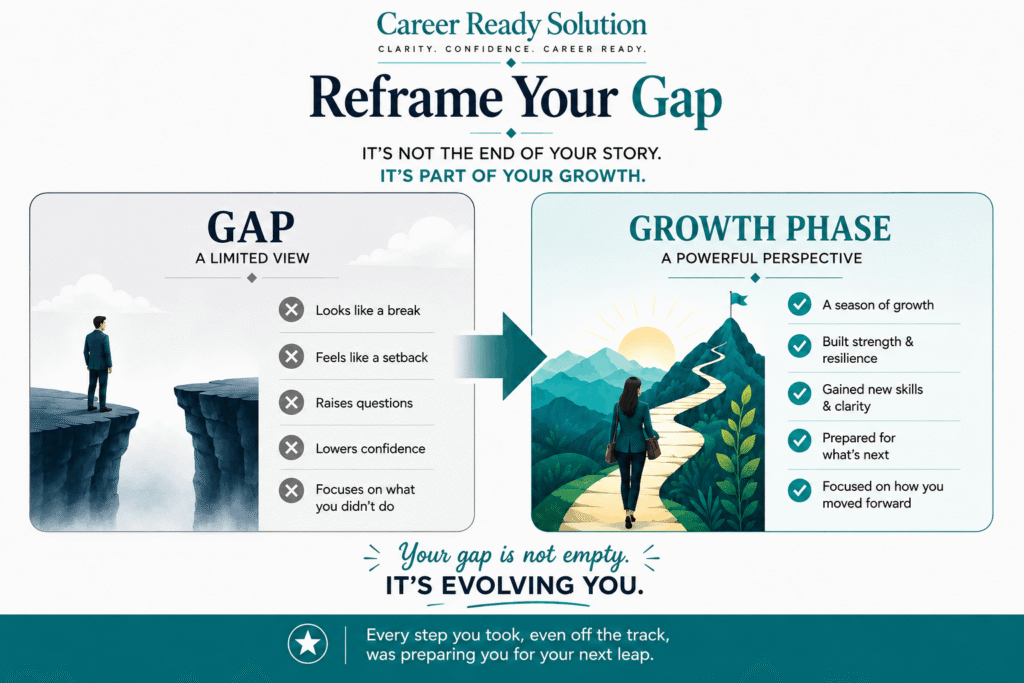
A career gap does not erase your previous experience. It does not make you less capable, and it does not mean your professional life stopped. It simply means your growth happened in a different way.
The challenge is learning how to communicate that growth on your resume and during an interview. If you also need help strengthening your resume structure, formatting and keywords, my ATS-Friendly Resume Guide covers the complete process.
In this guide, I will show you exactly how to explain your career gap without apologizing, hiding your timeline or underselling what you can offer.
Do You Need to Explain Every Career Gap?
No. A short gap of a few months or one that happened many years ago usually does not need a separate explanation.
But if the gap is recent, ongoing or clearly visible, address it briefly.
As a recruiter, a career gap does not automatically make me reject someone. But an unexplained gap makes me pause.
|
Avoid saying
|
Say this instead
|
|---|---|
|
“I wasn’t working for three years.”
|
“I took a three-year career break for family responsibilities. I am now ready to return to full-time work.”
|
|
“I couldn’t find a job.”
|
“My job search took longer than expected, but I remained focused on finding the right long-term opportunity.”
|
|
“I was unemployed.”
|
“My position ended during restructuring, and I have been preparing for my next role in [field].”
|
Do not invent courses, projects or freelance work to make the gap sound impressive. A simple, honest explanation is stronger than a polished story that is not true.
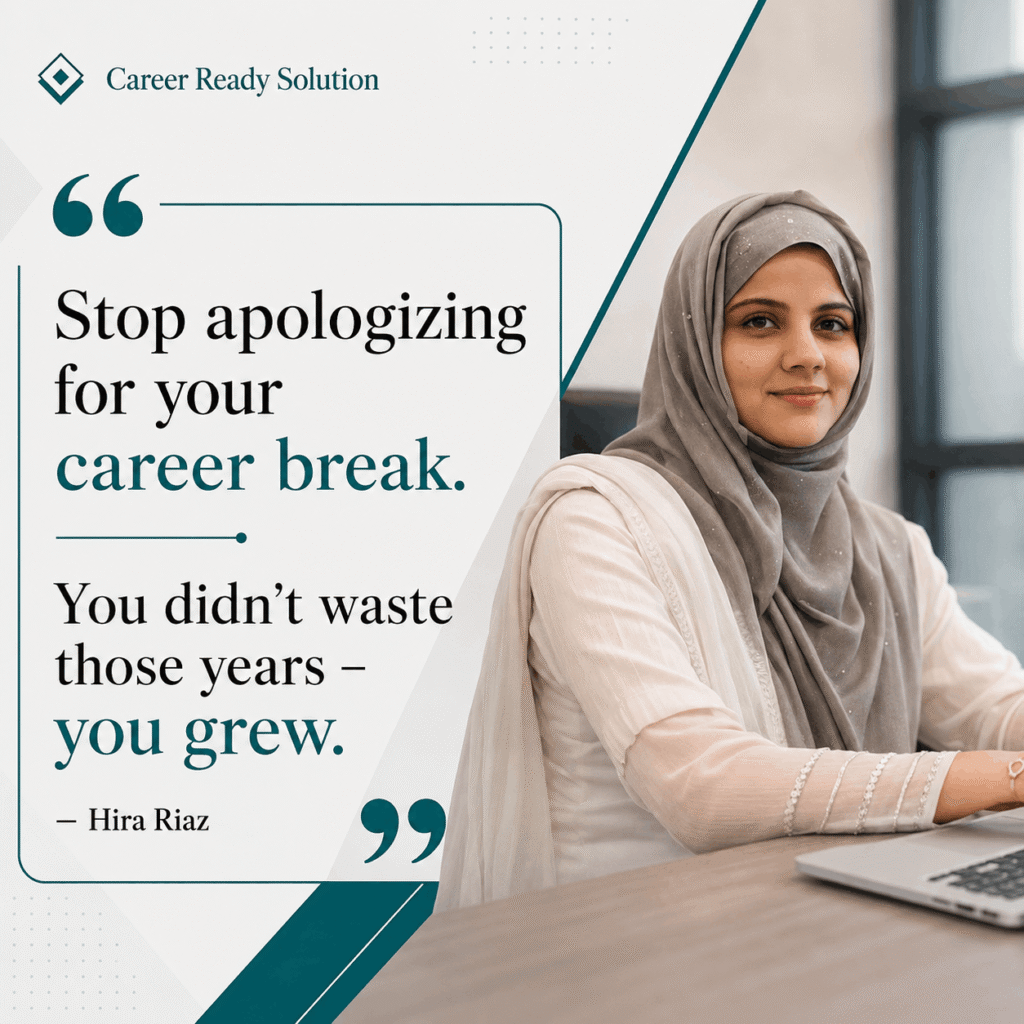
Your career gap is one chapter—not your entire professional story.
An unexplained gap is only one issue that can make a recruiter pause. Check these resume mistakes that quietly block shortlisting before you start applying again.
How to Explain a Career Gap on Your Resume (Step by Step)
Step 1: Choose the Right Resume Format
|
Format
|
Best For
|
|---|---|
|
Hybrid
|
Most career gaps – skills summary first, then experience
|
|
Functional
|
Long gaps or career changes – focuses on skills
|
|
Chronological
|
Only if your gap is short and easily explained
|
My Recommendation: Use the hybrid format. It highlights your skills upfront, so the gap isn’t the first thing a recruiter sees.
|
|
|
|---|---|
|
Step 2: List Your Career Break as a Role
|
Don't hide it. List it like any other role.
Title: Career Break – (Reason)
|
|
Step 3: Add Bullet Points Showing What You Did
|
This is the most important step. Show that you were active, not paused.
|
|
Step 4: Add Dates
|
Just like any role, add your start and end dates.
|
Once your timeline is clear, the rest of the document must still perform. Here is how to rebuild the rest of your resume for ATS without hiding the person behind it.
A cover letter can provide additional context when your career gap is directly relevant to your application—but you do not automatically need one for every vacancy. Here is how to decide when a cover letter still matters.
Career Gap Resume Examples – By Profession
Here are examples of how to write your career gap on your resume, organized by profession. Find yours and adapt it to your situation.
Career Break – Professional Development & Family Care (2018–2020)
- Completed CPA certification
- Did freelance bookkeeping for 5 small businesses, managing budgets totaling $2.5M
- Managed household budget and financial planning, saving $15,000 annually through strategic expense management
- Stayed updated on tax laws and accounting software, reducing tax filing errors by 25% for clients
Career Break – Education & Professional Development (2017–2020)
- Earned MS in Mechanical Engineering (CGPA 3.2)
- Completed certification in Project Management
- Did freelance CAD design projects, reducing material waste by 18% through optimized designs
- Stayed updated on industry trends through 8 online courses and 3 industry certifications
Career Break – Professional Development & Consulting (2018–2020)
- Earned certification in Talent Acquisition
- Did freelance recruitment consulting for 4 startups, filling 25+ positions with a 90% retention rate after 6 months
- Completed courses in HR analytics and AI recruitment
- Stayed updated on employment laws and hiring trends across 3 countries
Career Break – Leadership Development & Consulting (2017–2019)
- Earned certification in Leadership & Management
- Did freelance consulting for 3 small businesses, increasing operational efficiency by 22%
- Completed courses in operations and team management
- Managed volunteer teams of 15+ people at community organizations
Career Break – Upskilling & Freelance (2018–2020)
- Completed certification in Full-Stack Development
- Built 4 freelance web applications for small businesses, serving 500+ daily users
- Contributed to 3 open-source projects with 1,000+ GitHub stars
- Stayed updated on 5 new programming languages and frameworks
Career Break – Professional Development & Consulting (2019–2020)
- Completed certification in Sales Management
- Did freelance sales consulting for 3 startups, increasing their revenue by an average of 35% within 6 months
- Completed courses in CRM and sales analytics
- Stayed updated on sales trends and negotiation techniques
Career Break – Professional Development & Volunteering (2018–2020)
- Earned certification in Instructional Design
- Volunteered as a tutor at community center, improving student test scores by 30%
- Completed courses in online teaching and curriculum design
- Developed remote learning materials for 200+ students across 3 schools
Career Break – Professional Development & Family Care (2018–2020)
- Completed advanced certification in [specialty]
- Did part-time telehealth consultations for 50+ patients
- Stayed updated on new medical protocols and technologies through 6 continuing education courses
- Maintained professional nursing license and completed 30+ continuing education credits
Your career-break entry explains the past; your summary must sell the next chapter. Use these examples to write a resume summary that makes your comeback clear.
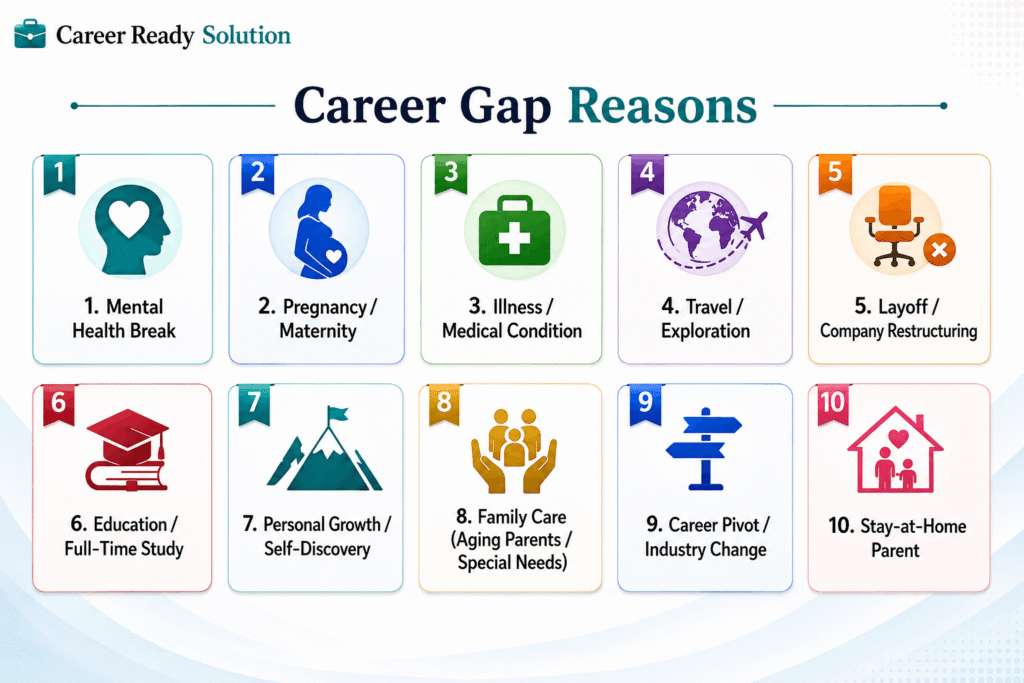
How to explain Employment Gap on a Resume Examples – By Reason
Here are examples organized by the reason for your career break. I’ve added metrics to make each example feel real and measurable.
Career Break – Health & Recovery (2018–2019)
- Focused on mental health and complete recovery
- Completed therapy and self-care practices
- Stayed current through 4 online courses and daily industry reading
- Now fully recovered and ready to return with renewed energy and focus
Career Break – Maternity & Family Care (2018–2020)
- Focused on pregnancy, childbirth, and early childhood care
- Completed 3 online courses in [field]
- Stayed updated on industry trends through monthly webinars and reading
- Developed patience, multitasking, and time management skills – managing schedules for a family of 5
Career Break – Health & Medical Recovery (2017–2018)
- Focused on medical treatment and complete recovery
- Completed light freelance work when possible, contributing to 5 projects
- Stayed current through industry reading and 4 online courses
- Now fully recovered and ready to return
Career Break – Travel & Global Exposure (2016–2017)
- Traveled to 12 countries, gaining cross-cultural exposure
- Developed adaptability, resilience, and communication skills in 5 different languages
- Built a global professional network of 100+ contacts
- Maintained professional connections through LinkedIn and monthly newsletters
Career Break – Company Restructuring (2020–2021)
- Company restructuring led to role elimination
- Used time to upskill – completed 2 certifications
- Conducted informational interviews with 25+ professionals
- Prepared and applied for 50+ roles, refining resume and interview skills
Career Break – Full-Time Education (2015–2018)
- Earned MBA / MS / PhD (CGPA 3.8+)
- Published 2 research papers in peer-reviewed journals
- Received 3 academic awards for research excellence
- Graduated with distinction and ranked in top 5% of class
Career Break – Personal Growth & Self-Discovery (2019–2020)
- Took time to re-evaluate career direction
- Completed 6 self-development courses
- Volunteered at 3 community organizations, contributing 200+ hours
- Developed clarity on career goals and a 5-year career roadmap
Career Break – Family Care (2018–2020)
- Cared for aging parents with health needs
- Managed medical appointments, care coordination, and 5+ medications daily
- Developed strong organizational and communication skills
- Completed 2 online courses in [field] during downtime
Career Break – Career Transition & Industry Change (2019–2020)
- Took time to research and transition to a new industry
- Completed 4 industry-specific certifications
- Conducted informational interviews with 30+ industry professionals
- Completed 5 courses in [new field] to build foundational skills
If your career break was spent raising children, use this stay-at-home mom resume guide to see how to list the break, translate your transferable skills and write a strong return-to-work summary.
If you are returning to a changed industry or entering a new one, make sure your wording matches today’s resume keywords, not yesterday’s job title.
Career Break – Family Care & Professional Development (2015–2020)
- Focused on raising children and managing household
- Earned MS in Strategic HRM (CGPA 3.82)
- Completed 2 professional certifications
- Volunteered at school and community events, managing 15+ events annually
- Developed strong skills in budgeting, coordination, and event management – saving $12,000 annually through smart household budgeting
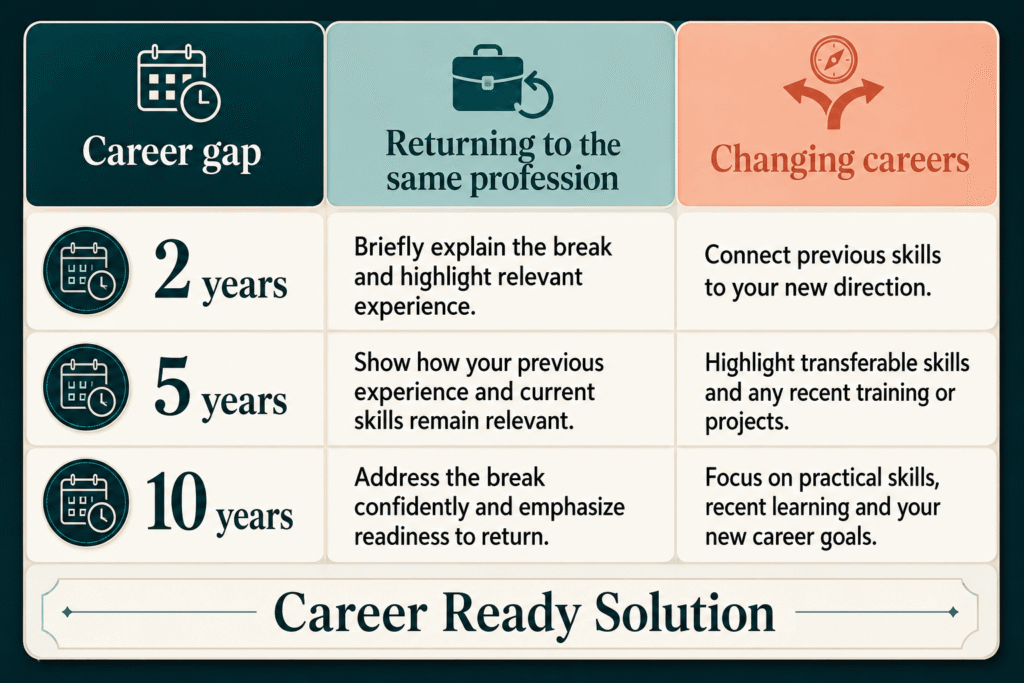
How to Explain a 2, 5 or 10-Year Career Gap
The length of your career gap changes how much reassurance an employer may need—but it does not change the basic approach. Explain the reason briefly, show your current readiness and connect your experience to the job you want.
Use the wording below as a starting point and include training, volunteering or projects only when they are true.
|
Gap length
|
Returning to the same profession
|
Changing careers
|
|---|---|---|
|
2 years
|
Career Break — Family Responsibilities (2024–2026)
Took planned time away from full-time work for family responsibilities while maintaining knowledge of developments in (profession/industry). |
Career Transition and Professional Development (2024–2026)
Used this period to explore [new field], develop relevant skills and complete (course, project or certification). |
|
5 years
|
Career Break — Family Care (2021–2026)
Managed family responsibilities and recently refreshed professional knowledge through (training, industry research or practical project). Now prepared to return to (profession). |
Career Break and Career Transition (2021–2026)
Prepared to move from (previous field) into (target field) by developing transferable skills in (skills) and completing [relevant preparation). |
|
10 years
|
Career Break — Full-Time Caregiving (2016–2026)
Took an extended break for caregiving responsibilities. Recently updated skills in (area) and prepared to return to [profession] with previous experience in (specialism). |
Career Break and Professional Reinvention (2016–2026)
After an extended period devoted to family responsibilities, completed recent training in (field) and developed a clear plan to begin a career in (target role). |
For a long career gap, do not write a long explanation on your resume. Employers primarily need to see that you are honest about the timeline and prepared for the role now.
A longer career gap does not require a longer resume. Use this recruiter-led guide to decide what still deserves space on your resume.
What Recruiters Really Want to Know About Your Career Gap
When I ask a candidate about a career gap, I am not looking for an apology or a detailed account of their personal life. I am trying to understand four things:
- Why did the break happen? A brief and honest explanation is enough.
- Is the situation resolved or manageable? The recruiter wants to understand your current availability.
- Are your skills still relevant? Recent training, projects or previous experience can provide reassurance.
- Why are you returning now? Your answer should show clear motivation for this role and career direction.
Your objective is not to justify your past. It is to demonstrate that you are ready for what comes next.
How to Explain a Career Gap in an Interview
Your career-gap answer should be brief, confident and forward-looking. Aim for approximately 20–30 seconds rather than explaining every detail.
Use this four-part structure:
|
Step
|
What to say
|
|---|---|
|
1. Name the reason
|
Briefly explain why you stepped away.
|
|
2. Mention relevant activity
|
Include training, caregiving, volunteering or projects only if applicable.
|
|
3. Confirm your readiness
|
Make it clear that you are prepared to return.
|
|
4. Connect to the role
|
Explain why this position is the right next step.
|
You do not need to disclose private medical or family details. You can simply say that you stepped away for personal responsibilities and that your circumstances now allow you to return.
Avoid apologizing, speaking negatively about previous employers or giving a five-minute personal history.
Your career-gap explanation is only one answer. Use my complete guide to prepare the rest of your interview with a clear plan, including STAR stories and common questions.
How to answer Career Gap in Interview Examples – By Profession
When an interviewer asks “Can you explain this gap in your resume?” use these scripts. Each is tailored to your profession and includes metrics to show impact.
A well-written script can still fall flat if it sounds apologetic, vague or overly rehearsed. Review these interview mistakes that can undo a strong answer before you practise.
Examples of Interview Scripts while explaining Career Gap
If your gap was due to a specific reason like mental health, pregnancy, or travel, use these scripts to explain it with confidence and metrics.
Difficult Career-Gap Situations and What to Say
Not every career gap includes a certification, freelance project or impressive story. You can still explain your situation honestly and professionally.
When You Did Not Study, Freelance or Upskill
Do not invent courses, projects or consulting work. Focus on why you stepped away and why you are ready now.
“I stepped away from work to manage personal responsibilities that required my full attention. I did not work professionally during that period, but my circumstances have now changed, and I am ready to return. I am currently refreshing my knowledge of (area) and am confident that my previous experience remains relevant to this role.”
When You Have Multiple Career Gaps
Acknowledge the overall pattern without defending every month separately.
“My career includes two breaks. The first was for family care, and the second followed a relocation. Between those periods, I returned to work and continued building experience in (field). Both circumstances are now settled, and I am looking for a stable position where I can contribute long term.”
When Your Job Search Took Longer Than Expected
Long-term unemployment can happen because of layoffs, market conditions, relocation or difficulty finding the right role.
“My position was eliminated during restructuring, and my job search has taken longer than expected. During that time, I reviewed my approach, refreshed my knowledge of (skill) and remained focused on positions that match my experience. I am particularly interested in this opportunity because (specific reason).”
Once you have explained your gap confidently, do not let the interview end with silence. Prepare two or three questions recruiters remember for the right reasons.
Keep Your Career-Gap Story Consistent Everywhere
Your wording can change depending on the platform, but the essential facts should remain consistent. Conflicting dates or different explanations can create more concern than the career gap itself.
Suppose you took a three-year break for family care. Here is how the same information can be presented:
|
Where
|
Example Wording
|
|---|---|
|
Resume
|
Career Break — Family Care | 2022–2025 Took planned time away from full-time employment to manage family responsibilities.
|
|
Cover letter
|
From 2022 to 2025, I stepped away from full-time work for family responsibilities. I am now ready to return and apply my previous experience in (area) to this position.
|
|
LinkedIn
|
Career Break — Full-Time Family Care Focused on family responsibilities while maintaining an interest in developments within (industry).
|
|
Application form
|
Enter the correct employment dates and explain the period as “Career break — family responsibilities” where the form allows additional information.
|
|
Interview
|
“I took a planned three-year break for family responsibilities. My circumstances now allow me to return, and I am ready to bring my previous experience in (area) to this role.”
|
You do not need to copy the same sentence everywhere. However, keep these details consistent:
- The approximate dates
- The main reason for the break
- Any courses, projects or freelance work you claim
- Your current readiness to return
- The career direction you are pursuing
If you use AI to refine your wording, keep your dates, achievements and explanation truthful. Here is how to use ChatGPT without losing your real voice or creating a resume you cannot defend.
Consistency builds credibility. Being a recruiter, I want to see your honesty whether I read your resume, visit your LinkedIn profile or speak with you during the interview.
How to Fill the Career Gap – Freelance, Consulting, Self-Employment
Even if you weren’t formally employed, you may have been working – just not in a traditional role.
|
Type of Work
|
How to List It
|
|---|---|
|
Freelance projects
|
Freelance (Role) – Self-Employed
|
|
Consulting work
|
Consultant – Independent
|
|
Self-employment
|
Owner –(Business Name)
|
|
Volunteer work
|
Volunteer – (Organization)
|
Example: Freelance Content Writer – Self-Employed (2017–2020)
- Wrote blog posts for 5 clients in the tech industry
- Increased client organic traffic by an average of 45%
- Managed 7 client accounts simultaneously

Conclusion: Your Career Gap Does Not Define You
I started this guide with my own story: a five-year career break, the fear of returning during COVID-19 and the performance-based salary increase I received within eight months.
That experience taught me something important.
A career gap does not erase everything you achieved before it.
You do not need to rename it, hide it or turn it into an extraordinary success story. You simply need to explain what happened honestly, show that you are ready to return and bring the conversation back to what you can contribute now.
Still unsure how to connect your career break, previous experience and next role? Explore my personalized career advice for professionals starting again.
Whether you stepped away for family care, health, education, travel, relocation or an extended job search, that period is only one part of your professional story.
Ready to Take the Next Step?
- Prefer a ready-to-edit format? Shop my ATS-Friendly Resume Templates
Connect with me on LinkedIn for practical career advice shared with more than 60,000 professionals.
How Do You Explain a Career Gap on a Resume?
List a recent or significant gap as “Career Break — (Reason)” with dates. Add one or two bullet points covering relevant courses, certifications, volunteering, freelance work or responsibilities—only when they are true. Keep the explanation brief, factual and confident.
Example:
Career Break — Family Care | 2015–2020
- Earned an MS in Strategic Human Resource Management.
- Completed two relevant professional certifications.
- Stayed current through industry research and professional networking
Frequently Asked Questions
List it as “Career Break – [Reason]” with bullet points showing what you did during that time. Include courses, certifications, volunteering, or freelance work. Frame it as growth – not a pause.
Be open and honest. Focus on what you did during the gap – courses, volunteering, freelance, or personal projects. Highlight transferable skills you gained. Some people note these periods as “career break” or “family responsibility.”
Use this formula: (Brief reason) + (What you did during the gap) + (Why you’re ready to return). Example: “I took a career break to focus on family. During that time, I earned my MS and completed certifications. I’m now excited to return to work.”
Family care, health reasons, professional development, education, travel, layoff, personal growth, or career change.
List it as “Career Break – Family Care” and highlight transferable skills like budgeting, coordination, event planning, and communication.
“Career Break – Family Care (2015–2020). Earned MS in Strategic HRM, managed household budget, coordinated schedules, completed 2 certifications.”
Use a hybrid resume format – skills summary first, then experience. List your career break as a role with dates and bullet points. Frame it as growth, not a pause.
Be honest and positive. Example: “I took a career break to focus on professional development. I earned my MBA and completed certifications. I’m now fully ready to return and apply my updated skills.”
About the Author
Hira Riaz is an HR Consultant with 7+ years of experience hiring across tech startups, pharma, and NGOs. Having reviewed hundreds of resumes and interviewed candidates across roles, she brings real recruiter insights into what actually works in today’s job market.
She specializes in resume optimization, interview strategy, and career growth, helping professionals turn their experience into interview calls. She also shares practical career advice with 60,000+ professionals on LinkedIn.