Why Do Recruiters Ghost You? 11 Real Reasons
Why do recruiters ghost you? An HR consultant reveals 11 real reasons behind recruiter silence, plus what to do if you’ve been ghosted after an interview.
Author: Hira Riaz
Published On 28 August, 2026.

TABLE OF CONTENTS
Estimated read time 12 minutes.
Why do recruiters ghost candidates?
Recruiters ghost because they’re overwhelmed, stuck waiting on hiring managers, or avoiding difficult conversations. Sometimes the role was put on hold, canceled, or was never real to begin with. Other times, companies are just collecting resumes for projects they haven’t won yet. It’s rarely about you – it’s about a broken system. Send one polite follow-up after a week, then move on.
Recruiter Ghosting in 2026: My Experience and What the Data Reveals
I have sat on both sides of the hiring table: as a candidate who has been ghosted and as a recruiter who has gone quiet on candidates I genuinely liked.
Sometimes the role was paused. Sometimes the hiring manager had not made a decision. Sometimes I simply did not have an update to share.
Does that make the silence acceptable? No. Candidates deserve communication, especially after investing their time in an interview.
But understanding what happens behind the scenes can help you stop blaming yourself and respond more strategically.
Recent research shows how widespread the problem has become:
- 53% of job seekers experienced ghosting in the past year, up from 48% in 2025 and 38% in 2024, according to Criteria’s 2026 Candidate Experience Report, as reported by Fortune.
- 45% of workers have been ghosted during the hiring process, including 22% after one or more interviews, according to LiveCareer’s 2026 Ghosting Consequences Report.
- 80% of hiring managers admitted to ghosting candidates in a 2024 Resume Genius survey of 625 hiring managers.
These numbers confirm that recruiter ghosting is not an isolated experience. But they do not explain why it happens or how to keep moving when an employer goes silent. That is why you need a job search strategy that keeps opportunities moving.
Below are the 11 real reasons recruiters ghost candidates, based on what actually happens behind the hiring table.
Behind the Scenes: Business Realities Recruiters Cannot Control
After more than seven years in HR, reporting to CEOs and COOs and building HR departments from scratch, I have learned one important truth: recruiters often communicate decisions they do not control.
A hiring manager delays feedback. A budget gets frozen. A project is postponed. Leadership cannot agree.
Suddenly, the recruiter has no clear update to share.
Does that excuse silence? No. Candidates still deserve communication.
But sometimes the recruiter is not the decision-maker. They are simply the messenger caught between a frustrated candidate and an uncertain business.
Now, let me show you what is really happening behind the scenes
Reason 1: The Role Was Quietly Put on Hold or Cancelled
Sometimes recruiters stop responding because the position itself has disappeared.
I once guided a candidate through four hiring stages, including interviews and a technical assessment. Despite several rescheduled meetings, the candidate remained patient and genuinely interested.
Then the CEO told me: “We don’t need this position right now. We already have enough resources.”
The technical team had continued interviewing without final leadership approval. I eventually sent a rejection email, but I could not explain the internal disagreement behind it.
The candidate was not rejected for poor performance. The company simply decided it no longer needed the role.
Reason 2: Ghost Jobs — When Companies Advertise Without an Active Vacancy
“Ghost jobs” are real and they’re becoming more common.
Industry research in 2026 suggests that anywhere from 18% to 33% of online job listings may be ghost jobs, depending on the platform and industry. A 2024 Greenhouse report found that 18–22% of jobs posted on their platform are ghost jobs, positions advertised with no intent to hire.
And a January 2025 survey by Clarify Capital found that nearly 1 in 3 employers (roughly 33%) admitted to posting job listings with no intention of filling them in the short term.
Why do companies do this?
- To gauge salary expectations
- To collect resumes for future use
- To create the illusion of growth
- To signal to investors and competitors that they’re scaling
But there’s an uglier side to this.
Some companies post roles to show they are “relevant.” They want the market to think they’re growing. They take interviews, give feedback, and sometimes even hire – but the roles are never permanent.
Ghost jobs and fake job postings are not the same. A ghost job may come from a real company, while a fake listing may be designed to deceive applicants. Before applying or sharing personal information, check how to know if a job posting is fake.
What to do:
If a job posting stays up for months, keep applying elsewhere. Don’t wait for a company that’s just performing growth.
Reason 3: Candidates Were Collected for a Future Project
This is another hidden practice candidates never see coming.
Some companies start posting jobs way before they actually get a project. And, it’s not only about start-ups, major players count too.
They’re not hiring, but just collecting resumes and also taking interviews. Building a talent pipeline so that when they do win a project, they can finalize immediately and hit the ground running.
If they don’t get the project, they never call you back. They don’t tell you the role was contingent on a deal. They don’t admit they were just collecting resumes. They simply go silent.
Why they don’t tell you:
Because admitting “we don’t have the work yet” makes them look uncertain. It hurts their market reputation. So they keep you waiting sometimes for months, while they chase projects that may never come.
Reason 4: The Recruiter Sent Mass Outreach Without Checking Fit
Some recruiters reach out to dozens or hundreds of candidates at once. They’re not looking for you specifically. They’re casting a wide net to see who responds.
If you reply and they’re not interested, they’ll just stop responding. You weren’t ghosted – you were never really considered.
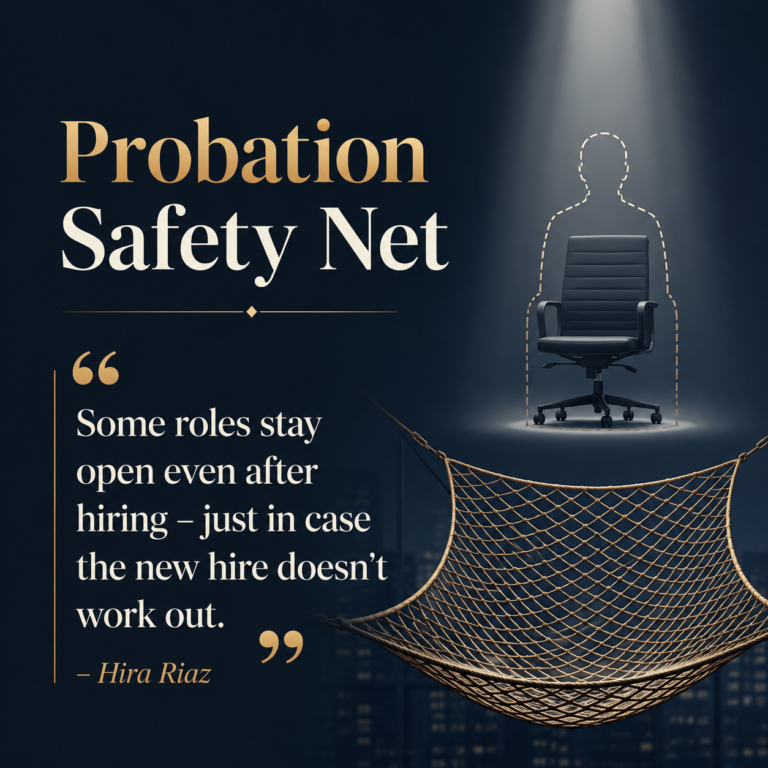
Reason 5: The Probation Safety Net – Keeping Job Roles Open "Just in Case"
Recently, one of my clients approached me on LinkedIn and shared her workplace story. Their HR department was hiring.
The company filled the position but keeps the role open, just in case the new hire doesn’t work out.
Why they do it:
- If the new hire leaves within the probation period, they don’t want to start from zero.
- If the new hire doesn’t perform, they want a backup list of candidates ready.
- It’s faster to interview pre-screened candidates than to post a new job later.
What it looks like from your side:
A role that’s always open but never filled. You apply and hear nothing. You follow up and get silence. You assume you were rejected but the truth is, the role was never actually available.
Reason 6: The Hiring Team Could Not Agree
This one hurts because it’s completely avoidable, yet it happens all the time.
While working as an HR officer, I spent four weeks interviewing internal and external candidates for an open position. Applicants prepared thoroughly, attended multiple interviews, and took time off work.
Then the hiring manager selected the internal candidate.
I asked, “If that was the preference all along, why did we interview everyone else?”
The external candidates never knew the real reason. They probably assumed they were not qualified, when the decision had little to do with their performance.
Sometimes, you were a strong candidate.
The company simply preferred someone already on the inside.
Reason 7: The Recruiter Was Managing Too Many Open Roles
Not every ghosting story is about internal politics or a frozen budget. Sometimes it really is the recruiter, not because they’re careless, but because they’re human, overworked, and often avoiding a conversation they don’t know how to have.
Here’s what’s actually going on when the silence is personal, not procedural.

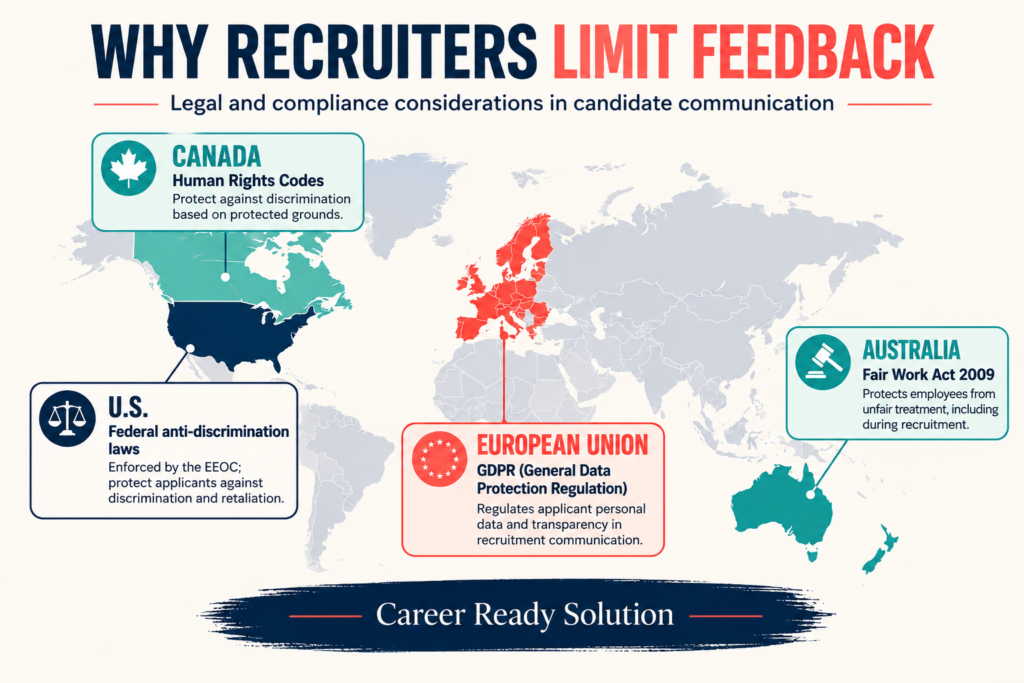
Reason 8: Fear of Giving Feedback (The Legal Risk – U.S., Canada, Australia & Europe)
Recruiters are scared to give feedback.Why? Legal risk.
If they say the wrong thing, it could lead to a lawsuit. If they say something vague like “you weren’t a good fit”, it doesn’t help you anyway.
And if they say something honest; “the hiring manager thought you were overqualified”, the candidate might argue or get defensive.
The result? Silence. Because silence is safe. Let’s see how it works in different countries:
🇺🇸 United States
In the U.S., employment counsel routinely advises against detailed feedback because of the risk of a claim under EEOC-enforced laws: Title VII of the Civil Rights Act, the Americans with Disabilities Act (ADA), and the Age Discrimination in Employment Act (ADEA). Any subjective comment can be used as the basis of a discrimination complaint, even when there was no discriminatory intent.
🇨🇦 Canada
The same caution applies in Canada under provincial human rights codes, like the Ontario Human Rights Code or the B.C. Human Rights Code, and the Canadian Human Rights Act for federally regulated employers. Legal and HR teams often instruct recruiters to give no feedback at all rather than risk a subjective comment being used against the company later.
🇦🇺 Australia
In Australia, several laws protect candidates from unlawful treatment during recruitment, including federal anti-discrimination laws and the Fair Work Act 2009 (Cth), which under section 351 prohibits adverse action against prospective employees for discriminatory reasons.
🇪🇺 European Union
In the EU, the legal landscape is even more complex. The Equal Treatment Directive (2006/54/EC) mandates that recruitment processes are free from discrimination based on gender in matters of employment and occupation. Additionally, the EU General Data Protection Regulation (GDPR) adds another layer of risk.
In Europe, a candidate can raise a formal GDPR Subject Access Request (SAR) to obtain their interview feedback. Article 15 of the GDPR allows individuals to access personal data held about them, which can include interview feedback, recruiter notes, and assessment scores — though companies sometimes withhold parts of this citing confidentiality or other exemptions.
Separately, GDPR Article 22 gives candidates another protection: the right not to be rejected by a fully automated hiring decision, like an AI screening tool, without human review.
Disclaimer: “This is general information, not legal advice. Consult an employment lawyer in your jurisdiction for guidance on a specific situation.”
Reason 9: Another Candidate Was Further Along
Recruiters rarely make hiring decisions alone. They’re waiting on:
- The hiring manager to review your resume
- The team to give feedback after your interview
- HR to approve the salary
- Finance to release the budget
- Leadership to sign off
Every person in that chain can delay the process. And the recruiter is the one who has to wait and then has to explain the delay to you.
But here's the catch
Most recruiters won’t tell you they’re waiting. They’ll just go silent until they have news.
Reason 10: Budget Approval or Hiring-Manager Feedback Was Delayed
The recruiter doesn’t have an update because the hiring manager hasn’t decided. Or because the team is still interviewing. Or because they’re waiting for approvals. They don’t want to say “I don’t know” so they say nothing.
Reason 11: Salary, Availability or Role Requirements Did Not Match
Some recruiters hate delivering bad news. They’d rather say nothing than say no.
I must accept that during my early days of recruitment, I’ve done this. I’ve delayed emails I didn’t want to send. We, humans, want to be good news senders and not otherwise.
I’ve avoided conversations I knew would be uncomfortable and every time, I regret it because silence is worse than rejection.
The lesson:
If you’re a recruiter, give the bad news. It’s the right thing to do. If you’re a candidate, don’t take silence personally. It’s often about the recruiter’s discomfort, not your qualifications.
What Recruiter Silence Means at Each Hiring Stage
Recruiter silence does not mean the same thing at every stage of the hiring process.
If you submitted an application and never spoke to anyone, your resume may not have been shortlisted. And, this is not Ghosting.
If employers stop responding before you reach the interview stage, it may be worth understanding why your resume is not getting shortlisted.
That is frustrating, but it is different from a recruiter who interviewed you, promised an update and disappeared.
If the silence happens immediately after you apply, the issue may be happening before a recruiter ever speaks with you. Check whether you’re using the right resume keywords for the job description.
Silence after an interview is not always a rejection, but you can strengthen your next opportunity by learning how to prepare for interviews with greater confidence .
Here is how to interpret the silence:
|
Hiring stage
|
What the silence may mean
|
What you should do
|
|---|---|---|
|
After submitting your application
|
Your application was not shortlisted, the role received many applicants, or hiring was paused.
|
Continue applying. Follow up once if you have a relevant contact.
|
|
After a recruiter contacted you first
|
The recruiter sent mass outreach, found stronger matches, or discovered a mismatch.
|
Send one short message after two to three business days.
|
|
After an initial screening
|
The recruiter may be waiting for hiring-manager feedback or reviewing other candidates.
|
Check the timeline you were given and follow up professionally.
|
|
After your first interview
|
Other interviews may still be underway, or the team may not have agreed on the next steps.
|
Wait until the promised update date, then send a polite follow-up.
|
|
After a final interview
|
Another candidate may be negotiating an offer, or internal approval may be delayed.
|
Request a clear status update while continuing your job search.
|
|
After a verbal offer
|
Compensation, budget, reference checks or final approvals may still be pending.
|
Ask when you can expect written confirmation. Do not resign or stop applying until the offer is confirmed.
|
If a recruiter says they are still interviewing other candidates, it is usually a process update rather than an automatic rejection. Here is how to interpret the message and decide when to follow up.
Being an HR professional for more than 7+ years, I would advise you that the later you are in the process, the more reasonable it is to expect an update.
Silence after a final interview deserves more follow-up than silence after an online application.
How Long Should You Wait Before Following Up?
The right follow-up timing depends on the stage of the hiring process and whether the recruiter gave you a specific deadline or not.
During an initial phone screening, ask when the company expects to complete interviews and when you should expect an update. These questions to ask a recruiter during a phone screen can help you establish the timeline before the call ends. For later interview rounds, use these questions to ask at the end of an interview.
If the recruiter said, “We will update you by Friday,” wait until Friday has passed. If you still have not heard back, send a short message after one or two business days.
If no timeline was provided, use this as a practical guide:
|
Situation
|
When to follow up
|
|---|---|
|
Recruiter contacted you, then stopped responding
|
After two to three business days
|
|
Initial phone screening
|
After three to five business days
|
|
First or second interview
|
After approximately five business days
|
|
Final interview
|
After five to seven business days
|
|
Verbal offer without written confirmation
|
After two to three business days
|
|
No response to your first follow-up
|
Send one final message after another four to five business days
|
These are guidelines, not fixed rules. Hiring can slow down during holidays, company restructures or when decision-makers are unavailable.
What matters most is the communication pattern. A recruiter who provides an honest update is dealing with a delay. A recruiter who repeatedly ignores reasonable follow-ups is showing you how the hiring process is being managed.
My HR advice
Follow up professionally, but never put the rest of your job search on hold.
What to Do When a Recruiter Ghosts You
Being ghosted can make you question your interview, your qualifications and even your career decisions. Before assuming the worst, take a step back and respond strategically.
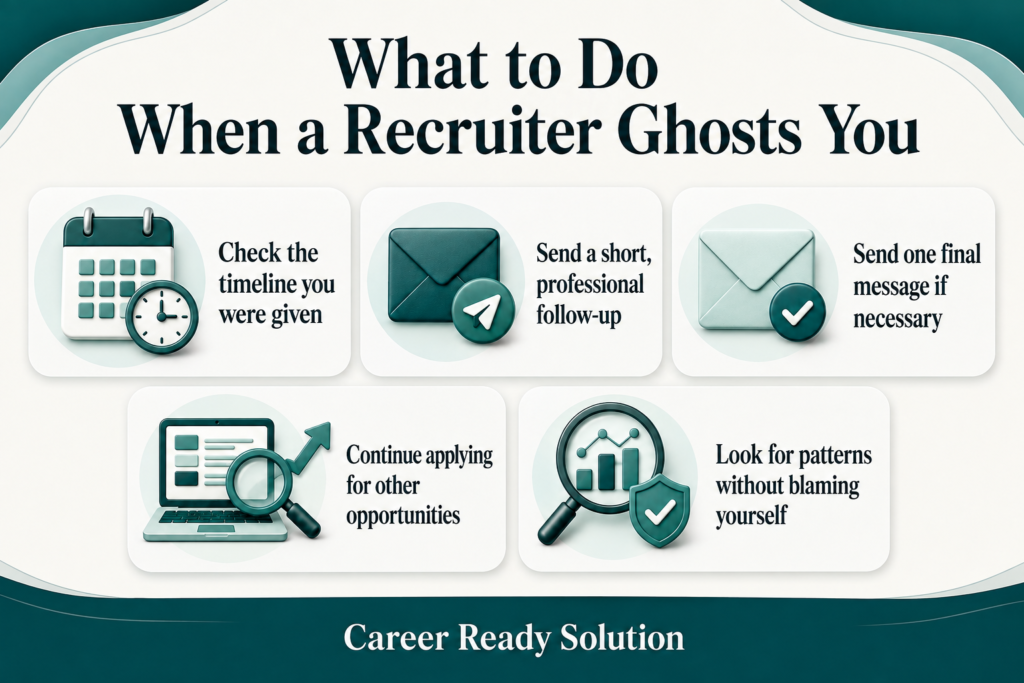
1. Check the timeline you were given
Review your previous emails and interview notes. If the recruiter said the process would take two weeks, three days of silence does not necessarily mean you have been ghosted.
If the recruiter says they are still interviewing other candidates, it is usually a hiring-process update—not an automatic rejection. Here is what the message means and how you should respond.
2. Send a short, professional follow-up
Mention the position, the date of your last conversation and your continued interest. Keep your message calm and direct.
Avoid writing, “Why are you ignoring me?” Even when your frustration is justified.
3. Send one final message if necessary
If your first follow-up receives no response, wait seven business days before sending one final check-in.
After that, stop chasing.
Repeated calls, daily emails or messages to multiple employees can damage your professional image.
4. Continue applying for other opportunities
A promising interview is not a job offer. Until you have a confirmed written offer, keep applying, networking and speaking with other employers.
5. Look for patterns without blaming yourself
If several recruiters disappear after the same stage, review what might be happening.
If you rarely receive interview invitations, check whether your resume is optimized to pass ATS screening and reach recruiters. If your applications are not closely matching the roles you want, learn how to identify the resume keywords employers actually look for.
And if your resume does not immediately communicate your strengths, explore these professional summary examples that highlight your value.
Sometimes there is something you can improve. Sometimes the hiring process is simply poorly managed. The important thing is to focus on what you can control.
Follow-Up Messages You Can Copy
A good follow-up message does not need to be long. It should remind the recruiter who you are, mention the role and ask for a clear update.
When a Recruiter Contacted You First
Subject: Following Up on the (Job Title) Opportunity
Hi (Recruiter’s Name),
Thank you for contacting me about the (Job Title) position. I wanted to follow up and check whether the opportunity is still active.
I remain interested and would appreciate any update on the next steps.
Best,
(Your Name)
After an Interview With No Update
Subject: Following Up on My Interview for (Job Title)
Hi (Recruiter’s Name),
I enjoyed speaking with you about the (Job Title) position on (Date). I am following up to see whether there are any updates regarding the hiring process or next steps.
I remain interested in the opportunity and would appreciate an update when available.
Best,
(Your Name)
Final Follow-Up When You Have Not Received a Response
Subject: Final Check-In Regarding (Job Title)
Hi (Recruiter’s Name),
I wanted to check in one final time regarding the (Job Title) position. I understand hiring priorities can change, but I would appreciate knowing whether I am still being considered.
If the role has been filled or the process has been paused, a brief update would be helpful.
Thank you,
(Your Name)
Keep your tone professional, even if the experience has been disappointing. You are asking for clarity, not permission to move forward.
What If the Recruiter Comes Back?
Sometimes recruiters reappear after days or weeks of silence.
If the recruiter reconnects and schedules another interview, take a moment to review interview mistakes that quietly cost candidates opportunities.
They may explain that the role was paused, the hiring manager was unavailable, or another candidate declined an offer. In some cases, you were a backup candidate and the company is now reopening the conversation.
The important question is not simply whether you should reply. It is whether the opportunity still makes sense for you.
Before moving forward, ask:
- Is the position currently approved and actively hiring?
- What caused the delay?
- What stage is the hiring process at now?
- What are the next steps and expected timeline?
- Have the salary, responsibilities or working arrangements changed?
You can respond professionally without pretending the silence never happened:
Subject: Re: (Job Title) Opportunity
Hi (Recruiter’s Name),
Thank you for getting back to me. I am open to discussing the [Job Title] position further.
Before moving ahead, could you please confirm whether the role is actively hiring and share the expected timeline for the next steps?
Best,
(Your Name)
A delayed response does not automatically mean the company is a bad employer. However, repeated silence, vague explanations and changing promises are valid reasons to proceed carefully.
Remember: you are evaluating the employer too.
Conclusion: Recruiter Ghosting Is Not Always About You
After years in HR, I have seen qualified candidates lose opportunities because roles were cancelled, internal candidates were preferred, or hiring managers delayed decisions.
Often, recruiters are caught between candidates who deserve answers and business decisions they cannot control. Does that excuse poor communication? No. But it does mean the silence is rarely a reflection of your abilities.
Keep applying, follow up professionally, and do not let one unanswered message define your confidence.
Tired of sending applications that go nowhere? Start with my Job Search Strategy Guide.
Worried your resume is holding you back? My ATS-Friendly Resume Guide will help you fix it. And if interviews leave you second-guessing yourself, my Interview Preparation Guide will help you prepare with confidence.
If repeated silence has made you question your entire approach, explore personalized career advice to regain clarity and confidence.
Connect with me on LinkedIn for career advice trusted by more than 60,000 professionals.
Why do recruiters ghost candidates?
Recruiters ghost because they’re overwhelmed, stuck waiting on hiring managers, or avoiding difficult conversations. Sometimes the role was put on hold, canceled, or was never real to begin with. Other times, companies are just collecting resumes for projects they haven’t won yet. It’s rarely about you – it’s about a broken system. Send one polite follow-up after a week, then move on.
KEY TAKEAWAYS
|
|
|
|---|---|
|
1
|
Recruiters take the blame for a broken system. Budget freezes, leadership misalignment, and project delays are often out of their control.
|
|
2
|
Some companies post jobs before they have projects. They're collecting resumes in case they win work. If they don't win, they never call you back.
|
|
3
|
Some companies keep roles open even after hiring – because the new hire is on probation. If the new hire doesn't work out, they want a backup list ready.
|
|
4
|
Some companies post roles to look busy. They interview candidates but never make roles permanent. It's a performance.
|
|
5
|
Legal risk is a real factor – in the U.S. (EEOC laws), Canada (human rights codes), Australia (Fair Work Act, AHRC), and Europe (GDPR, Equal Treatment Directive), companies are terrified of lawsuits, so they say nothing.
|
|
6
|
Send one polite follow-up after 5–7 days – then a second after another week. Then move on.
|
|
7
|
Don't burn bridges – the same recruiter might contact you again.
|
|
8
|
Focus on what you can control – your resume, your networking, your interview prep.
|
Frequently Asked Questions
They’re overwhelmed, waiting on hiring managers, avoiding conflict, or dealing with internal misalignment. It’s rarely personal.
1–2 weeks is typical. After that, a follow-up is reasonable. If you still don’t hear back after two follow-ups, assume they’re not interested.
Legal risk (EEOC, human rights codes, GDPR, Fair Work Act), time constraints, and fear of conflict. Most companies have policies against giving detailed feedback.
No – two follow-ups max. After that, you’re crossing into “annoying” territory.
You can apply to other roles at the same company later. But don’t keep chasing the same recruiter.
It’s rarely personal – usually internal chaos. The role may have been filled internally, put on hold, or the recruiter is stuck waiting on slow feedback from hiring managers. They’re also overwhelmed and simply forget to close the loop. Sometimes, they found a better candidate but don’t know how to tell you.
This happens when internal dynamics shift – budget freezes, restructuring, or a last-minute internal hire. The recruiter may have been overruled or is stalling because the company is still undecided. It’s unprofessional, but it’s often beyond the recruiter’s control.
Mostly because of automated mass outreach – recruiters send generic messages to hundreds of candidates and don’t follow up. Up to 30% of job postings are “ghost jobs” anyway. They’re checking interest, not actually hiring. If you respond and they go silent, it’s likely they were never serious about you specifically.
Send a polite email: “I understand if you can’t share details, but I’d appreciate any insight you can offer.” Don’t expect a response.
About the Author
Hira Riaz is an HR Consultant with 7+ years of experience hiring across tech startups, pharma, and NGOs. Having reviewed hundreds of resumes and interviewed candidates across roles, she brings real recruiter insights into what actually works in today’s job market.
She specializes in resume optimization, interview strategy, and career growth, helping professionals turn their experience into interview calls. She also shares practical career advice with 60,000+ professionals on LinkedIn.