
Career Ready Solution

How to Know If a Job Posting Is Fake: 12 Red Flags and Verification Steps


Author: Hira Riaz
Published On 28 Sept, 2026.

TABLE OF CONTENTS

Is It a Fake Job, a Ghost Job or an Expired Listing?
12 Red Flags of a Fake Job Posting
How to Verify a Job Posting in Five Minutes
How to Spot Fake Job Postings on Indeed and LinkedIn
What Legitimate Recruiters Do—and What Scammers Try to Copy
What to Do If You Already Applied to a Fake Job
How to Report a Fake Job Posting
Conclusion: Verify Before You Apply

Estimated read time 9 minutes.

How do you know if a job posting is fake?

Verify that the vacancy appears on the company’s official careers page, confirm the recruiter’s identity and inspect the email domain carefully. Stop if anyone asks you to pay a fee, purchase equipment, deposit a check or provide banking details before verified onboarding. One unusual detail may not prove fraud, so evaluate the entire hiring process before sharing personal information.

Knowing how to tell if a job posting is fake can protect your money, personal information and valuable job-search time.

In more than seven years of my HR and recruitment, I have managed hiring processes and communicated with candidates at every stage. One unusual detail does not always mean a vacancy is fraudulent. However, when several warning signs appear together, it is time to pause and investigate.

Before applying, look at the whole picture. Check the job description, company website, recruiter’s identity, interview process and offer details.

Spotting scams is only one part of protecting yourself. You also need a safer job-search system for finding genuine opportunities.

Is It a Fake Job, a Ghost Job or an Expired Listing?

Not every suspicious listing is a scam. Understanding the difference helps you respond appropriately.

Listing Type
What It Means
Main Warning Sign
Fake job scam
A criminal or impersonator created the vacancy to collect money or information (scam)
Payment, identity theft or check request
Ghost job
A real company posts a role it may not currently intend to fill (not a scam, but wastes your time)
Listing remains open with no genuine hiring activity
Expired listing
The position was filled or closed, but the advertisement remains online (not a scam)
Vacancy is absent from the current careers page
Talent-pipeline listing
A company collects candidates for present or future openings (not a scam, if explained honestly)
No definite hiring date

A ghost job may waste your time without being a criminal scam. Here is what may really be happening when an employer advertises a role and then goes silent.

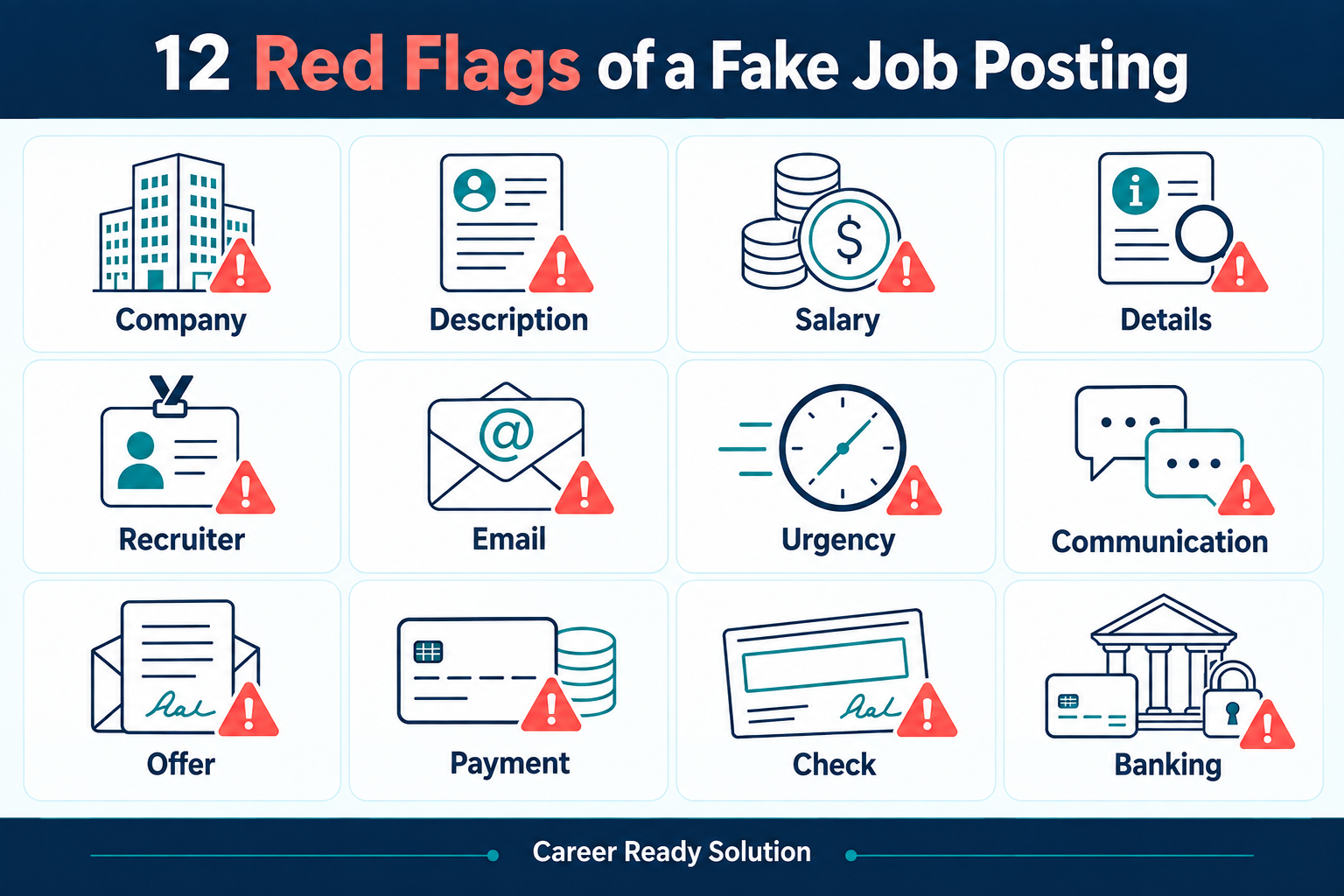
12 Red Flags of a Fake Job Posting

Some fake postings are obvious. Others are convincing enough to fool experienced job seekers. Here are the 12 red flags I’ve seen most often, drawn from years of sitting on the other side of the hiring process.

Warning Signs Inside the Job Advertisement

🚩

The company has no verifiable website or online presence.

A legitimate employer has a professional website, a physical address and some online footprint. If you can't find them anywhere else, proceed with extreme caution.

🚩

The job description is extremely vague, copied or inconsistent.

Scammers often reuse generic text. Look for contradictions in salary, location or responsibilities.

🚩

The salary is unusually high for the experience required.

If it sounds too good to be true, it probably is. Compare the offer with market rates for similar roles.

🚩

The company name, location or job details change across platforms.

Check if the listing appears consistently across different job boards and the company's website.

🚩

Perfect grammar does not prove legitimacy.

Scammers can now produce polished advertisements via AI, so don't rely on language quality alone.
Warning Signs in Recruiter Communication

🚩

The recruiter uses an unrelated or lookalike email domain.

A legitimate company email ends with their official domain. Watch for misspellings like @companny.com instead of @company.com.

🚩

You cannot verify the recruiter's identity or connection to the company.

Search for them on LinkedIn. Check if they appear on the company's website or have a legitimate employment history.

🚩

They create extreme urgency or pressure you to respond immediately.

Scammers rush you to prevent careful thought. Legitimate recruiters respect your time.

🚩

They insist on communicating only through text, Telegram or another informal channel.

Nuance: Gmail, WhatsApp or text communication alone does not automatically prove fraud—especially with independent recruiters—but the recruiter and vacancy must still be independently verified.

Scam Signals During the Interview and Job Offer

🚩

You receive an offer without a genuine interview.

Real employers evaluate your skills. An immediate offer without any assessment is suspicious.

🚩

You are asked to pay for training, equipment, software or background checks.

Legitimate employers cover these costs. If you're asked to pay, stop.

🚩

The employer sends a check and asks you to purchase equipment or return money.

This is a classic scam. The check will bounce, and you'll lose the money you sent.

🚩

You are asked for banking details, passwords or sensitive identification too early.

These details are requested during formal onboarding—not before an offer.
Suspicious Sign or Definite Job Scam?

Not every strange detail means the job is fake. Sometimes you just need to check further. But some signs clearly tell you to stop.

This table will help you understand the difference

Situation Risk Level Recommended Response
Recruiter uses WhatsApp but has a verifiable company identity Verify carefully Continue only after confirming the recruiter
Vacancy is not on the company website Suspicious Contact the company independently
Salary appears unusually high Suspicious Compare it with market rates
Interview happens only by text High risk Request a video or formal interview
Employer asks you to pay money Stop immediately Do not pay or continue
Employer sends a check for equipment Stop immediately Do not deposit or transfer money
Recruiter requests banking information before an offer Stop immediately End contact and report it

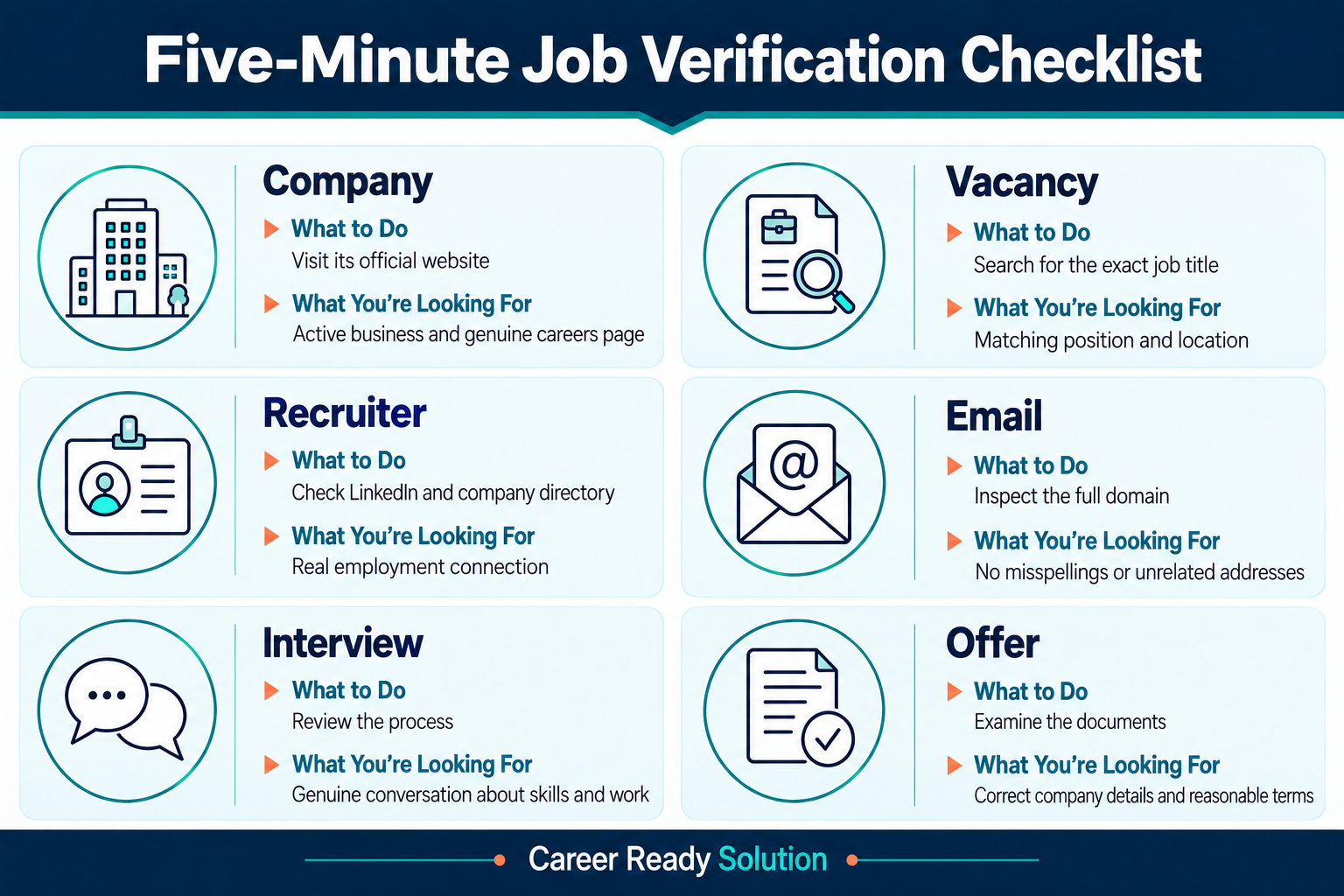
How to Verify a Job Posting in 5 Minutes

You don’t need hours of research to spot a scam. These five quick checks can confirm whether a posting is legitimate before you spend time applying.

Check the Company's Official Careers Page

Search for the role directly on the company's website. Do not rely only on the advertisement link. A vacancy may occasionally be confidential or handled through an agency, so an absent listing requires verification—not an automatic scam conclusion.

Verify the Recruiter's Identity and Email Domain

Check:

  • The company's LinkedIn profile
  • The recruiter's employment history
  • The company email domain
  • Lookalike spellings (e.g., @companny.com)
  • Website creation date and contact details
  • Whether the recruiter is an authorized staffing agency

Compare the Job Description Across Different Sources

Check whether the title, salary, location, responsibilities and company name remain consistent across platforms. Inconsistencies are a warning sign.

Contact the Employer Independently

Do not use the phone number or link supplied by the suspicious recruiter. Find the company's official contact information independently.
Five-Minute Job Verification Checklist

Once you verify the company, use the interview to investigate the opportunity further with questions that reveal how the role, team and employer really operate.

How to Spot Fake Job Postings on Indeed and LinkedIn

Scammers exploit each platform’s weaknesses differently. Having reviewed job postings on both Indeed and LinkedIn for years, here’s what separates a real listing from a fake one on each.

How to Know If a Job on Indeed Is Real

Appearing on Indeed does not replace independent verification.

What to do:

  • Visit the employer's official careers page
  • Compare the Indeed listing with the company listing
  • Inspect the employer profile and posting history
  • Never send payment through instructions received from a listing
  • Report suspicious advertisements through the platform

How to Spot Fake Job Postings on LinkedIn

Check:

  • Whether the recruiter genuinely works for the company
  • Profile history, activity and connections
  • The company page through a separate search
  • Do not trust a profile only because it contains a photograph and company logo
  • Confirm the role outside LinkedIn before sharing sensitive information

What Legitimate Recruiters Do—and What Scammers Try to Copy

As an HR Manager who has recruited across pharma, NGOs and tech startups, I’ve seen both legitimate hiring processes and suspicious imitations. Here’s what a normal recruitment process looks like:

The recruiter can explain the role and company in detail. Candidates receive an opportunity to ask questions. Skills and experience are evaluated genuinely. Salary and employment terms remain consistent. Official documents identify the actual employer. Candidates are never asked to pay for the opportunity.

I once encountered a suspicious vacancy on a job board. The recruiter claimed to represent a company I knew well. But the email domain was wrong—@companycareers.net instead of @company.com. I contacted the company directly. They confirmed the posting was fake.

That single verification step saved me from wasting time on a fraudulent process.

If the hiring process checks out, shift from investigation to preparation with my recruiter-led playbook for handling the real interview.


Normal Hiring Step vs. Suspicious Imitation

Scammers often mimic real hiring processes closely enough to seem legitimate at first glance, which is exactly what makes them dangerous. 

The table below breaks down what a normal step actually looks like versus the red flags that signal an imitation designed to steal your information or money.

Legitimate Hiring Practice
Suspicious Imitation
Recruiter discusses your experience
Recruiter offers the role without assessing you
Interview is scheduled formally
Interview consists only of text messages
Employer provides clear role details
Information changes during each conversation
Equipment is supplied according to company policy
Candidate must purchase equipment using a mailed check
Banking details are requested during verified onboarding
Banking details are requested before a formal offer

What to Do If You Already Applied to a Fake Job

If you’ve already submitted an application or shared personal details, quick action matters more than panic. Here’s what I recommend to candidates in this exact situation.

What You Shared and What to Do Next
What You Shared
What to Do
Resume and email address
Watch for phishing messages and unexpected recruiter contact
Password
Change it immediately anywhere it was reused
Identification documents
Contact the appropriate identity-theft authority and monitor your accounts
Banking information
Contact your bank immediately
Money
Contact your bank or payment provider and report the transaction
Deposited check
Do not transfer money; inform your bank that the check may be fraudulent
Login through a suspicious link
Change passwords and enable multifactor authentication

Disclaimer: This is general guidance. Consult local legal or fraud authorities for specific advice.

How to Report a Fake Job Posting

Reporting a fake posting helps protect other job seekers from falling into the same trap. Here’s how to do it on the major platforms.

Report the Listing to the Job Platform

Report the suspicious vacancy to Indeed, LinkedIn or the platform where it appeared.

Notify the Company Being Impersonated

Contact the real company. This helps them warn other candidates.

Report Money or Identity Theft

If repeated suspicious opportunities have left your search without direction, turn scattered applications into a focused career plan.

Conclusion: Verify Before You Apply

Not every unusual detail means a job posting is fake. Sometimes information is missing, a recruiter is working independently or the company has not updated its careers page. That is a reason to investigate further, not immediately assume the worst.

But some warning signs are too serious to ignore. If someone asks you to send money, deposit a check or share banking information before a verified offer and formal onboarding, stop and investigate.

Before applying, take a few minutes to:

  1. Visit the company’s official careers page and confirm that the position exists.
  2. Verify the recruiter through LinkedIn, the company website or its official directory.
  3. Never pay someone to secure a job or purchase equipment from a supplier they have selected.

Protecting yourself does not require hours of research. Five careful minutes could save you from wasted time, financial loss and identity theft.

If you want a complete system for finding and evaluating genuine opportunities, follow my step-by-step Job Search Strategy.

Want a quick checklist you can use before every application? Download my Fake Job Warning Guide and keep it nearby while you search.

Once a vacancy passes your checks, the next step is making sure your application gets noticed. Start with a resume framework designed for ATS screening.

How do you know if a job posting is fake?

  • Verify that the vacancy appears on the company’s official careers page, confirm the recruiter’s identity and inspect the email domain carefully.
  • Stop if anyone asks you to pay a fee, purchase equipment, deposit a check or provide banking details before verified onboarding.
  • One unusual detail may not prove fraud, so evaluate the entire hiring process before sharing personal information.

Frequently Asked Questions

Check the employer’s official careers page, compare listing details and verify the recruiter independently. Appearing on Indeed does not prove legitimacy—the company itself must be verified.

Check recruiter profiles, company pages, employment history, email domains and suspicious external links. A polished profile with a company logo is not proof of legitimacy—verify independently.

Confirm the vacancy on the company website. Verify the recruiter’s identity. Check the interview process and offer terms. If you’re asked to pay money, stop.

Scammers use large job platforms to reach many applicants and obtain money, personal information or banking details. Indeed does not create these listings—they are posted by scammers impersonating employers.

Reddit can reveal patterns and other candidates’ experiences. But individual comments are not proof. Always verify information through the company and official sources.

A ghost job is posted by a real company that may not currently intend to fill it. The listing remains open without active hiring. This is usually not a scam, but it wastes your time.

There is no single verified percentage that applies to every platform, industry and country. Estimates vary widely. Instead of relying on a statistic, verify each job independently.

Yes. Job scams and company impersonation are genuine concerns, particularly with remote hiring. The FTC reports that job scam losses have increased significantly in recent years. Always verify before applying.

About the Author

Hira Riaz is an HR Consultant with 7+ years of experience hiring across tech startups, pharma, and NGOs. Having reviewed hundreds of resumes and interviewed candidates across roles, she brings real recruiter insights into what actually works in today’s job market.

She specializes in resume optimization, interview strategy, and career growth, helping professionals turn their experience into interview calls. She also shares practical career advice with 60,000+ professionals on LinkedIn.

3 may 2026 about the author