Career Ready Solution

How to Stay Motivated During a Long Job Search - (Step by step scan of Job search with solution)


Author: Hira Riaz
Published On 22 Sept, 2026.

TABLE OF CONTENTS

How Do You Stay Motivated During a Long Job Search?

Are You Burned Out – or Is Your Job-Search Strategy Not Working?

Diagnose Where Your Job Search Is Getting Stuck
What to Change After 30, 60 or 90 Days of Job Searching
Build a Job-Search Routine You Can Actually Sustain
What Recruiters Know That Job Seekers Cannot See
Choose a Motivation Plan That Matches Your Situation
How to Protect Your Confidence During Rejection, Ghosting and Waiting
Conclusion: You Do Not Need More Pressure – You Need a Workable System

Estimated read time 13 minutes.

From 47 Applications to One Referral: What My Own Job Search Taught Me

I remember the day I hit “apply” for the 47th time that month. Same resume, different company name. My inbox stayed empty.

Then I got a job – not through an online application, but through a referral from a former colleague. That one referral opened a door I couldn’t open alone.

That experience changed everything. I realized that the “spray and pray” method was broken. And I wasn’t the problem.

I restarted my career in an NGO. From there, I moved to a tech startup, then into consulting. Each transition taught me something new about how job searching really works.

That experience taught me that motivation lasts longer when it is supported by a system. My recruiter-tested job-search strategy for finding hidden roles and earning referrals explains how to build that system. 

A long job search becomes exhausting when your effort produces little feedback. After weeks of applications and silence, you may start applying everywhere out of panic—or avoid applying altogether.

This guide is not about toxic positivity. It’s not about “just stay positive” or “keep grinding.” It’s about building a job search you can actually sustain without losing yourself in the process.

Are You Burned Out – or Is Your Job-Search Strategy Not Working?

This is the most important question you can ask yourself. The answer changes everything.

Signs You Are Experiencing Job-Search Burnout
Sign What It Looks Like
You dread opening your laptop Even the thought of checking email feels exhausting
You feel numb after rejections Instead of disappointment, you feel nothing
You compare yourself obsessively Everyone else is getting jobs. Why not you?
You have physical symptoms Headaches, low energy, trouble sleeping, brain fog
You've lost interest in hobbies Things you used to enjoy now feel pointless

If you recognize these signs, you're not alone. And you're not weak. You're human.

Signs Your Strategy Needs to Change
Sign What It Looks Like
You're applying to 20+ jobs a week Quantity over quality – you've stopped tailoring
You're using the same resume for every job No tailoring, no keywords, no effort
You're not getting any interviews Your applications aren't landing
You're not networking You're hiding behind your computer
You're applying to jobs you don't want You've given up on targeting
When Burnout and an Ineffective Strategy Are Happening Together

This is the most common scenario – and the most dangerous. You're burned out because your strategy isn't working, and your strategy isn't working because you're burned out.

The way out is to pause, diagnose, and reset.

Job-Search Burnout vs Ineffective Strategy
What You Experience Likely Cause What to Do Instead
Dread opening laptop, exhausted before starting Burnout – chronic stress Take 2-3 days completely off. No LinkedIn, no email
Applying to 20+ jobs a week, no responses Strategy too broad Pause and audit your resume. Is it tailored?
Getting interviews but no offers Weak interview preparation Practice STAR stories. Record yourself. Get feedback
Feeling numb after rejections Emotional exhaustion Acknowledge the feeling, take a short break
Not hearing back after follow-ups Strategy lacks persistence Send one follow-up, then move on
Constantly comparing to others Identity tied to job Limit LinkedIn time. Focus on what you can control

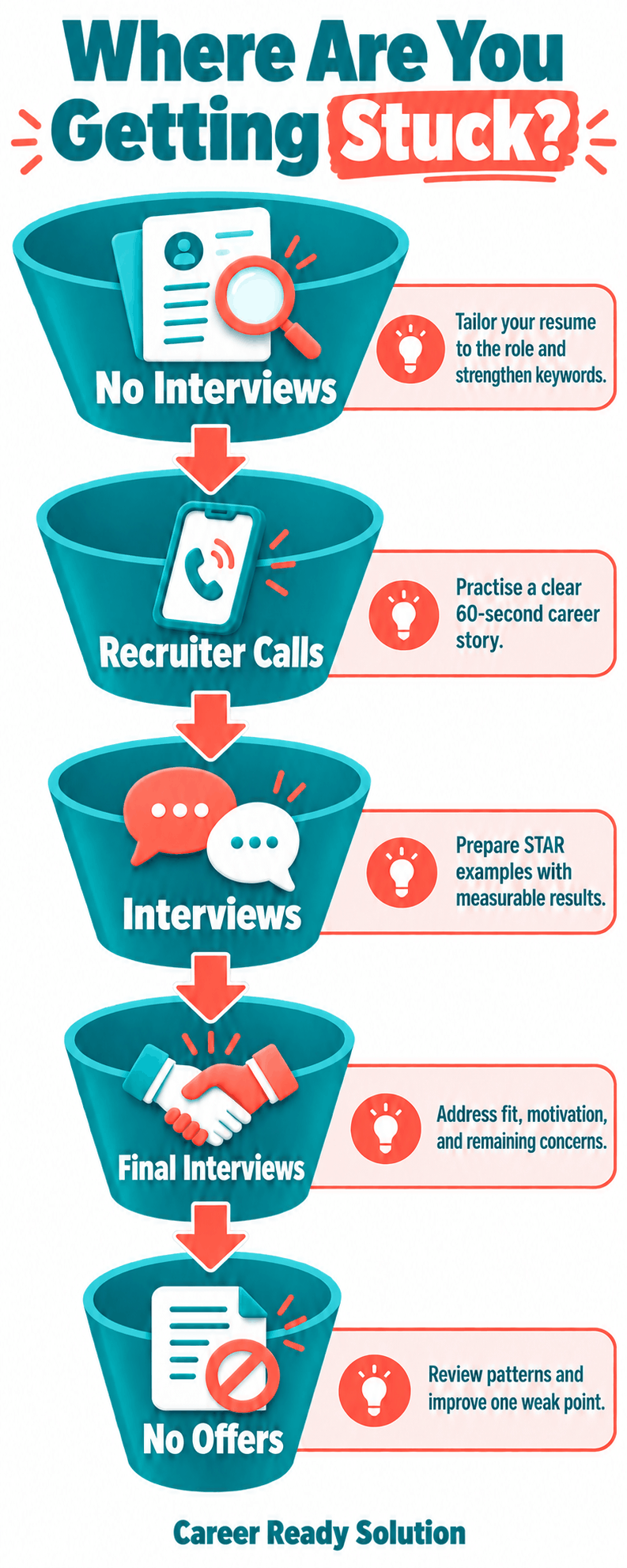
Diagnose Where Your Job Search Is Getting Stuck

Most candidates don’t know where their job search is failing. And, I am not saying this in a void. Almost daily, I get DMs on LinkedIn from professionals who are tired of the job searching process. 

They just know it’s failing. Here’s a framework to diagnose exactly where you’re getting stuck.

You Are Applying but Receiving No Interviews
Potential Problem What to Review Next Action
Your resume isn't tailored to the role Resume content, keywords, ATS optimization Pull keywords from the job description. Rewrite your summary and bullet points
You're not meeting the minimum qualifications Job requirements, your experience Target roles where you meet at least 70% of the requirements
You're not using the right keywords ATS keyword matching Use Jobscan or similar tools. Copy keywords from the JD
Your resume has formatting issues ATS-friendly formatting Save as .docx. Use standard headings. No columns, tables, or graphics

Before assuming the market has rejected your experience, check the quiet resume problems that stop strong candidates from getting shortlisted.

You Receive Recruiter Calls but Do Not Reach the Next Round
Potential Problem What to Review Next Action
Your positioning isn't clear "Tell me about yourself" answer Craft a 60-second answer that connects your experience to the role
Salary expectations are misaligned Your salary range vs. their budget Research market rates. Give a range, not a single number
Availability doesn't match Start date, work location, remote/hybrid preferences Be flexible where possible. Clarify expectations early
Your phone presence is weak Nervousness, unclear answers Practise with a friend. Record yourself. Slow down and breathe
You Attend Interviews but Receive No Offers
Potential Problem What to Review Next Action
Weak examples (no STAR) Your behavioral interview answers Prepare 5-7 STAR stories covering leadership, problem-solving, and teamwork
Poor communication Rambling, unclear answers, no structure Practise aloud. Time your answers (1-2 minutes). Use STAR
Lack of role-specific evidence No proof you can do the job Bring specific examples. Quantify achievements
Insufficient preparation Company research, interviewer background Spend 30 minutes researching before every interview

Repeated interviews without an offer do not prove that you lack value. Start by checking the interview habits that quietly cost qualified candidates the offer.
Interview preparation guidance for candidates who receive no job offers
You Reach Final Interviews but Keep Getting Rejected
Potential Problem What to Review Next Action
You're not differentiating yourself What sets you apart from other finalists Define your unique value proposition. What can you offer that others can't?
You're not demonstrating business value How you'll solve their problems Connect your skills to their specific challenges. Use their language
Weak closing No strong final impression End with a memorable summary of why you're the right fit
Internal candidate was preferred You were the backup candidate Accept it and move on – it's not about you

Before your next final round ends, prepare questions that uncover hesitation and help you finish the conversation stronger.

You Cannot Find Enough Suitable Vacancies
Potential Problem What to Review Next Action
Your job titles are too narrow Job titles, industries, locations Broaden your search. Consider related roles or industries
You're only using job boards Job boards, company pages, networks Visit company career pages. Network with employees. Use LinkedIn search
You're not considering transferable skills Your skills vs. job requirements Identify skills that transfer across roles. Look for roles that need those skills
You're not leveraging the hidden market Unadvertised roles Reach out to hiring managers directly. Get referrals. Talk to your network
Guidance on finding suitable job vacancies and expanding your job search
Diagnose Your Job-Search Funnel
Your Result Likely Problem What to Do Next
No interviews Resume not tailored, wrong keywords Pull keywords from JD. Tailor your resume. Use ATS-friendly format
Recruiter calls, no next round Weak positioning, salary mismatch Craft a stronger "Tell me about yourself" answer. Research salary
Interviews, no offers Weak examples, poor communication Prepare 5-7 STAR stories. Practise aloud. Quantify achievements
Final interviews, no offers No differentiation, internal candidate Define your unique value. Connect skills to their challenges
No suitable vacancies Too narrow search, only job boards Broaden search. Visit company pages. Network. Reach out directly
Diagnose your job-search funnel and identify the next step in your job search

What to Change After 30, 60 or 90 Days of Job Searching

These are review points – not deadlines by which you “should” have received a job.

After 30 Days: Review Your Resume and Job Target
  • What to review: Your resume, LinkedIn profile, and target roles
  • What to change: Tailor your resume to each role. Update your LinkedIn headline and summary
  • Who can help: A mentor, former colleague, or career coach
  • What progress should look like: 3-5 tailored applications, 10-15 connection requests, 2-3 informational interviews

DO NOT rebuild your resume using random advice from different sources. Follow the complete ATS resume blueprint that connects formatting, keywords and recruiter readability. 


After 60 Days: Use Your Results to Find the Weakest Stage
  • What to review: Your job-search funnel – where are you losing candidates?
  • What to change: Focus on the weakest stage. If you’re not getting interviews, fix your resume. If you’re not getting offers, fix your interview skills
  • Who can help: A friend or colleague who can give honest feedback on your resume or interview performance

What progress should look like: Improvement in the weakest stage. More responses, more interviews, or better feedback


After 90 Days: Make a Strategic Reset Without Blaming Yourself
  • What to review: Everything – strategy, targeting, approach, and your wellbeing
  • What to change: Consider a pivot – new industry, new role, new approach
  • Who can help: A career coach or mentor.

What progress should look like: A clear plan for the next 30 days. Renewed energy and focus

30, 60 and 90 Day Job-Search Reset Plan

30-, 60- and 90-Day Job-Search Reset Plan ⌄
Time Searching What to Review & Change What Progress Should Look Like
30 days Review resume, LinkedIn, target roles. Tailor and refine. 3–5 tailored applications, 10–15 connection requests.
60 days Review your weakest stage (resume, interviews, networking). Improvement in the weakest stage – more responses or interviews.
90 days Review everything – strategy, approach, wellbeing. Clear plan for next 30 days. Renewed energy and focus.
Build a Job-Search Routine You Can Actually Sustain ⌄

Stop setting goals based on outcomes you can't control. Focus on what you can control.

Uncontrollable Goal Controllable Goal
"Get a job by next month" "Apply to 5 targeted roles this week"
"Get an interview" "Send 10 connection requests with personalized notes"
"Get an offer" "Practise interview answers for 30 minutes each day"

Choose Quality Applications Over Panic Applying

Indeed recommends aiming for 10-15 applications per week for an effective job search. That’s about 2-3 jobs per day.

Quality applications are:
  • Tailored to the specific role
  • With a resume that matches the job description
  • With a cover letter (if it adds value)
  • Followed up with a connection request or email
Panic applications are:
  • Sent to every job that matches a keyword
  • With the same resume for every role
  • Without any follow-up or networking
Quality over quantity. EVERY TIME.

The focused application also means speaking the employer’s language. Use my step-by-step method for finding the keywords employers and ATS actually search for to tailor your resume without stuffing it with unnatural phrases. 

What to Do When You Have No Motivation to Apply for Jobs

Your Regular-Energy Job-Search Plan
  • Apply to 2-3 targeted jobs per day
  • Send 5-7 connection requests
  • Practise interview questions for 15-20 minutes
  • Spend 30 minutes on industry reading or learning
Your Low-Energy “Minimum Viable” Job-Search Plan
  • Apply to 1 targeted job
  • Send 2-3 connection requests
  • Update one section of your resume or LinkedIn
  • Do 10 minutes of interview practise
  • Take a walk

A Sustainable Weekly Job-Search Schedule

Day Focus Area Key Activities
Monday Applications & Networking 2–3 applications, 3 connection requests, 15 min interview prep
Tuesday Follow-ups & Learning 2–3 follow-ups, 2 messages, 30 min skills development
Wednesday Applications & Resume 2–3 applications, 3 connections, update 1 resume section
Thursday Follow-ups & Prep 2–3 follow-ups, 15 min interview prep, 30 min learning
Friday Applications & Review 2–3 applications, 2–3 follow-ups, review week's progress
Saturday Rest No job search activities
Sunday Rest No job search activities

How to Stop Obsessing Over Your Job Search

I would suggest you give your job search a starting and finishing time. Your job search should not be your entire life.

Set specific hours – say, 9 AM to 1 PM, or 10 AM to 3 PM. When those hours are over, you’re done for the day.

Stop Checking Email and Application Portals Constantly

Checking your email every 10 minutes doesn't make responses come faster. It just makes you anxious.

Check your email twice a day – once in the morning, once in the afternoon. That's enough.

Use a "Follow Up Once, Then Move Forward" Rule

When you follow up and don't hear back, follow up once more – then move on.

Maintain a Life That Is Not Defined by Employment

  • Exercise. Read. Cook. Call a friend. Watch a movie.
  • Do things that remind you that you're a whole person – not just a job seeker.

What Recruiters Know That Job Seekers Cannot See

I often tell candidates that a rejection does not always mean you were unqualified. 

Being in HR and Recruitment for more than seven years, I’ve rejected qualified candidates for reasons that had nothing to do with their skills. 

For instance, Budget freezes,  Internal hires,  Team restructuring,  hiring managers who changed their mind.

Those same hidden factors also explain why recruiters sometimes go silent. If this has happened to you, understanding why recruiters ghost candidates and what their silence actually means can help you stop treating every unanswered application as a judgment on your ability.

A rejection is not a verdict on your worth. It’s often a verdict on circumstances you can’t see.

What Healthy Persistence Looks Like to a Recruiter

Healthy persistence is:

  • A polite follow-up after 5-7 days
  • A genuine interest in the role and company
  • Flexibility and professionalism
  • Respect for the recruiter's time

Unhealthy persistence is:

  • Daily follow-ups
  • Demanding feedback
  • Pushing for answers
  • Not accepting a "no"

When to Follow Up – and When to Move On

Follow up once. Wait 5-7 days. If you don't hear back, follow up one more time. After that, move on.

A recruiter who ghosts you is a recruiter who doesn't respect your time. You've dodged a bullet.

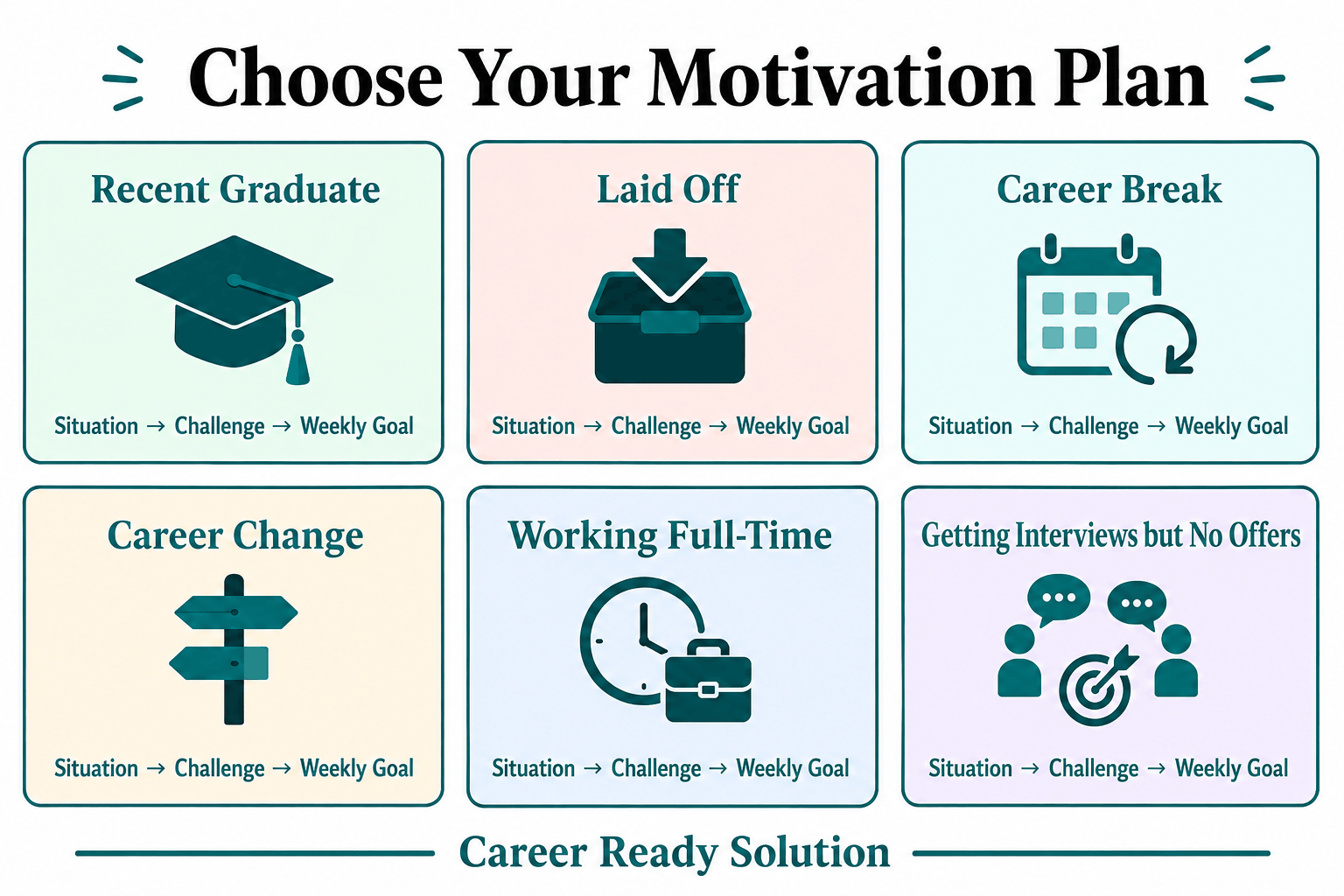
Choose a Motivation Plan That Matches Your Situation

Your Situation Main Challenge Sustainable Weekly Goal
Recent graduate with limited experience Imposter syndrome, lack of confidence Apply to 5 entry-level roles, attend 1 networking event
Laid off unexpectedly Shock, anger, loss of identity Apply to 3-5 roles, send 10 connection requests
Returning after a career break Fear of being outdated Apply to 3-5 roles, complete 1 certification
Changing careers Fear of starting over Apply to 3-5 roles, connect with 10 people in new industry
Job searching while working full-time Time pressure, burnout Apply to 3-5 roles, network during lunch breaks
Getting interviews but no offers Frustration, feeling close Practise 2 STAR stories daily, record yourself
If You Are a Recent Graduate With Limited Experience

You're competing against people with years of experience. That's frustrating. But you have something they don't: fresh perspective, energy, and the ability to learn quickly.

Focus on: Internships, projects, volunteering, and coursework. Frame these as experience. And don't be afraid to apply for roles that ask for 1-2 years of experience – often, they'll consider fresh graduates.

Your sustainable weekly goal: Apply to 5 entry-level roles, attend 1 networking event, connect with 10 alumni.

If limited experience is making it difficult to describe your value, these role-specific resume summaries built from projects, internships and measurable strengths will help you position yourself more clearly.

If You Were Laid Off Unexpectedly

This is one of the hardest situations. You didn't choose this. You've lost not just your job, but your routine, your identity, and often your confidence.

Give yourself time to process. It's okay to be angry, sad, or scared. You don't have to pretend you're fine.

Once you're ready, treat your job search like a job. Set hours. Take breaks. Don't let one bad day define your search.

Your sustainable weekly goal: Apply to 3-5 roles, send 10 connection requests, schedule 1 informational interview.

If You Are Returning After a Career Break

You might feel like you're starting from scratch. You're not. Your experience before the break still counts. And the skills you developed during your break – budgeting, coordination, communication, empathy – are valuable.

Reframe your break as a growth phase. You didn't pause your life. You grew in a different domain. Own it.

Your sustainable weekly goal: Apply to 3-5 roles, complete 1 certification, connect with 5 former colleagues.

If You Are Changing Careers

You're starting over in a new field – which means you're competing against people with more experience. But you bring something they don't: a fresh perspective and transferable skills.

Focus on what you can transfer. Your communication skills, your problem-solving ability, your work ethic – these transfer across industries.

Your sustainable weekly goal: Apply to 3-5 roles, complete 1 course, connect with 10 people in your new industry.

If You Are Job Searching While Working Full-Time

This is one of the hardest situations. You're already exhausted from your current job – and now you have to find time to look for a new one.

Protect your energy. You don't have to apply to 10 jobs a week. 3-5 targeted applications are enough. Use your lunch breaks for networking. Use weekends for resume updates.

Your sustainable weekly goal: Apply to 3-5 roles, network during lunch breaks, update your resume on weekends.

If You Are Getting Interviews but No Offers

This is the most frustrating stage. You're close – but not close enough.

Something is going wrong in the interview. Practice your STAR stories. Record yourself. Ask for feedback after each interview. Even if they don't give it, ask anyway.

Your sustainable weekly goal: Practise 2 STAR stories daily, record yourself, ask for feedback after each interview.

If You Are Getting Interviews but No Offers

How to Protect Your Confidence During Rejection, Ghosting and Waiting

Use a 24-Hour Job-Rejection Reset

When you get rejected, give yourself 24 hours to feel it. Be disappointed. Be frustrated. Be angry.

Then, reset. Identify one useful lesson from the experience. And move on.

The 24-hour rule: Feel it today. Learn from it tomorrow.

Confidence becomes easier to rebuild when you know exactly what to practise. My complete interview playbook—from STAR stories to confident follow-up gives you a structured place to begin.

Ask for Feedback Without Depending on Receiving It

Ask for feedback after every rejection. Most recruiters won't give it – but you should still ask. It shows you're open to growth.

How to ask:

"I understand if you can't share details, but I'd appreciate any insight you can offer. Thank you for your time."

If you don't get feedback, that's okay. The act of asking is valuable in itself.

Create an Evidence File of Your Skills and Achievements

When you're in the middle of a long job search, it's easy to forget how capable you are.

Create a file of your achievements. Every compliment you've received. Every project you've led. Every problem you've solved.

Read it when you're feeling low.

If the silence is making you question your performance, the real reasons recruiters ghost candidates—and what to do next will help you separate hiring-side delays from problems you can actually fix.

Conclusion: You Do Not Need More Pressure—You Need a Workable System

When your job search has lasted for months, pushing yourself harder is rarely the answer. Motivation cannot rescue an unfocused search—but a few deliberate changes can.

Here is what to do next:

  1. Identify where your search is stuck. Are you receiving no interviews, getting screening calls but not progressing, or reaching interviews without offers?
  2. Change one part of your approach. Do not rebuild everything at once. Fix the weakest stage, track the results and adjust again if necessary.
  3. Follow a sustainable weekly plan. Set defined search hours, focus on quality applications and take proper breaks.
  4. Separate your worth from your results. An employer’s decision does not define your experience, ability or future.

Your next opportunity could come through an application, referral or conversation. You cannot control which one opens the door, but you can make every action more focused.

For the complete process, start with my Job Search Strategy Guide. If applications are not turning into interviews, strengthen your approach with my ATS-Friendly Resume Guide. If interviews are where you lose momentum, use my Interview Preparation Guide to prepare more confidently.

Can ChatGPT write a resume?

  • Yes, ChatGPT can write a resume, but using it without caution can backfire. 74% of hiring managers say they can spot AI‑generated applications. 
  • The safest approach is to use ChatGPT as a coach and not as a replacement for yourself.
  • Polish your own messy draft, add specific numbers and personal details, and never let AI invent achievements you can’t explain in an interview.
  • A hybrid resume (AI for structure, you for soul) works best.

Frequently Asked Questions

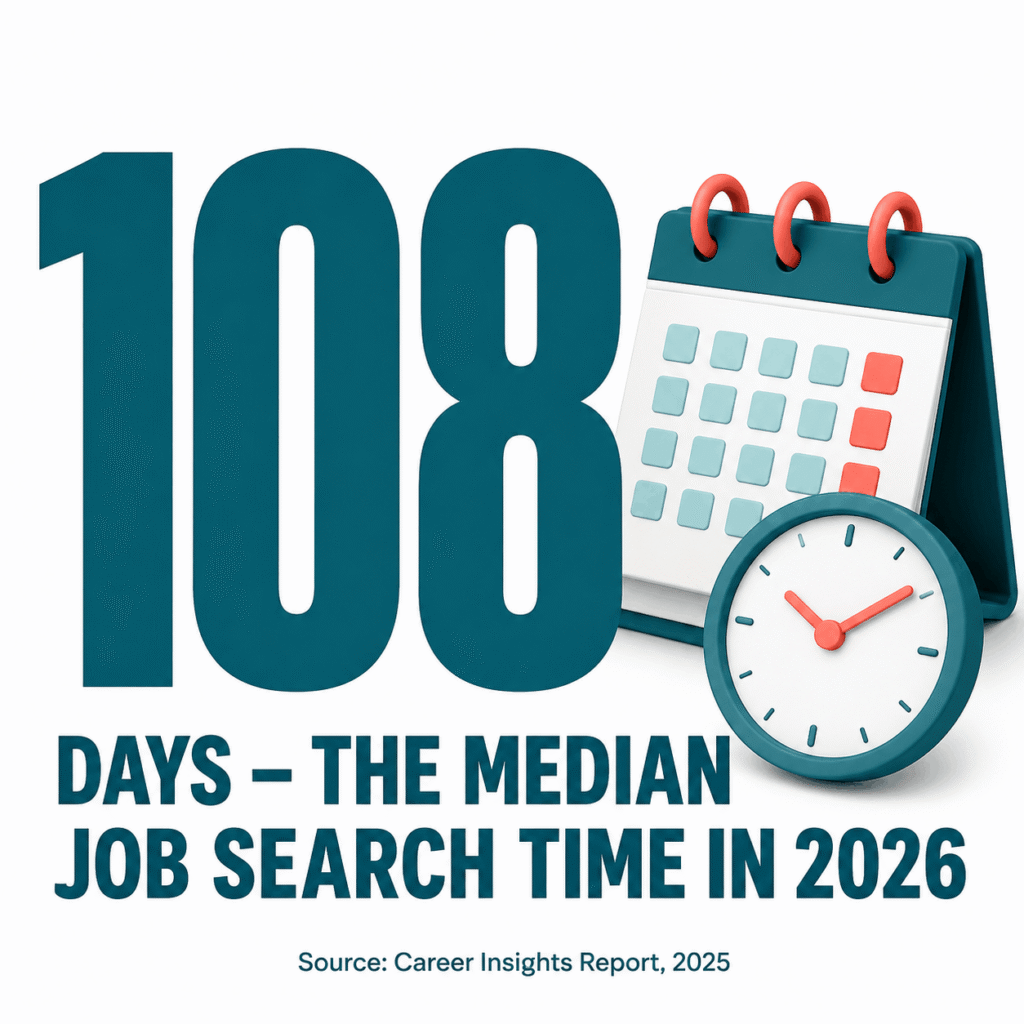
The median job search time in 2026 is now 108 days – a 30% increase from just one quarter ago. About 45% of job seekers report searching for at least three months, and 25% have been searching for more than a year. 25.7 weeks is the mean duration of unemployment as of February 2026.

A long job search is anything that feels long to you. There’s no “should.”

Two to three hours a day is a solid goal. More than that, and you risk burnout. Less than that, and you might not be making progress.

Quality over quantity. Two focused hours are better than eight distracted hours.

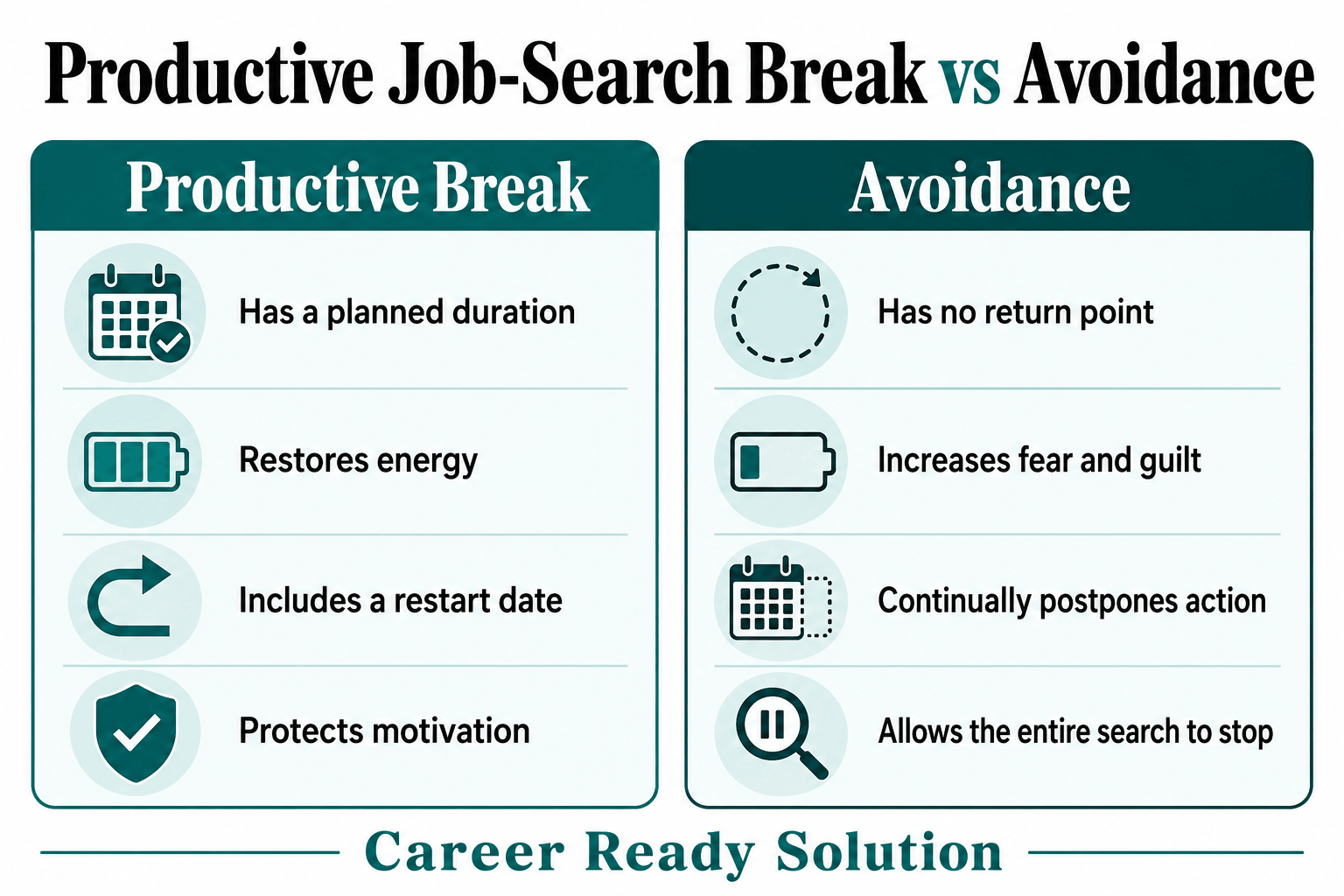
Yes. More than 53% of workers have paused their job search to protect their mental health.

Taking a break is not giving up. It’s taking care of yourself so you can come back stronger.

Audit your resume. Is it tailored? Does it include keywords from the job description? Is it ATS-friendly?

Expand your search. Are you only looking at job boards? Try company career pages, networking, and reaching out directly to hiring managers.

Get feedback. Ask a mentor, former colleague, or career coach to review your resume and approach.

Stop checking your email constantly. Check twice a day – morning and afternoon.

Keep applying. Don’t wait for one company. Keep your options open.

Trust the process. You’ve done your part. The rest is out of your control.

Be honest and positive. Focus on what you did during the search.

“I’ve been intentional about finding the right role. I’ve used this time to upskill, network, and refine what I’m looking for. I’m excited about this opportunity because it aligns with my skills and goals.”

Protect your energy. You’re already tired from your current job. Don’t push yourself too hard.

Set a time limit. Two hours a day, max. Use your lunch breaks for networking. Use weekends for resume updates.

Celebrate small wins. A reply from a recruiter. A connection request accepted. A referral given.

Yes. Always keep applying until you have a signed offer. One company should never be your only hope.

Diversify your applications. It reduces pressure and protects your confidence.

About the Author

Hira Riaz is an HR Consultant with 7+ years of experience hiring across tech startups, pharma, and NGOs. Having reviewed hundreds of resumes and interviewed candidates across roles, she brings real recruiter insights into what actually works in today’s job market.

She specializes in resume optimization, interview strategy, and career growth, helping professionals turn their experience into interview calls. She also shares practical career advice with 60,000+ professionals on LinkedIn.

3 may 2026 about the author