Interview Questions for Candidates With No Experience (25 Questions + Sample Answers)
Author: Hira Riaz
Published On 28 August, 2026.

TABLE OF CONTENTS
Conclusion
Key Takeaways
FAQs
Estimated read time 15 minutes.
How to Prepare for an Interview With No Experience
“I don’t have any experience. How do I answer interview questions?”
I hear this from fresh graduates, career changers, and students all the time. My answer? You have more experience than you think.
When I started hiring for a Tech start-up, many fresh software engineers assumed they had nothing valuable to discuss because they had never held a full-time job.
Yet the candidates who performed best in interviews weren’t always the ones with the strongest technical skills. They were the ones who knew how to explain their university projects, internships, and problem-solving experiences.
I’ve interviewed hundreds of fresh graduates at university recruitment drives. I’ve sat across from nervous students, taken their coding tests, and watched them struggle to explain their university projects.
And you know what? The ones who succeeded weren’t always the ones with the most experience. They were the ones who understood their projects inside out and could present them with confidence.
My Complete Interview Preparation Guide covers everything else you’ll need too — from researching the company to negotiating your first salary offer.
In this guide, I’ll walk you through 25 interview questions with sample answers tailored for candidates with no formal experience.
Preparing for an interview without experience is different – but not impossible. Here’s what I tell candidates:
1. Know your university projects inside out.
2. Practice your problem-solving skills.
3. Be honest about what you know – and what you don’t.
4. Treat your university projects as experience.
5. Practice your answers aloud.
From my Hiring Notebook
I once interviewed a fresh graduate who had no internship experience. But he had built a solid project and could explain it inside out. He talked about the tools he used, the problems he solved, and how he worked with his team. He got the job. His project was his experience.

What Counts as Experience
“I don’t have experience.”Most candidates say this and these candidates are wrong. Here’s what counts as experience and how to talk about it:
Internships
Even a short internship counts. It shows you’ve worked in a professional environment, followed instructions, and delivered results. Frame it as experience, not “just an internship.”
Example: “During my internship at XYZ, I helped streamline the onboarding process, reducing the time to complete paperwork by 30%.”
University Projects – Your Biggest Asset
This is where I focus most when interviewing freshers. If you don’t have internship experience, your university projects are what I’ll judge you on.
How to present your project:
- What problem were you solving?
- What tools and technologies did you use?
- What was your specific role in the team?
- What challenges did you face and how did you overcome them?
- What was the outcome?
Example: “In my final-year project, we built a mobile app to help students find study groups. I was responsible for the backend development and worked with two teammates. We faced challenges with database syncing, but we resolved it by implementing a new architecture. The app was used by 200+ students.”
Even without formal work experience, your university projects still belong on your resume, so get your resume past the bots with the right formatting.
Volunteer Work
Volunteering shows initiative, commitment, and empathy. It’s a real experience.
Example: “I coordinated a community food drive that collected 500kg of donations and managed a team of 15 volunteers.”
Freelancing
Freelance work is real work. If you wrote content, designed websites, or provided services to clients, you have experience. Treat it like a job – list it that way.
Example: “As a freelance content writer, I produced weekly blog posts for three clients, helping one client increase web traffic by 25%.”
Student Club
Leadership in student clubs is leadership. If you were treasurer, president, or event coordinator, you were managing budgets, teams, and deadlines. That’s experience.
Example: “As President of the Business Society, I managed a team of 12 and organised three networking events with 200+ attendees.”
Coursework
Relevant coursework matters. If you completed modules directly related to the role, mention them. Use terms like “studied” and “applied” rather than “learned.”
Example: “My coursework included modules on financial accounting and management accounting, where I developed analytical and problem-solving skills.”
Before we get into the questions, make sure you’re not walking in with these rookie interview slip-ups working against you

Interview Questions on Personal Background (Q1- Q5)
1. Tell Me About Yourself (No Experience Example)
This is the most common opening question. Your answer sets the tone for the entire interview.
What Recruiters want: A quick summary of who you are, what you bring, and what you’re looking for. Not your life story.
Formula: (Current status) + (Key skills/achievements) + (What you’re looking for)
SAMPLE ANSWER
“I’m a recent graduate in (Subject) from (University). During my studies, I completed an internship where I supported the marketing team and helped increase social media engagement by 25%. I also led a student project where we developed a new product concept and pitched it to local businesses. I’m now looking to start my career in [field], where I can apply these skills and grow professionally.”
|
Weak Answer
|
Strong Answer
|
|---|---|
|
"I'm a fresh graduate looking for an opportunity."
|
"I'm a recent marketing graduate with internship experience and a passion for digital campaigns."
|
|
"I don't have much experience."
|
"During my internship, I contributed to a campaign that boosted engagement by 25%."
|
|
"I'll do any job."
|
"I'm specifically interested in [role] because it aligns with my skills in [area]."
|
COMMON MISTAKE: Rambling about personal life, hobbies, or unrelated jobs. Stick to what’s relevant to the role. (I usually face this even from experienced candidates. Please avoid this.)
2. Why Should We Hire You?
Having conducted hundreds of fresh grads interviews, I know this question terrifies candidates as they assume they have no experience. But it’s your chance to show confidence and connect the dots for the interviewer.
What Recruiters want: Proof you can do the job or that you can learn it quickly.
Formula: (Your skills) + (How they match the role) + (Your willingness to learn)
SAMPLE ANSWER
“You should hire me because I bring strong organisational skills, I’m highly motivated to learn, and I’ve already developed a foundation in [field] through my studies. In my internship, I demonstrated the ability to complete tasks on time and adapt quickly to new systems. I’m confident I can hit the ground running and grow into this role.”
|
Weak Answer
|
Strong Answer
|
|---|---|
|
"I'm a hard worker."
|
"In my internship, I consistently completed tasks ahead of schedule."
|
|
"I'll do my best."
|
"I've already developed [skills] through coursework and projects."
|
|
"I need a job."
|
"I'm excited about this role because it aligns with my career goals in [field]."
|
COMMON MISTAKE: Apologising for your lack of experience. Never apologise. Frame it as “I’m building my foundation” instead of “I don’t have experience.”
3. What Are Your Strengths?
This is your chance to shine. Choose strengths that are relevant to the role and back them up with examples.
What Recruiter/Hiring Manager want: Proof you have the skills they need.
Formula: (Strength) + (Example from internship, project, or volunteering)
SAMPLE ANSWER
“One of my key strengths is adaptability. During my internship, I was asked to learn a new software system within three days to assist the team on a project. I dedicated time to online tutorials, mastered the basics, and was able to support the team’s deliverables on time. I’m comfortable stepping into unfamiliar situations and learning quickly.”
|
Weak Answer
|
Strong Answer
|
|---|---|
|
"I work hard."
|
"I'm proactive – in my final-year project, I took the initiative to contact industry professionals for feedback."
|
|
"I'm a good communicator."
|
"I presented research findings to my class of 30 and received positive feedback on clarity and delivery."
|
|
"I'm a team player."
|
"In my group project, I coordinated tasks among 5 members and ensured we delivered on time."
|
HR TIP
Choose strengths that match the job description. If they mention “communication,” make that one of your strengths.
COMMON MISTAKE: Listing generic strengths without proof. Always include an example.
4. What Is Your Biggest Weakness?
This question is a test of self-awareness and honesty. The key is to choose a genuine weakness and show how you’re working on it.
What Hiring Managers want: Honesty, self-awareness, and a growth mindset.
Formula: (Weakness) + (How you’re addressing it)
SAMPLE ANSWER
“My biggest weakness is that I sometimes over-prepare for presentations. I tend to spend too much time perfecting slides instead of rehearsing delivery. I’ve been addressing this by setting strict time limits on slide creation and recording myself to focus on speaking clearly and staying within time limits.”
|
Weak Answer
|
Strong Answer
|
|---|---|
|
"I'm a perfectionist."
|
"I sometimes over-prepare for presentations, so I'm learning to set time limits."
|
|
"I don't have any weaknesses."
|
"I struggle with public speaking, so I've joined a speaking group to improve."
|
|
"I work too hard."
|
"I tend to take on too many tasks, so I'm learning to delegate and prioritise better."
|
COMMON MISTAKE: Giving a cliché answer like “I’m a perfectionist” or “I care too much.” Recruiters have heard these a thousand times and they considered it a Red flag.
5. Why Do You Want This Job?
This question tests whether you’ve done your research and whether you’re genuinely interested in the role.
What they want: Proof you’ve researched the company and understand why the job matters.
Formula: (Something you like about the company) + (How it connects to your goals) + (Why you’re excited)
SAMPLE ANSWER
“I want this job because I’ve been following (Company) for some time and I admire your work in (area). I’m particularly interested in this role because it will allow me to use my skills in (field) while learning from experienced professionals. I’m looking for a place where I can grow and contribute, and I see that potential here.”
|
Weak Answer
|
Strong Answer
|
|---|---|
|
"I need a job."
|
"I'm excited about this role because it aligns with my career goals."
|
|
"I've always wanted to work here."
|
"I admire your work in [specific area] and want to contribute to that mission."
|
|
"The pay is good."
|
"I'm interested in the company's growth and how I can contribute to it."
|
HR TIP
Research the company before the interview. Mention something specific – a recent launch, a new product, their mission statement.
COMMON MISTAKE:
Giving a generic answer. Always personalise it.
Interview Questions on Education and Skills (Q6 - Q10)
6.What Did You Learn During Your Studies?
Your degree taught you more than subject knowledge. It taught you how to think, research, and communicate.
What Recruiters want: Proof you can apply what you learned.
SAMPLE ANSWER
“My degree taught me how to think critically and work under pressure. For example, during my final-year project, I had to research, analyse, and present complex information within tight deadlines – skills I know I’ll use in this role.”
7. Which Course Prepared You Most for This Role?
Choose a course directly relevant to the job and explain why it matters.
SAMPLE ANSWER
“The course that prepared me most was (Course Name). It covered [specific topic] and gave me hands-on experience with (tool/software). I also worked on a project that required (specific skill), which directly applies to this role.”

8. What Technical Skills Do You Have?
List technical skills from your coursework, internships, or self-learning.
SAMPLE ANSWER
“I have experience with Microsoft Office, particularly Excel and PowerPoint. I also learned (specific software) during my coursework and completed an online course on (topic). I’m comfortable learning new tools quickly.”
9. Which Achievement Are You Most Proud Of?
This can be academic or personal – choose something that shows character, determination, or skill.
SAMPLE ANSWER
“I’m most proud of my final-year project, where I developed a solution to reduce food waste in local restaurants. My team worked with three restaurants to implement a tracking system that cut waste by 15% within two months.”
10. What Certifications or Training Have You Completed?
List any certifications, online courses, or training you’ve done – even free ones count.
SAMPLE ANSWER
“I completed a certification in (Topic) from (Platform), where I learned (specific skill). I’m currently working on (another certification) to expand my knowledge.”
Behavioral Interview Questions (11-15)
11. Describe a Time You Solved a Problem
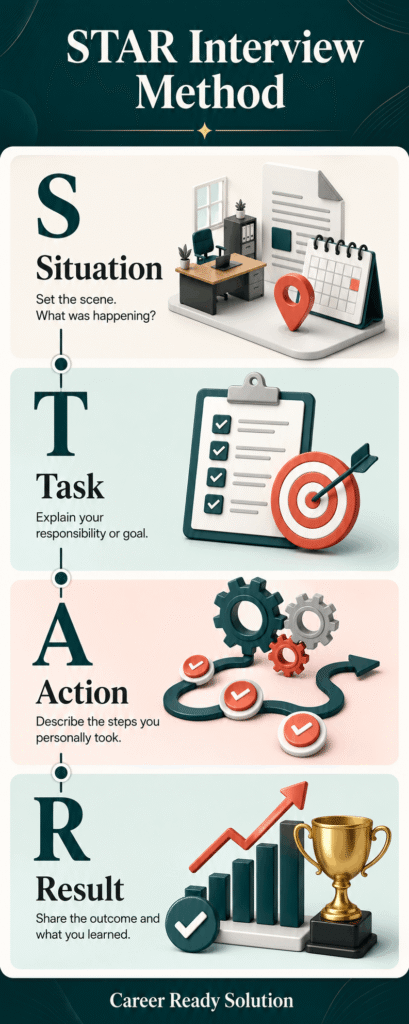
This is one of the most important behavioral questions. Use the STAR method.
What they want: Proof you can think critically and take action.
S – Situation: Set the context
T – Task: What was your goal?
A – Action: What specific steps did you take?
R – Result: Quantify the outcome
SAMPLE ANSWER
“During my internship, I noticed that the team was spending too much time searching for files in a disorganized shared drive (S). I suggested creating a new folder structure and naming system (T). I created the structure with input from colleagues (A). The new system reduced search time by 30% and was adopted across the department (R).”
|
Weak Answer
|
Strong Answer
|
|---|---|
|
"I solved a problem in a group project."
|
"In my group project, I helped resolve a conflict between two team members by facilitating a discussion and finding a compromise."
|
|
"I worked hard to fix it."
|
"I created a new system that reduced search time by 30%."
|
|
"I asked for help."
|
"I researched solutions online and then implemented the best one."
|
COMMON MISTAKE:
Not taking ownership. Use “I” not “we” when describing your specific contribution.
12. Describe a Time You Worked in a Team
Teamwork is essential in almost every job. Show the recruiter that you can collaborate.
SAMPLE ANSWER
“In my final-year project, I worked with four students from different disciplines to develop a business plan. I was responsible for the marketing section and coordinated with the finance and operations team members to align our approach. We delivered a comprehensive plan that received a distinction.”
Don’t:
❌ Talk only about yourself – teamwork means collaboration.
❌ Blame teammates if something went wrong.
❌ Say “I just followed instructions” – show initiative.
13. Describe a Time You Handled a Conflict
Conflict resolution shows maturity and interpersonal skills.
SAMPLE ANSWER
“During a group project, two team members disagreed on the direction of our presentation. I scheduled a meeting where each person presented their ideas. We voted on the best approach and incorporated elements from both perspectives. The final presentation was stronger because of it.”
Don’t:
❌ Gossip or badmouth the other person.
❌ Say you’ve never had a conflict – it sounds unrealistic.
❌ Make it sound like you were always right.
14. Describe a Time You Failed
This tests your ability to learn from mistakes.
SAMPLE ANSWER
“In my first semester of university, I didn’t manage my time well and received a lower grade than I expected. I realised I needed a better system, so I started using a planner and breaking tasks into smaller steps. My grades improved significantly, and I learned the importance of planning ahead.”
Don’t:
❌ Choose a failure that was catastrophic or shows your poor judgment.
❌ Blame others for your failure.
❌ Forget to mention what you learned.
15. Describe a Time You Worked Under Pressure
This shows resilience and composure.
SAMPLE ANSWER
“During my internship, I was asked to complete a report with a tight deadline. I prioritised the most important sections, created a schedule, and completed the report on time. My supervisor appreciated my ability to stay calm and focused.”
Don’t:
❌ Choose an example that was actually easy (e.g., “I had to finish homework”).
❌ Skip the outcome – show you delivered despite the pressure.
Interview Questions on Motivation and Growth (16-20)
16. Where Do You See Yourself in Five Years?
This tests ambition and alignment with the company’s goals.
SAMPLE ANSWER
“I see myself growing into a role where I can take on more responsibility in [field]. I’d like to develop my skills and eventually contribute to team leadership. I’m looking for an organisation that supports that journey.”
17. How Do You Handle Feedback?
Employers want candidates who are coachable.
SAMPLE ANSWER
“I welcome feedback because it helps me improve. During my internship, I asked my supervisor for regular check-ins. When I received constructive feedback, I acted on it immediately and saw my performance improve.”
18. How Do You Prioritise Your Work?
This shows organisation and time management.
SAMPLE ANSWER
“I prioritise by deadline and importance. I use a simple to-do list to track tasks and break larger projects into smaller steps. This helps me stay focused and deliver on time.”
19. How Do You Learn New Skills?
This shows your ability to grow and adapt.
SAMPLE ANSWER
“I learn best by doing. When I need to learn a new skill, I research it, watch tutorials, and then practise. I also ask for feedback from others to make sure I’m on the right track.”
20. How Do You Stay Motivated?
This tests resilience and drive.
SAMPLE ANSWER
“I stay motivated by setting small goals and celebrating progress. I remind myself why I’m working towards this role and keep learning new things to stay engaged.”
Interview Questions on Job Readiness Questions (21-25)
21. Are You Willing to Learn?
This is your chance to show enthusiasm and a growth mindset.
SAMPLE ANSWER
“Absolutely. I’m excited about the opportunity to learn new skills and grow in this role. I’ve already been taking online courses and reading industry publications to prepare.”
Must-Do: Show proof – mention a specific skill you recently learned on your own.
Example: “Yes. Last month, I taught myself the basics of [software] through YouTube tutorials and built a small project.”
22. What Would You Do If You Didn’t Know How to Complete a Task?
This shows problem-solving and initiative.
SAMPLE ANSWER
“I would first research the task online or review any available resources. If I’m still unsure, I would ask a colleague or my supervisor for guidance while showing them what I’ve already done.”
Must-Do: Show you take initiative – don’t just say “I’ll ask someone.”
Example: “I’d research it first, try to solve it, and then ask for guidance with specific questions – not a blank stare.”
23. What Are Your Salary Expectations?
Be honest but flexible. Research industry standards and give a range.
SAMPLE ANSWER
“I’m looking for a salary that reflects the role and my skills. Based on my research, the typical range for entry-level roles in this field is [range]. I’m open to discussion.”
Must-Do: Research the market and give a range – not a single number.
Example: “Based on my research, entry-level roles in this field range between [X] and [Y]. I’m open to discussion.”
24. When Can You Start?
Be realistic and flexible.
SAMPLE ANSWER
“I can start within [X weeks]. I’m available immediately if needed.
Must-Do: Be realistic and flexible.
HR Truth
Employers don’t want to wait a month for a fresh graduate. The sooner, the better.
25. Do You Have Any Questions for Us?
Always have questions. It shows interest.
SAMPLE ANSWER
“What does success look like in this role in the first 90 days?”
“How would you describe the company culture?”
“What opportunities are there for professional development?”
If this is an initial recruiter screening rather than a full hiring-manager interview, your questions should focus more on the role, hiring process, salary range and practical details. Start with these questions to ask during your first recruiter phone screen.
Want more depth than the three examples above? Here are 10 smarter questions to ask back, with the reasoning behind each one.
Conclusion
I’ve seen candidates with no internships crack interviews because they knew their projects inside out.
And I’ve also seen candidates come back. They failed the first time, took my advice, practised, and aced the next interview. That’s what I want for you.
Don’t wait until you feel ready. Prepare, practise, and show up. Your lack of experience is not a weakness, it’s your starting point.
You’ve got this.
Ready to Ace Your First Interview?
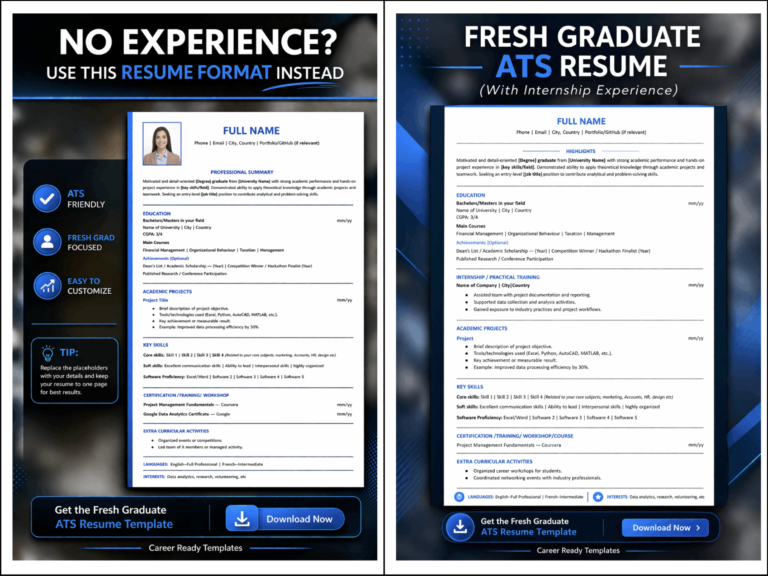
Choose my Fresh Graduate Resume Templates – with projects and experience sections, with or without photo as per your regional preference.
Connect with me on LinkedIn – daily career tips with 60k+ followers
Question: How do you answer interview questions with no experience?
- Focus on transferable skills from internships, projects, volunteering, and coursework.
- Use the STAR method for behavioral questions.
- Frame your lack of experience as a fresh start with enthusiasm to learn.
- Example: “I may not have direct experience, but I’m a fast learner and have already developed (skills) through my studies.”
|
KEY TAKEAWAYS
|
||
|---|---|---|
|
1
|
You have more experience than you think. Internships, projects, volunteering, and coursework all count.
|
|
|
2
|
Know your university projects inside out. If you can't explain your own project clearly, I'll question your understanding.
|
|
|
3
|
Practice problem-solving. Use platforms like HackerRank. I've seen candidates come back, ace the test, and nail the interview.
|
|
|
4
|
Use the STAR method for behavioral questions.
|
|
|
5
|
Never apologise for your lack of experience. Frame it as a fresh start.
|
|
|
6
|
Show enthusiasm and willingness to learn – it's your biggest asset.
|
|
|
7
|
Practise your answers aloud – confidence comes from preparation.
|
|
Frequently Asked Questions
You should hire me because I bring strong transferable skills, a willingness to learn, and a foundation in [field] built through my studies, internships, and projects. I may not have direct experience, but I have the ability to learn quickly and contribute from day one.
Be honest and confident. Acknowledge that you don’t have direct experience, but highlight what you do have – skills from coursework, projects, internships, or volunteering. Use this formula: “I may not have direct experience in this role, but I’ve developed [specific skills] through my studies and projects.”
“I’m a recent graduate in [Subject] from [University]. During my studies, I completed an internship where I developed [specific skill]. I also led a student project that taught me [specific skill]. I’m looking for a role where I can apply these skills and grow professionally.”
“I may not have direct experience in this role, but I’m a fast learner. I’ve already taken courses in [topic] and completed a project where I applied [skill]. I’m excited about this opportunity and ready to learn.”
Internships, university projects, volunteer work, freelancing, student club leadership, and relevant coursework all count as experience. If you can demonstrate skills, solve problems, and work with others – it’s experience.
Absolutely. Even a short internship shows you’ve worked in a professional environment, followed instructions, and delivered results. Frame it as experience, not “just an internship.”
Yes. Unpaid internships still provide real experience – you’ve learned skills, worked with teams, and delivered results. The fact that it was unpaid doesn’t make it less valuable. List it on your resume and talk about it confidently in interviews.
About the Author
Hira Riaz is an HR Consultant with 7+ years of experience hiring across tech startups, pharma, and NGOs. Having reviewed hundreds of resumes and interviewed candidates across roles, she brings real recruiter insights into what actually works in today’s job market.
She specializes in resume optimization, interview strategy, and career growth, helping professionals turn their experience into interview calls. She also shares practical career advice with 60,000+ professionals on LinkedIn.